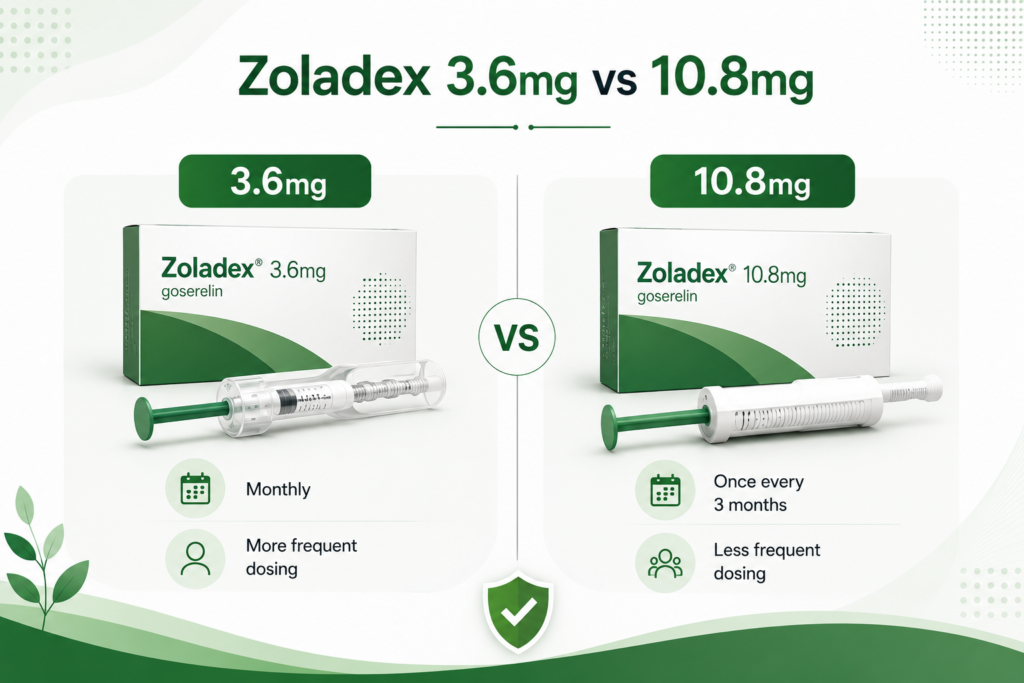
It is one of the most common procurement questions that hospital pharmacists and oncology nurses encounter when a patient is first prescribed Zoladex: which one do we order — the 3.6mg or the 10.8mg?
The question sounds simple. The answer requires understanding not just the difference in dose and interval but also which indications each formulation is approved for, why that distinction matters clinically, and what the practical implications are for hospital procurement and patient management. This article covers all of it — without clinical dosing advice, and with full deference to the prescribing physician for all treatment decisions.
What Is Zoladex — A Brief Recap
Zoladex (Goserelin Acetate) is a synthetic GnRH agonist manufactured by AstraZeneca, supplied as a biodegradable implant pre-loaded into a single-use subcutaneous injection device. It works by initially stimulating, then suppressing, the pituitary gland’s release of luteinising hormone (LH) and follicle-stimulating hormone (FSH) — ultimately driving testosterone in men and oestrogen in pre-menopausal women to castrate or post-menopausal levels respectively.
This hormone suppression mechanism makes Zoladex effective across a range of hormone-sensitive conditions — from prostate cancer and breast cancer to endometriosis and uterine fibroids. The two available formulations — 3.6mg and 10.8mg — both contain the same active ingredient and work through the same mechanism. What differs is the amount of Goserelin per implant and, critically, the dosing interval and the range of approved indications.
For a detailed explanation of how Zoladex works and what it is used for across all its indications, see the full Zoladex product information page at A.K. Pharma. For broader context on GnRH agonist therapy in oncology and gynaecology, the National Cancer Institute’s hormone therapy overview and the European Association of Urology (EAU) guidelines on prostate cancer provide comprehensive clinical reference material.
The Core Difference — Dose, Interval, and Indications
This table is the most important thing to understand before ordering either formulation:
| Zoladex 3.6mg | Zoladex 10.8mg | |
|---|---|---|
| Goserelin content | 3.6mg per implant | 10.8mg per implant |
| Dosing interval | Every 28 days (monthly) | Every 12 weeks (3-monthly) |
| Annual injections | 13 per year | 4 per year |
| Prostate cancer | ✅ Approved | ✅ Approved |
| Breast cancer | ✅ Approved | ❌ Not approved |
| Endometriosis | ✅ Approved | ❌ Not approved |
| Uterine fibroids | ✅ Approved | ❌ Not approved |
| Endometrial thinning | ✅ Approved | ❌ Not approved |
| Central precocious puberty | ✅ Approved (specialist use) | ❌ Not approved |
The clinical implication is straightforward: Zoladex 10.8mg is only approved for prostate cancer. Every other indication — breast cancer, endometriosis, uterine fibroids, endometrial thinning — requires the 3.6mg monthly formulation. This is not a matter of preference or convenience. It is the approved label, and the treating physician’s prescription will specify which formulation is appropriate for each patient and indication.
Why Two Formulations Exist — The Clinical Rationale
The 10.8mg 3-monthly depot was developed specifically for men with prostate cancer on long-term androgen deprivation therapy (ADT), for a straightforward reason: these patients are typically on continuous treatment for months or years, and reducing the number of clinic visits from 13 per year to 4 per year represents a meaningful quality-of-life improvement — particularly for elderly patients, for whom frequent clinic attendance can be burdensome.
From a pharmacokinetic standpoint, the 10.8mg implant is engineered to release Goserelin at a rate that maintains testosterone suppression at castrate levels (below 0.5 ng/mL or 50 ng/dL) consistently throughout the 12-week dosing interval. According to published clinical pharmacology data and the manufacturer’s prescribing information, serum testosterone remains suppressed at castrate levels throughout the 3-month interval in the vast majority of patients, making the 3-monthly depot clinically equivalent to the monthly formulation for testosterone suppression in this indication.
For women being treated with Zoladex for breast cancer, endometriosis, or uterine fibroids, the 3-monthly formulation is not approved — partly because these indications typically involve treatment of defined duration (for endometriosis, treatment is usually limited to 6 months per course to protect bone mineral density) and partly because the clinical data supporting Zoladex in these indications was established using the monthly 3.6mg formulation.
The American Society of Clinical Oncology (ASCO) and the European Society for Medical Oncology (ESMO) publish current guidelines on GnRH agonist use across oncology indications that provide detailed clinical context on depot formulation selection.
Zoladex 3.6mg — When Is This the Right Formulation?
The 3.6mg monthly formulation is the one to order when:
The patient is a woman on Zoladex for any indication. Breast cancer ovarian suppression, endometriosis, uterine fibroids, endometrial thinning before ablation — all require the 3.6mg monthly formulation. There is no approved 3-monthly alternative for these patients. Hospitals managing gynaecology and oncology departments that include pre-menopausal women will always need the 3.6mg formulation in stock.
The patient is a man who has just started Zoladex for prostate cancer. The initial period of ADT — particularly the first 1 to 2 months — is when the testosterone flare occurs and when monitoring is most active. Many urologists prefer the monthly formulation at initiation to allow closer monitoring and dose interval flexibility before considering whether to transition to the 3-monthly depot for longer-term maintenance.
The prescribing physician has specified 3.6mg. The treating specialist determines which formulation is prescribed. Hospital procurement should always match the prescription exactly — the two formulations are not interchangeable without explicit physician direction.
For pre-menopausal women with hormone receptor-positive breast cancer being treated with ovarian function suppression, the combination of Zoladex with aromatase inhibitors like Arimidex (Anastrozole) is supported by the SOFT and TEXT landmark trials — the 3.6mg monthly Zoladex formulation is the approved form for this combination. Related breast cancer medicines including Faslodex (Fulvestrant) and Kryxana (Ribociclib) are also available through A.K. Pharma for hospitals managing hormone receptor-positive breast cancer caseloads.
Zoladex 10.8mg — When Is This the Right Formulation?
The 10.8mg 3-monthly formulation is the one to order when:
The patient is a man with prostate cancer on established, ongoing ADT. Once testosterone suppression is confirmed and the patient is tolerating Zoladex well, many urologists transition to the 3-monthly depot for the convenience benefit — 4 clinic visits per year instead of 13 is a significant practical advantage for the patient and for the clinic’s scheduling.
The prescription specifically requests the 10.8mg or 3-monthly formulation. The prescribing urologist or oncologist will specify which formulation is appropriate. Procurement should not substitute one for the other without confirming with the prescribing physician.
Long-term continuous ADT is planned. For men with metastatic hormone-sensitive prostate cancer or locally advanced prostate cancer on long-term ADT in combination with radiotherapy, the 3-monthly depot is often the most practical long-term option — particularly when combined with newer agents like Bdenza (Enzalutamide) for castration-resistant disease, where treatment continuity over many months is a core part of the management plan.
The National Comprehensive Cancer Network (NCCN) prostate cancer guidelines and the EAU prostate cancer guidelines provide the most comprehensive current evidence base for ADT formulation selection in prostate cancer management.
The Alternative GnRH Agents — When Zoladex Is Not the Right Choice
Zoladex is not the only GnRH-based hormone therapy option available. Understanding when an alternative might be more appropriate is useful context for hospital procurement teams managing hormone therapy caseloads.
Luprodex (Leuprolide Acetate) is another GnRH agonist available through A.K. Pharma, supplied as a 22.5mg 3-monthly depot. It works through the same mechanism as Goserelin and is used for similar indications — prostate cancer, endometriosis, and uterine fibroids. Some prescribers prefer Leuprolide Acetate; others prefer Goserelin. The choice between them is a clinical decision made by the treating specialist, and hospitals managing active hormone therapy caseloads may stock both.
Firmagon (Degarelix) is a GnRH antagonist — a fundamentally different mechanism of action. Unlike GnRH agonists such as Zoladex and Luprodex, Degarelix suppresses testosterone immediately without the initial testosterone flare. This makes Firmagon the preferred option in men where the flare poses a clinical risk — those with severe bone metastases, significant urinary obstruction, or spinal cord involvement. If a prescribing urologist has specified Firmagon rather than Zoladex, it is typically for a specific clinical reason related to the flare risk, and the two should not be substituted.
What This Means for Hospital Procurement
For hospital pharmacy teams placing Zoladex orders, the practical procurement implications are:
Stock both formulations if the department manages both prostate cancer and gynaecology/breast cancer patients. A gynaecology department cannot use 10.8mg in place of 3.6mg. An oncology department managing prostate cancer patients who have been transitioned to 3-monthly dosing cannot substitute 3.6mg without physician confirmation.
Match the prescription exactly. The prescribing physician specifies the formulation. Zoladex 3.6mg and Zoladex 10.8mg are not the same product and are not clinically interchangeable without explicit physician direction.
Plan ordering cycles around the dosing interval. For patients on the 3-monthly depot, orders are placed every 12 weeks. For patients on the monthly formulation, orders are placed every 4 weeks. For departments managing large prostate cancer caseloads, mapping patient cohorts to their next dosing date and planning procurement accordingly avoids both last-minute urgent orders and overstocking.
Maintain consistent supply. For patients on long-term ADT, a gap in Zoladex supply — even a short one — can allow testosterone to recover, potentially affecting the consistency of hormone suppression that the treatment depends on. Establishing a reliable supply relationship with a licensed specialty pharmaceutical distributor is the practical solution. A.K. Pharma is a licensed medicine distributor in Delhi and pharmaceutical distributor in Delhi supplying genuine Zoladex — both 3.6mg and 10.8mg formulations — to hospitals and oncology centres across India with complete batch documentation and authorised AstraZeneca sourcing. Contact us at 011 4172 6999 or WhatsApp +91 9810034827 to discuss supply planning for your department’s Zoladex requirements.
Related hormone therapy and oncology medicines available through A.K. Pharma for hospitals managing comprehensive hormone therapy caseloads:
- Luprodex (Leuprolide Acetate) — alternative GnRH agonist, 3-monthly depot
- Firmagon (Degarelix) — GnRH antagonist, immediate testosterone suppression without flare
- Andocur (Cyproterone Acetate) — anti-androgen for flare cover and combination ADT
- Bdenza (Enzalutamide) — for castration-resistant prostate cancer
- Arimidex (Anastrozole) — aromatase inhibitor for post-menopausal and OFS combination breast cancer
- Faslodex (Fulvestrant) — endocrine therapy for HR+ breast cancer
- Browse all Cancer Medicines at A.K. Pharma
- Browse all Hormone Medicines at A.K. Pharma
- Learn about the Named Patient Program for medicines not yet commercially available in India
- Learn about the Patient Assistance Program for eligible patients
Frequently Asked Questions
Q. Can Zoladex 10.8mg be used instead of 3.6mg for a female patient with endometriosis?
No. Zoladex 10.8mg is only approved for prostate cancer in men. For women with endometriosis, uterine fibroids, breast cancer, or endometrial thinning, the approved formulation is Zoladex 3.6mg monthly. The two formulations are not interchangeable for these indications.
Q. Why is Zoladex 10.8mg not approved for breast cancer or endometriosis?
The approved indications for each formulation are based on the clinical trial data used to support regulatory approval. The evidence base for Zoladex in breast cancer, endometriosis, and uterine fibroids was established using the 3.6mg monthly formulation. The 10.8mg depot was developed specifically for the prostate cancer indication, where long-term continuous ADT makes the 3-monthly dosing interval particularly valuable.
Q. How does the treating physician decide whether to use 3.6mg or 10.8mg for a prostate cancer patient?
The decision is based on several factors — whether the patient is newly starting treatment or on established ADT, the monitoring schedule the urologist prefers, patient preference for visit frequency, and clinical factors specific to the individual patient. The prescribing physician will specify which formulation is appropriate. Procurement should match the prescription exactly.
Q. Is testosterone suppression equivalent between Zoladex 3.6mg and 10.8mg in prostate cancer?
According to published clinical pharmacology data and the manufacturer’s prescribing information, serum testosterone remains at castrate levels throughout the 12-week dosing interval with the 10.8mg depot in the vast majority of patients — making the 3-monthly formulation clinically equivalent to the monthly formulation for testosterone suppression in this specific indication.
Q. What happens if a patient misses their Zoladex injection date?
This is a clinical question that should be directed to the treating urologist or oncologist. In general, testosterone suppression begins to wane after the end of the dosing interval. For the monthly depot, this means from approximately day 28 onward. For the 3-monthly depot, from approximately week 12 onward. Timely administration is important for maintaining consistent hormone suppression, which is why reliable supply is critical for patients on long-term ADT.
Q. Can Zoladex be substituted with Luprodex or Firmagon?
Substitution of one GnRH agent for another should only happen on the explicit direction of the prescribing physician. Luprodex contains a different active ingredient (Leuprolide Acetate) and Firmagon works through a fundamentally different mechanism (GnRH antagonism). These are not generic substitutions — they are different medicines.
Q. Where can hospitals in India source both Zoladex formulations?
Both Zoladex 3.6mg and Zoladex 10.8mg are available through A.K. Pharma — a licensed medicine distributor in Delhi serving hospitals and oncology centres across India. Contact A.K. Pharma at 011 4172 6999 or WhatsApp +91 9810034827 for availability, pricing, and supply planning.
Disclaimer: This article is intended for informational and sourcing/procurement purposes only and does not constitute medical or clinical advice. All treatment decisions — including formulation selection, dosing, and duration — should be made by a qualified urologist, oncologist, or gynaecologist in accordance with the approved prescribing information. A.K. Pharma is a licensed medicine distributor and does not provide clinical guidance.