- Delivering Pan India

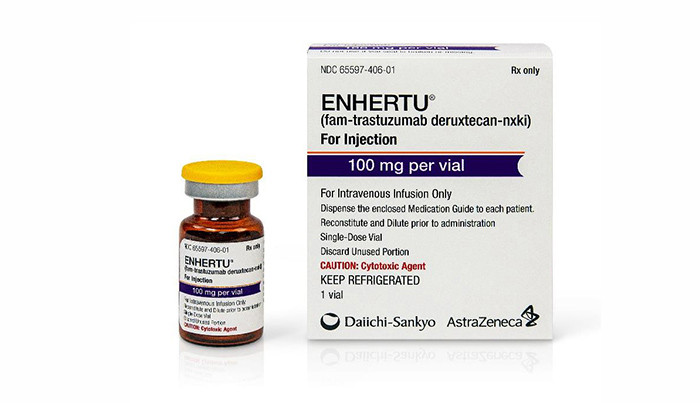
Trastuzumab Deruxtecan 100mg Injection — HER2-Targeted Antibody-Drug Conjugate for HER2-Positive and HER2-Low Breast Cancer, Gastric Cancer and HER2-Mutant NSCLC
Supplied only against a valid prescription from a registered medical practitioner.
Sourced from authorised channels
Temperature-controlled packing
Hospitals, clinics, pharmacies
Delhi drug licence holder
Enhertu® (Trastuzumab Deruxtecan) — Breakthrough ADC Redefining HER2-Targeted Cancer Treatment
The Most Active HER2-Targeted Therapy Ever Developed — Now Extending to HER2-Low and HER2-Mutant Cancers
Enhertu® (Trastuzumab Deruxtecan/T-DXd) is a HER2-targeted antibody-drug conjugate (ADC) consisting of three components — a HER2-targeting monoclonal antibody (Trastuzumab) linked via a novel tetrapeptide-based cleavable linker to a topoisomerase I inhibitor payload (DXd, an exatecan derivative) — at a high drug-to-antibody ratio (DAR) of approximately 8. This precisely engineered three-component ADC system delivers potent cytotoxic DXd payload selectively to HER2-expressing cancer cells — achieving unprecedented response rates and survival improvements in HER2-positive breast cancer, HER2-low breast cancer, HER2-positive gastric/GEJ adenocarcinoma, and HER2-mutant non-small cell lung cancer.
Enhertu has fundamentally transformed oncology practice in two ways — first by demonstrating the most active anti-tumour activity ever seen in HER2-positive metastatic breast cancer (median PFS 28.8 months in the DESTINY-Breast03 trial), and second by establishing an entirely new patient population — HER2-low breast cancer — as a treatable entity with HER2-directed therapy. The latter alone expanded the population eligible for HER2-targeted treatment from approximately 20% of metastatic breast cancer patients (HER2-positive) to approximately 60% (combining HER2-positive and HER2-low).
A.K. Pharma is a trusted medicine distributor in Delhi supplying genuine Enhertu (Trastuzumab Deruxtecan) to hospitals, oncology centres, breast cancer clinics, and pharmacies across India. Manufactured jointly by AstraZeneca and Daiichi Sankyo, Enhertu represents the leading edge of ADC technology and precision oncology — described by oncologists globally as one of the most important cancer medicines developed in the past decade.
What is Enhertu (Trastuzumab Deruxtecan)?
Enhertu contains Trastuzumab Deruxtecan — also known as T-DXd or DS-8201 — a third-generation HER2-targeted antibody-drug conjugate. Understanding its three-component architecture is essential to appreciating why it outperforms earlier HER2-targeted therapies:
Component 1 — HER2-Targeting Antibody (Trastuzumab): The antibody component is Trastuzumab — identical to the Trastuzumab (Herceptin) used in earlier HER2-targeted therapies. It binds with high affinity to the extracellular domain IV of HER2 — directing the ADC selectively to HER2-expressing cancer cells. The antibody also retains the direct anti-tumour mechanisms of Trastuzumab — ADCC activity, HER2 shedding inhibition, and PI3K/AKT pathway downregulation.
Component 2 — Cleavable Tetrapeptide Linker: A novel tetrapeptide linker (GGFG) connects the antibody to the DXd payload. This linker is specifically designed to be cleaved by lysosomal proteases (cathepsins) inside cancer cells after ADC internalisation — releasing the DXd payload intracellularly. The linker is stable in systemic circulation — minimising off-target DXd release and toxicity — but efficiently cleaved in the acidic, protease-rich lysosomal environment of tumour cells.
Component 3 — DXd Topoisomerase I Inhibitor Payload: DXd is a highly potent exatecan derivative that inhibits topoisomerase I — an enzyme essential for DNA replication and transcription. DXd is approximately 10 times more potent than the topoisomerase I inhibitor SN-38 (the active metabolite of irinotecan). Critically, DXd is membrane-permeable — allowing it to diffuse out of HER2-expressing cells after release and kill neighbouring tumour cells regardless of HER2 expression. This “bystander killing effect” is a key mechanism contributing to Enhertu’s activity in heterogeneous tumours including HER2-low cancers.
High Drug-to-Antibody Ratio (DAR ~8): Earlier ADCs like T-DM1 (Kadcyla) had a DAR of approximately 3.5 — meaning approximately 3-4 payload molecules per antibody. Enhertu has a DAR of approximately 8 — delivering approximately twice as much cytotoxic payload per antibody molecule. This higher payload density, combined with the more potent DXd payload and the bystander effect, explains Enhertu’s dramatically superior clinical activity compared to T-DM1.
Full prescribing information is available at the FDA label for Trastuzumab Deruxtecan.
Clinical Studies and Evidence
DESTINY-Breast03 Trial (T-DXd vs T-DM1 in HER2-Positive Metastatic Breast Cancer) Published in the New England Journal of Medicine (2022), DESTINY-Breast03 was a Phase 3 randomised controlled trial of 524 patients with HER2-positive unresectable or metastatic breast cancer who had received prior Trastuzumab and Taxane — the pivotal head-to-head comparison of Enhertu vs T-DM1 (Kadcyla) as second-line HER2-positive metastatic breast cancer therapy. Results at updated analysis:
The 28.8-month median PFS with Enhertu in second-line HER2-positive metastatic breast cancer is the longest PFS ever demonstrated in this setting — a result that transformed global treatment guidelines within months of publication.
DESTINY-Breast04 Trial (T-DXd in HER2-Low Metastatic Breast Cancer) Published in the New England Journal of Medicine (2022), DESTINY-Breast04 was a Phase 3 randomised controlled trial of 557 patients with HER2-low (IHC 1+ or IHC 2+/ISH–) metastatic breast cancer — a population previously considered HER2-negative and therefore ineligible for HER2-targeted therapy. Results:
DESTINY-Breast06 Trial (T-DXd in HER2-Ultralow Breast Cancer) The DESTINY-Breast06 trial extended Enhertu’s activity to HER2-ultralow breast cancer (IHC >0 but <1+) — further expanding the potential patient population for HER2-targeted therapy beyond HER2-low. Results demonstrated meaningful clinical activity in this previously undefined patient population — suggesting HER2 expression at any detectable level may be sufficient for Enhertu benefit.
DESTINY-Lung02 Trial (T-DXd in HER2-Mutant NSCLC) Published in the Journal of Clinical Oncology (2023), DESTINY-Lung02 demonstrated:
DESTINY-Gastric01 Trial (T-DXd in HER2-Positive Gastric/GEJ Cancer) Published in the New England Journal of Medicine (2021), DESTINY-Gastric01 demonstrated:
DESTINY-Breast01 (T-DXd in Previously Treated HER2-Positive Breast Cancer) The Phase 2 DESTINY-Breast01 trial demonstrating 60.9% ORR in heavily pre-treated HER2-positive metastatic breast cancer patients — including patients who had received T-DM1 — was the initial proof-of-concept trial that established Enhertu’s remarkable activity and led to accelerated FDA approval.
Available Strengths
Enhertu is available as:
| Presentation | Dose | Reconstitution |
|---|---|---|
| Enhertu 100mg powder for concentrate for solution for infusion | 100mg lyophilised powder per vial | Reconstitute with sterile water, then dilute in 5% dextrose |
Dosing:
Indications — What Enhertu is Used For
HER2-Positive Metastatic Breast Cancer:
HER2-Low Metastatic Breast Cancer:
HER2-Positive Gastric/GEJ Adenocarcinoma:
HER2-Mutant NSCLC:
For detailed indication information refer to MedlinePlus Trastuzumab Deruxtecan.
Key Benefits of Enhertu
Most Active HER2-Targeted Therapy in Oncology History The 28.8-month median PFS in DESTINY-Breast03 — more than quadrupling the PFS of T-DM1 — represents the most dramatic improvement ever seen in a head-to-head oncology trial in HER2-positive breast cancer. This result transformed Enhertu from a promising investigational agent to the undisputed standard of care in a single trial readout.
Established HER2-Low as a New Treatable Entity DESTINY-Breast04 created an entirely new cancer subtype — HER2-low breast cancer — that is now routinely tested for and targeted with Enhertu. This expanded the population eligible for HER2-targeted therapy from ~20% to ~60% of metastatic breast cancer patients — one of the most significant expansions of treatment eligibility in oncology.
Bystander Killing Effect — Activity in Heterogeneous Tumours Enhertu’s membrane-permeable DXd payload diffuses out of HER2-expressing cells after intracellular release — killing adjacent HER2-negative tumour cells. This bystander effect is particularly important in HER2-low cancers where HER2 expression is heterogeneous — ensuring tumour cells not directly targeted by the antibody are still affected.
High Drug-to-Antibody Ratio — Maximum Payload Delivery DAR ~8 delivers approximately twice the payload per antibody compared to T-DM1 (DAR ~3.5) — combined with the more potent DXd payload (10x more potent than SN-38) — resulting in dramatically greater cytotoxic effect per ADC molecule reaching the tumour.
Activity Across Multiple Tumour Types Proven activity in HER2-positive breast cancer, HER2-low breast cancer, HER2-positive gastric cancer, and HER2-mutant NSCLC — with ongoing trials in colorectal cancer, biliary tract cancer, endometrial cancer, and other HER2-expressing tumours. Enhertu is likely to receive additional indications as evidence matures.
First Approved Therapy for HER2-Mutant NSCLC Enhertu is the first and only approved targeted therapy for HER2-mutant NSCLC — a patient population with no previously approved targeted option despite HER2 mutation being a recognised oncogenic driver in this disease.
How Enhertu Works — ADC Mechanism in Detail
Step 1 — Systemic Circulation: After IV infusion, Enhertu circulates in the bloodstream as an intact ADC. The tetrapeptide linker is stable in plasma — minimising premature DXd release and reducing off-target toxicity.
Step 2 — HER2 Binding: The Trastuzumab antibody component binds with high affinity to HER2 domain IV on the surface of HER2-expressing cancer cells — including cells with high HER2 expression (IHC 3+, IHC 2+/ISH+) and low HER2 expression (IHC 1+, IHC 2+/ISH–).
Step 3 — Internalisation: The HER2-Enhertu complex is internalised into the cancer cell via receptor-mediated endocytosis — forming an endosome that fuses with lysosomes.
Step 4 — Lysosomal Cleavage: Lysosomal proteases (cathepsins B and L) cleave the tetrapeptide GGFG linker — releasing free DXd within the cancer cell.
Step 5 — Topoisomerase I Inhibition: Released DXd inhibits topoisomerase I — an enzyme that relieves torsional stress during DNA replication by creating transient single-strand DNA breaks. DXd stabilises the topoisomerase I-DNA cleavage complex — preventing religation of the DNA strand break → single and double strand DNA breaks accumulate → DNA damage response → cell cycle arrest → apoptosis.
Step 6 — Bystander Killing: Released DXd is membrane-permeable — it diffuses from the targeted HER2-expressing cell into surrounding tumour cells — killing HER2-negative or HER2-low neighbouring cells. This bystander effect is unique to Enhertu’s ADC design and is absent in T-DM1 (whose DM1 payload is membrane-impermeable).
Direct Antibody Effects: The Trastuzumab component also contributes directly — ADCC (antibody-dependent cellular cytotoxicity) activating NK cells to kill HER2-expressing cells, inhibition of HER2 ectodomain shedding, and downregulation of PI3K/AKT survival signalling — providing anti-tumour effects in addition to payload delivery.
For detailed mechanism overview refer to ESMO Breast Cancer Guidelines and ASCO Clinical Practice Guidelines.
HER2 Testing — Understanding HER2-Positive vs HER2-Low
HER2 status is determined by immunohistochemistry (IHC) and/or in situ hybridisation (ISH):
| HER2 Status | IHC Score | ISH | Enhertu Indication |
|---|---|---|---|
| HER2-Positive | IHC 3+ | Any | ✅ Yes — DESTINY-Breast03 |
| HER2-Positive | IHC 2+ | ISH+ | ✅ Yes — DESTINY-Breast03 |
| HER2-Low | IHC 2+ | ISH– | ✅ Yes — DESTINY-Breast04 |
| HER2-Low | IHC 1+ | ISH– | ✅ Yes — DESTINY-Breast04 |
| HER2-Zero | IHC 0 | ISH– | ❌ Not indicated |
Key clinical implication: Pathologists must now distinguish between IHC 0 and IHC 1+ (and between IHC 1+ and IHC 2+/ISH–) — distinctions that were previously considered clinically irrelevant. Re-testing of archival samples may be warranted in patients previously classified as HER2-negative who may be HER2-low and eligible for Enhertu.
Enhertu vs T-DM1 (Kadcyla) — Why Enhertu is Superior
| Feature | Enhertu (T-DXd) | T-DM1 (Kadcyla) |
|---|---|---|
| Payload | DXd (topoisomerase I inhibitor) | DM1 (microtubule inhibitor) |
| DAR (drug-to-antibody ratio) | ~8 | ~3.5 |
| Payload membrane permeability | ✅ Membrane-permeable — bystander effect | ❌ Membrane-impermeable — no bystander |
| HER2-positive PFS (2nd line) | 28.8 months (DESTINY-Breast03) | 6.8 months (DESTINY-Breast03) |
| HER2-positive ORR (2nd line) | 79.7% | 34.2% |
| HER2-low activity | ✅ Yes (DESTINY-Breast04) | ❌ No |
| Gastric cancer indication | ✅ Yes | ❌ No |
| NSCLC indication | ✅ Yes (HER2-mutant) | ❌ No |
| ILD risk | ✅ Yes — Black Box Warning | ✅ Yes — lower rate |
| Available at A.K. Pharma | Request Quote | Contact us |
Dosage and Administration
Standard Dose — Breast Cancer and NSCLC:
Gastric/GEJ Cancer:
Reconstitution:
Infusion:
Dose Modifications for ILD:
Dose Modifications for Other Toxicities:
Full dosing guidelines available at Drugs.com Trastuzumab Deruxtecan Dosage.
Critical Safety — Interstitial Lung Disease (ILD) and Pneumonitis
Enhertu carries a Black Box Warning for Interstitial Lung Disease (ILD) and Pneumonitis — the most important safety concern with this medicine:
Monitoring:
Management:
Patient and Caregiver Education: All patients receiving Enhertu must be educated about ILD symptoms and instructed to contact their oncologist immediately if they develop new or worsening cough, shortness of breath, or fever.
Who Should Use Enhertu
Enhertu is prescribed for:
Breast Cancer:
Gastric/GEJ Cancer:
NSCLC:
Enhertu is prescribed by medical oncologists, breast cancer specialists, thoracic oncologists, and gastrointestinal oncologists. A.K. Pharma supplies Enhertu to hospitals, oncology centres, and pharmacies across Delhi and India.
Possible Side Effects
Common side effects include nausea (73-78%), fatigue (49-57%), vomiting (45-47%), alopecia (37-46%), constipation (34-38%), decreased appetite (29-32%), anaemia (27-31%), and neutropenia (23-30%).
Serious side effects include:
Interstitial Lung Disease (ILD) — Black Box Warning: As described above — occurs in 10-15% of patients including fatal cases. Vigilant monitoring and prompt management are essential. See ILD section above for complete management guidance.
Left Ventricular Dysfunction: Decreases in LVEF reported — monitor cardiac function with echocardiogram or MUGA scan before starting and periodically. Withhold for LVEF <40% or symptomatic congestive heart failure.
Embryo-Foetal Toxicity: Enhertu causes foetal harm based on mechanism. Effective contraception required during treatment and for 7 months (females) or 4 months (males) after final dose. Do not breastfeed during treatment and for 7 months after final dose.
Haematological Toxicity: Neutropenia, thrombocytopenia, and anaemia — monitor CBC before each cycle. Dose reduce or delay for Grade ≥3 haematological toxicity.
Full side effect information available at FDA Trastuzumab Deruxtecan Safety Information.
Precautions
Storage and Handling
As a responsible medicine distributor in Delhi, A.K. Pharma maintains full cold chain requirements during storage and supply of Enhertu ensuring product integrity for every unit supplied.
Manufacturer Information
Enhertu (Trastuzumab Deruxtecan) is jointly developed and commercialised by AstraZeneca and Daiichi Sankyo — a collaboration combining AstraZeneca’s oncology commercial expertise with Daiichi Sankyo’s pioneering ADC technology platform (DXd ADC platform). Trastuzumab Deruxtecan received FDA accelerated approval in December 2019 for HER2-positive breast cancer, with regular approval and expanded indications following DESTINY-Breast03, DESTINY-Breast04, DESTINY-Gastric01, and DESTINY-Lung02 results. A.K. Pharma supplies only genuine Enhertu sourced from authorized distributors.
Related Cancer Medicines Available at A.K. Pharma
Frequently Asked Questions
Q. What is Enhertu used for? Enhertu (Trastuzumab Deruxtecan) is used to treat HER2-positive and HER2-low metastatic breast cancer, HER2-positive gastric and gastroesophageal junction adenocarcinoma, and HER2-mutant non-small cell lung cancer. More information available at MedlinePlus.
Q. What is the generic name of Enhertu? The generic name of Enhertu is Trastuzumab Deruxtecan — also referred to as T-DXd or DS-8201. It is a HER2-targeted antibody-drug conjugate jointly developed by AstraZeneca and Daiichi Sankyo.
Q. What is HER2-low breast cancer and why is it important? HER2-low breast cancer is defined as IHC 1+ or IHC 2+/ISH– HER2 expression — previously classified as HER2-negative. The DESTINY-Breast04 trial established that Enhertu significantly improves progression-free and overall survival in HER2-low metastatic breast cancer — creating an entirely new treatable patient population. Approximately 45-55% of metastatic breast cancer patients are HER2-low — dramatically expanding the number of patients eligible for Enhertu.
Q. How is Enhertu different from Kadcyla (T-DM1)? Enhertu has a higher drug-to-antibody ratio (~8 vs ~3.5), uses a more potent topoisomerase I inhibitor payload (DXd — 10x more potent than SN-38), has a cleavable linker enabling intracellular payload release, and has a membrane-permeable payload enabling bystander killing of HER2-negative neighbouring cells. The DESTINY-Breast03 trial demonstrated a 28.8-month median PFS with Enhertu vs 6.8 months with T-DM1 — establishing Enhertu as markedly superior.
Q. What is ILD and why is it a concern with Enhertu? ILD (Interstitial Lung Disease) is inflammation and scarring of lung tissue — a serious and potentially fatal side effect of Enhertu occurring in approximately 10-15% of patients. It carries a Black Box Warning. Patients must be monitored throughout treatment for new or worsening respiratory symptoms (cough, breathlessness, fever). Any new respiratory symptoms require immediate CT scan evaluation. Grade ≥3 ILD requires permanent discontinuation.
Q. What dose of Enhertu is used for breast cancer vs gastric cancer? For breast cancer and NSCLC the dose is 5.4mg/kg IV every 3 weeks. For gastric/GEJ adenocarcinoma the dose is 6.4mg/kg IV every 3 weeks. Both doses are based on actual body weight.
Q. Can Enhertu be diluted in normal saline? No — Enhertu must only be diluted in 5% Dextrose solution. Precipitation occurs with sodium chloride (normal saline or 0.9% NaCl) — which is a critical preparation error to avoid. Always use a 5% Dextrose infusion bag.
Q. Is Enhertu available in India? Enhertu can be supplied to hospitals, oncology centres, and pharmacies across India through licensed pharmaceutical distributors. Contact A.K. Pharma — medicine distributor in Delhi — for availability and pricing.
Q. What is the price of Enhertu in India? Enhertu 100mg price in India varies. Contact A.K. Pharma at 011 4172 6999 or WhatsApp +91 9810034827 for current pricing and bulk supply rates.
Q. How to order Enhertu from A.K. Pharma? You can request a quote directly from this page, call us at 011 4172 6999, or WhatsApp us at +91 9810034827 with your requirements and we will respond promptly.
Q. Does A.K. Pharma supply Enhertu in bulk? Yes. A.K. Pharma supplies Enhertu in bulk to oncology centres, breast cancer clinics, hospitals, and pharmacies across Delhi and India. Contact us for bulk pricing and availability.
Why Order Enhertu from A.K. Pharma?
Contact A.K. Pharma for Enhertu Supply 📍 E-2/257A, 2nd Floor, Shastri Nagar, New Delhi 110052 📞 011 4172 6999 📱 WhatsApp: +91 9810034827 🌐 akpharma.in