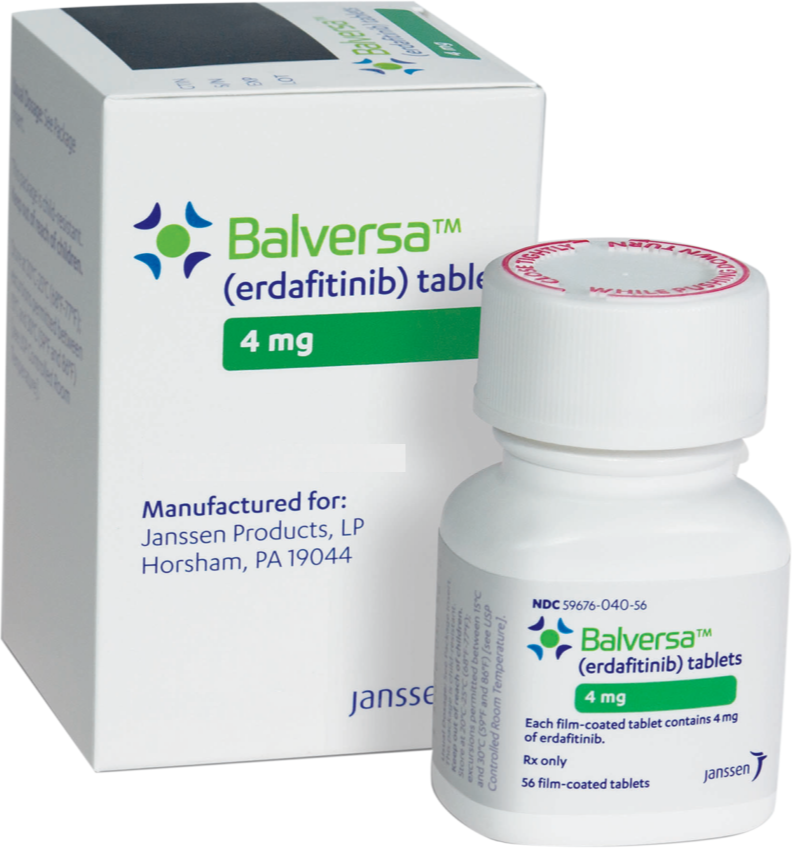
Erdafitinib 3mg, 4mg, 5mg Tablets — Pan-FGFR Tyrosine Kinase Inhibitor for Locally Advanced or Metastatic Urothelial Carcinoma With FGFR2 or FGFR3 Alterations
Supplied only against a valid prescription from a registered medical practitioner.
Sourced from authorised channels
Temperature-controlled packing
Hospitals, clinics, pharmacies
Delhi drug licence holder
Balversa® (Erdafitinib) — First-in-Class FGFR Inhibitor for Bladder Cancer
The First Targeted Therapy Approved for Bladder Cancer — Precision Medicine for FGFR-Altered Urothelial Carcinoma
Balversa® (Erdafitinib) is a once-daily oral pan-FGFR (fibroblast growth factor receptor) tyrosine kinase inhibitor that selectively inhibits FGFR1, FGFR2, FGFR3, and FGFR4 — approved for the treatment of adults with locally advanced or metastatic urothelial carcinoma (mUC) harbouring susceptible FGFR2 or FGFR3 alterations (mutations or fusions) who have received prior platinum-containing chemotherapy. Erdafitinib was the first targeted therapy of any kind approved for bladder cancer — a disease that historically had limited systemic treatment options beyond platinum-based chemotherapy and had not seen a molecularly targeted approval in decades.
FGFR alterations — including FGFR3 point mutations (most commonly S249C, R248C, Y373C, G370C) and FGFR2/3 fusions — are found in approximately 15-20% of metastatic urothelial carcinomas and represent a clearly defined oncogenic driver. In FGFR-altered bladder cancer, the mutated or fused FGFR is constitutively active — continuously driving downstream RAS/MAPK and PI3K/AKT signalling → uncontrolled urothelial carcinoma cell proliferation and survival. By selectively inhibiting all four FGFR kinases, Erdafitinib blocks this constitutive FGFR signalling — providing clinically meaningful responses in patients with FGFR-altered mUC who have exhausted platinum-based chemotherapy options.
A.K. Pharma is a trusted medicine distributor in Delhi supplying genuine Balversa (Erdafitinib) in all three tablet strengths — 3mg, 4mg, and 5mg — to hospitals, oncology centres, urology oncology units, and pharmacies across India. Manufactured by Janssen Pharmaceuticals (Johnson & Johnson), Balversa is an essential precision oncology medicine for the FGFR-altered metastatic bladder cancer population — requiring mandatory companion diagnostic testing before prescribing.
What is Balversa (Erdafitinib)?
Balversa contains Erdafitinib — a potent, selective small molecule pan-FGFR tyrosine kinase inhibitor with activity against all four FGFR family members (FGFR1, FGFR2, FGFR3, FGFR4).
FGFR Biology — Why FGFR Alterations Drive Bladder Cancer:
The fibroblast growth factor receptor (FGFR) family consists of four transmembrane receptor tyrosine kinases (FGFR1-4) that normally mediate FGF ligand-driven signalling controlling cell proliferation, survival, migration, and angiogenesis. In normal urothelium, FGFR3 is expressed and activated transiently in response to FGF ligands — driving controlled cell growth and repair.
FGFR alterations in bladder cancer — most commonly FGFR3 activating point mutations and FGFR2/3 gene fusions — create constitutively active FGFR kinases independent of FGF ligand binding:
FGFR3 Point Mutations (most common — ~75% of FGFR-altered mUC):
FGFR2/3 Gene Fusions (~25% of FGFR-altered mUC):
Downstream Oncogenic Signalling: Constitutively active FGFR → continuous activation of:
Erdafitinib’s Selectivity: Erdafitinib inhibits all four FGFR kinases (FGFR1-4) with IC50 values in the low nanomolar range — providing pan-FGFR coverage that addresses FGFR3 mutations, FGFR2/3 fusions, and any potential FGFR1/4-driven resistance mechanisms. The selectivity profile also includes some activity against RET, CSF1R, and PDGFRB — but the primary clinical activity in mUC is FGFR-mediated.
Full prescribing information is available at the FDA label for Erdafitinib.
Clinical Studies and Evidence
BLC2001 Trial (Erdafitinib in FGFR-Altered mUC — Pivotal Phase 2) Published in the New England Journal of Medicine (2019) with updated analyses, the BLC2001 trial was the pivotal Phase 2 open-label trial of 99 patients with locally advanced or metastatic urothelial carcinoma harbouring susceptible FGFR2 or FGFR3 alterations who had received prior platinum-based chemotherapy. Key results:
THOR Trial (Erdafitinib vs Chemotherapy — Phase 3 Confirmatory) Published in the New England Journal of Medicine (2023), the landmark THOR trial was a Phase 3 randomised controlled trial of 266 patients with previously treated FGFR-altered mUC — comparing Erdafitinib vs chemotherapy (Docetaxel or Vinflunine) in two cohorts:
Cohort 1 (Previously treated with anti-PD-1/PD-L1 + platinum chemotherapy):
THOR Cohort 2 (Previously treated with platinum only — no prior immunotherapy):
The THOR trial results represent a landmark — demonstrating that a targeted therapy significantly prolongs survival compared to chemotherapy in a biomarker-selected bladder cancer population. The 36% reduction in mortality with Erdafitinib vs chemotherapy in FGFR-altered mUC post-immunotherapy is one of the most clinically meaningful survival improvements demonstrated in bladder cancer.
Available Strengths
Balversa is available in the following tablet strengths:
| Strength | Use |
|---|---|
| Balversa 3mg Tablets | Starting dose component — 4 tablets = 12mg starting dose (pre-pharmacodynamic dose uptitration) |
| Balversa 4mg Tablets | Uptitrated dose — 4 tablets = 16mg after pharmacodynamic-guided uptitration |
| Balversa 5mg Tablets | Dose reduction levels — 2 tablets = 10mg; or combination with other strengths |
Important — Unique Pharmacodynamic-Guided Dose Uptitration: Erdafitinib uses a unique serum phosphate-guided dose uptitration strategy — unlike most targeted therapies with fixed doses. Starting dose is 8mg once daily (pre-titration) — after 14-21 days, serum phosphate is measured:
This pharmacodynamic dose titration maximises efficacy (higher phosphate = FGFR inhibition biomarker) while managing toxicity — a distinctive feature of Erdafitinib management.
All three strengths are available from A.K. Pharma — enabling this dose titration strategy without needing to source from multiple suppliers.
Indications — What Balversa is Used For
Locally Advanced or Metastatic Urothelial Carcinoma:
Mandatory Companion Diagnostic Testing — FGFR Testing Required: Balversa must only be used in patients with FGFR2 or FGFR3 alterations confirmed by a validated molecular test. FGFR wild-type patients do not benefit and should not receive Erdafitinib. FGFR testing options include:
Susceptible FGFR Alterations: FGFR3 mutations: S249C, R248C, G370C, Y373C, A393E, K652E, K652M, K652T, K652Q FGFR3 fusions: FGFR3-TACC3, FGFR3-BAIAP2L1, FGFR3-JAKMIP1, FGFR3-TNIP2 FGFR2 fusions: FGFR2-BICC1, FGFR2-CASP7, FGFR2-AFF3, FGFR2-AGAP1
For detailed indication information refer to MedlinePlus Erdafitinib.
Key Benefits of Balversa
First Targeted Therapy Approved for Bladder Cancer — Historical Milestone Before Erdafitinib, bladder cancer had no approved molecularly targeted therapy — a disease with high incidence and poor outcomes in the metastatic setting, where platinum chemotherapy and immunotherapy were the only systemic options. Erdafitinib’s approval as the first targeted therapy in bladder cancer represents a paradigm shift — establishing precision oncology principles in a tumour type where they had not previously been applied.
Significant OS Benefit Over Chemotherapy — THOR Phase 3 The THOR trial demonstrates a 36% reduction in mortality risk — median OS 12.1 vs 7.8 months — with Erdafitinib vs chemotherapy in FGFR-altered mUC. This OS benefit over active chemotherapy comparators (Docetaxel, Vinflunine) in a Phase 3 trial definitively establishes Erdafitinib as the preferred treatment for FGFR-altered mUC after platinum chemotherapy.
Four-Fold Higher Response Rate vs Chemotherapy The THOR trial demonstrates a 45.6% ORR with Erdafitinib vs 11.5% with chemotherapy — a four-fold difference in response rate. High response rates translate to meaningful symptom relief and quality of life improvement for patients with symptomatic metastatic bladder cancer.
Oral Once-Daily Convenience Once-daily oral tablet administration — no IV infusions required — allows outpatient management and maintains patient independence and quality of life.
Pharmacodynamic-Guided Dosing — Optimised Individual Dose The serum phosphate-guided dose uptitration strategy personalises the Erdafitinib dose for each patient — maximising the dose for those who can tolerate higher FGFR inhibition while avoiding overtoxicity in those where pharmacodynamic markers indicate adequate inhibition at lower doses. This represents an innovative approach to dose individualisation in oncology.
All Three Strengths Available — Complete Dosing Flexibility A.K. Pharma supplies all three Balversa strengths (3mg, 4mg, 5mg) — enabling the full pharmacodynamic dose titration protocol and dose reduction steps without sourcing from multiple suppliers.
How Balversa Works — FGFR Inhibition in Bladder Cancer
Step 1 — ATP Binding Site Inhibition: Erdafitinib binds competitively to the ATP-binding cleft of FGFR1, FGFR2, FGFR3, and FGFR4 kinase domains — preventing ATP binding and blocking kinase catalytic activity. Without ATP, FGFR cannot phosphorylate its substrates — including its own autophosphorylation sites and downstream signalling adaptors (FRS2, GRB2, SOS).
Step 2 — FRS2/GRB2/SOS Complex Blockade: Without FGFR kinase activity, the docking adaptor FRS2 (FGFR substrate 2) cannot be phosphorylated — preventing recruitment of GRB2 and SOS to the receptor complex → RAS cannot be activated.
Step 3 — MAPK Pathway Suppression: Without RAS activation → RAF, MEK, ERK are not activated → ERK-driven transcription of proliferation genes is suppressed → bladder cancer cell cycle progression is blocked.
Step 4 — PI3K/AKT Pathway Suppression: Without FGFR kinase activity → PI3K is not recruited to the receptor complex → AKT is not phosphorylated and activated → mTOR signalling is suppressed → protein synthesis for cancer cell growth is reduced → apoptosis sensitivity increases.
Step 5 — STAT3 Pathway Suppression: FGFR inhibition → reduced STAT3 phosphorylation → reduced anti-apoptotic gene (BCL-2, BCL-XL, MCL-1) expression → increased cancer cell apoptosis.
Step 6 — Anti-Angiogenic Effect: FGFR1 and FGFR2 are expressed on endothelial cells and mediate FGF-driven angiogenesis — FGFR inhibition contributes to anti-angiogenic effects in the tumour microenvironment.
Why FGFR Testing is Essential: In FGFR wild-type urothelial carcinoma — FGFR signalling is not the primary oncogenic driver. Erdafitinib provides minimal benefit in FGFR wild-type tumours while exposing patients to its toxicity profile. Mandatory FGFR testing ensures only patients with a genuine target are treated.
For detailed mechanism overview refer to EAU Urothelial Carcinoma Guidelines and NCCN Bladder Cancer Guidelines.
Dosage and Administration
Starting Dose:
Pharmacodynamic-Guided Uptitration (Day 14-21):
Why Phosphate Level Guides Dosing: FGFR inhibition blocks FGF23-mediated phosphate excretion in the kidney → serum phosphate rises with FGFR inhibition. Serum phosphate elevation is therefore a pharmacodynamic biomarker of FGFR inhibition:
Dose Reduction Schedule:
Phosphate Management: Hyperphosphataemia from FGFR inhibition-mediated reduced renal phosphate excretion requires:
Monitoring Schedule:
| Parameter | Frequency |
|---|---|
| Serum phosphate | Day 14-21 (uptitration decision); then monthly |
| Ophthalmological assessment (slit-lamp) | Baseline; monthly for first 4 months; then every 3 months |
| Renal function | Baseline; periodically |
| LFTs | Baseline; periodically |
| Blood glucose | Baseline; periodically |
Full dosing guidelines available at Drugs.com Erdafitinib Dosage.
Ocular Toxicity — Critical Safety Monitoring
Central serous retinopathy (CSR) and retinal pigment epithelial detachment (RPED) are the most clinically significant toxicities unique to FGFR inhibitors — requiring mandatory ophthalmological monitoring:
Incidence:
Mechanism: FGFR1 and FGFR2 are expressed in retinal pigment epithelium — FGFR inhibition disrupts fluid transport across the RPE → subretinal fluid accumulation → CSR/RPED.
Monitoring:
Management:
Dry Eye: Dry eye (keratoconjunctivitis sicca) occurs in approximately 25% of patients — manage with preservative-free lubricating eye drops (artificial tears). Avoid contact lenses during treatment.
Who Should Use Balversa
Balversa is prescribed for:
Pre-Treatment Requirements:
Patients Not Suitable for Balversa:
Balversa is prescribed by medical oncologists and urological oncologists. A.K. Pharma supplies Balversa to hospitals, oncology centres, and pharmacies across Delhi and India.
Possible Side Effects
Common side effects include stomatitis/oral mucositis (58%), diarrhoea (47%), dry mouth (45%), dry skin (38%), nail toxicity (onycholysis, nail changes — 41%), alopecia (33%), palmar-plantar erythrodysaesthesia (31%), fatigue (30%), nausea (28%), dysgeusia (altered taste — 27%), and decreased appetite (25%).
Serious side effects include:
Hyperphosphataemia: Occurs in approximately 76% of patients — the most common laboratory abnormality. Grade 3 (>10mg/dL) in approximately 30%. Managed with dietary phosphate restriction and phosphate binders. Dose reduce for Grade ≥3 that does not respond to dietary management.
Central Serous Retinopathy/RPED: See dedicated ocular toxicity section above — requires mandatory ophthalmological monitoring.
Stomatitis: Grade 3-4 in approximately 11% — painful oral mucositis limiting oral intake. Manage with good oral hygiene, saline rinses, and topical analgesics. Dose reduce for Grade ≥3.
Onycholysis (Nail Toxicity): Nail separation and changes in approximately 41% — often painful and affects quality of life. Manage with nail trimming, protective footwear, and topical antiseptics to prevent secondary infection.
Hepatotoxicity: AST/ALT elevation — monitor LFTs and dose reduce for significant elevation.
Embryo-Foetal Toxicity: Erdafitinib can cause foetal harm. Effective contraception required during treatment and for 1 month after last dose in females; for 1 week in males.
Full side effect information available at FDA Erdafitinib Safety Information.
Precautions
Storage and Handling
As a responsible medicine distributor in Delhi, A.K. Pharma stores all medicines including Balversa under manufacturer-recommended conditions ensuring product integrity for every supply.
Manufacturer Information
Balversa (Erdafitinib) is manufactured by Janssen Pharmaceuticals, a subsidiary of Johnson & Johnson. Erdafitinib received FDA approval in April 2019 — the first targeted therapy approved for bladder cancer. Regular approval based on THOR Phase 3 data was granted in 2023. A.K. Pharma supplies only genuine Balversa sourced from authorized Janssen distributors.
Related Cancer Medicines Available at A.K. Pharma
Frequently Asked Questions
Q. What is Balversa used for? Balversa (Erdafitinib) is used to treat locally advanced or metastatic urothelial carcinoma (bladder cancer) in adults with susceptible FGFR2 or FGFR3 alterations who have received prior platinum-containing chemotherapy. FGFR testing is mandatory before prescribing. More information available at MedlinePlus.
Q. What is the generic name of Balversa? The generic name of Balversa is Erdafitinib. It is a pan-FGFR tyrosine kinase inhibitor — the first targeted therapy approved for bladder cancer — manufactured by Janssen Pharmaceuticals.
Q. Is FGFR testing required before prescribing Balversa? Yes — FGFR2 or FGFR3 alteration testing by a validated molecular diagnostic test is mandatory before prescribing Balversa. Patients without confirmed susceptible FGFR alterations should not receive Erdafitinib. Comprehensive genomic profiling (NGS) of tumour tissue is the preferred testing method.
Q. What is the pharmacodynamic-guided dose uptitration and why is it done? Balversa starts at 8mg once daily. Between Day 14 and Day 21, serum phosphate is measured — elevated phosphate is a biomarker of FGFR inhibition. If phosphate is <5.5mg/dL (suggesting insufficient FGFR inhibition), the dose is uptitrated to 9mg once daily to maximise anti-tumour efficacy. If phosphate is ≥5.5mg/dL, the dose is maintained at 8mg. This personalised dosing strategy optimises the benefit-risk balance for each patient.
Q. Why does Balversa cause eye problems? FGFR1 and FGFR2 are expressed in the retinal pigment epithelium — FGFR inhibition disrupts normal fluid transport in the retina → central serous retinopathy and retinal detachment. Mandatory ophthalmological monitoring (baseline, monthly for 4 months, then every 3 months) is required to detect and manage ocular toxicity early.
Q. What are the three strengths of Balversa and how are they used? Balversa 3mg and 4mg tablets are used to achieve the 8mg starting dose (e.g. two 4mg = 8mg) and 9mg uptitrated dose. Balversa 5mg is used for dose reductions (two 5mg = 10mg is not a standard dose — 5mg is used in combination with other strengths for 6mg reduction dose). A.K. Pharma supplies all three strengths — consult prescribing information for exact dose combinations.
Q. Is Balversa available in India? Balversa can be supplied to hospitals, oncology centres, and pharmacies across India through licensed pharmaceutical distributors. Contact A.K. Pharma — medicine distributor in Delhi — for availability and pricing.
Q. What is the price of Balversa in India? Balversa price in India varies by strength and pack size. Contact A.K. Pharma at 011 4172 6999 or WhatsApp +91 9810034827 for current pricing and bulk supply rates.
Q. How to order Balversa from A.K. Pharma? You can request a quote directly from this page, call us at 011 4172 6999, or WhatsApp us at +91 9810034827 with your requirements and we will respond promptly.
Q. Does A.K. Pharma supply Balversa in bulk? Yes. A.K. Pharma supplies Balversa in bulk to oncology centres, hospitals, and pharmacies across Delhi and India. Contact us for bulk pricing and availability.
Why Order Balversa from A.K. Pharma?
Contact A.K. Pharma for Balversa Supply 📍 E-2/257A, 2nd Floor, Shastri Nagar, New Delhi 110052 📞 011 4172 6999 📱 WhatsApp: +91 9810034827 🌐 akpharma.in