Ivosidenib 250mg Tablets — IDH1 Inhibitor for IDH1-Mutated Acute Myeloid Leukaemia, Myelodysplastic Syndromes and Previously Treated IDH1-Mutated Cholangiocarcinoma
Supplied only against a valid prescription from a registered medical practitioner.
Sourced from authorised channels
Temperature-controlled packing
Hospitals, clinics, pharmacies
Delhi drug licence holder
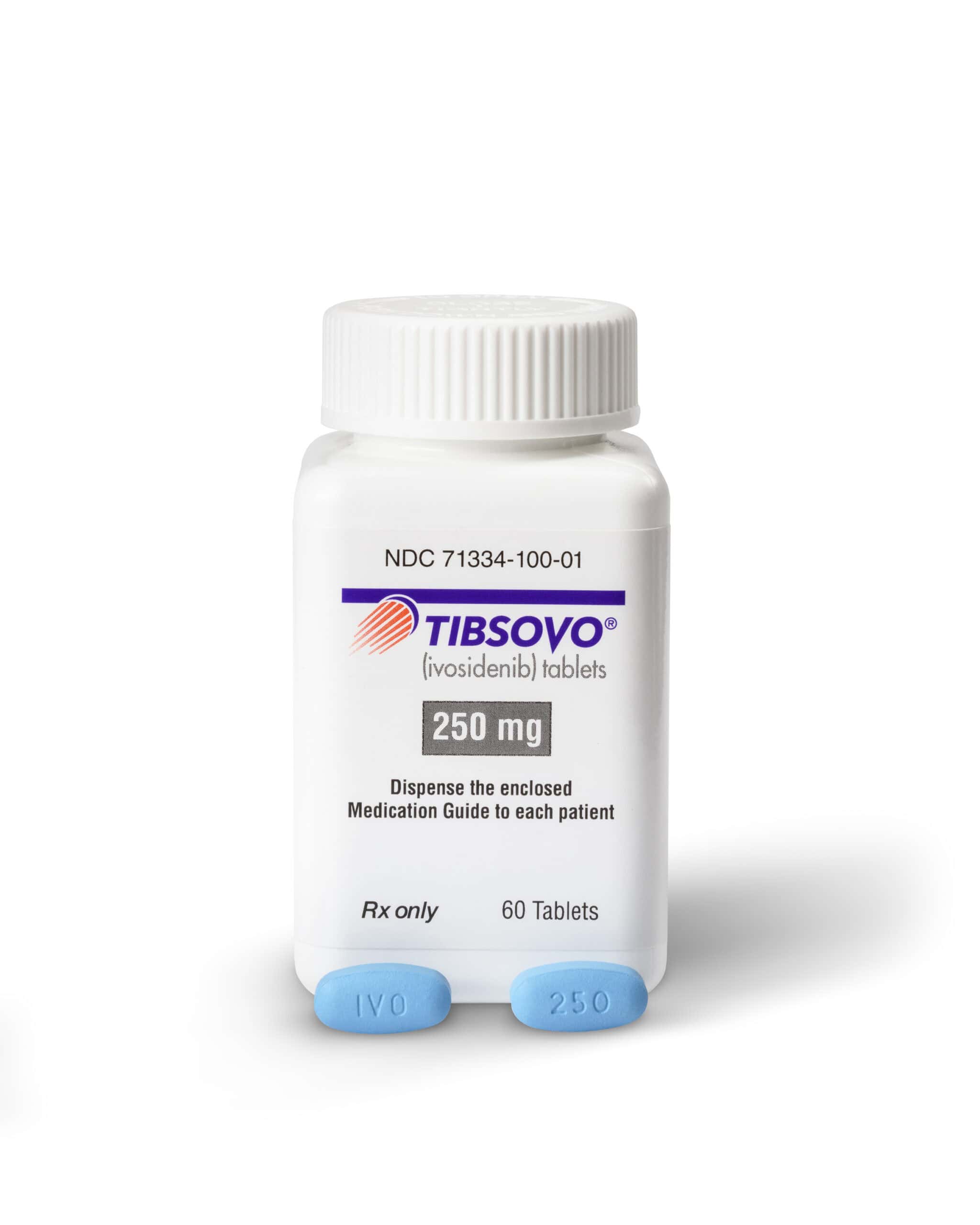
Tibsovo® (Ivosidenib) — First-in-Class IDH1 Inhibitor for IDH1-Mutated Haematological and Solid Tumours
The First Approved IDH1 Inhibitor — Targeting the Metabolic Enzyme Mutation Driving AML, MDS and Cholangiocarcinoma
Tibsovo® (Ivosidenib) is a potent, selective, oral inhibitor of the mutant isocitrate dehydrogenase-1 (IDH1) enzyme — the first IDH1 inhibitor approved for any clinical indication. IDH1 mutations are recurrent oncogenic mutations found in approximately 6-10% of acute myeloid leukaemia (AML), 3-5% of myelodysplastic syndromes (MDS), and 10-20% of intrahepatic cholangiocarcinomas (iCCA) — creating a constitutively active mutant IDH1 enzyme that produces an oncometabolite (2-hydroxyglutarate/2-HG) that drives epigenetic dysregulation, impairs normal cell differentiation, and promotes leukaemic and tumour cell proliferation. By selectively targeting and inhibiting mutant IDH1 — while sparing normal wild-type IDH1 function — Ivosidenib reduces 2-HG production, restores normal epigenetic regulation, and re-enables differentiation of leukaemic blast cells into mature blood cells — a mechanism fundamentally different from cytotoxic chemotherapy.
Tibsovo is approved for IDH1-mutated AML (newly diagnosed in patients ≥75 years or those unfit for intensive chemotherapy, and relapsed/refractory AML), IDH1-mutated MDS after failure of hypomethylating agent therapy, and previously treated IDH1-mutated locally advanced or metastatic cholangiocarcinoma — making it one of the few precision oncology medicines with proven efficacy across both haematological malignancies and a solid tumour indication.
A.K. Pharma is a trusted medicine distributor in Delhi supplying genuine Tibsovo (Ivosidenib) to hospitals, haematology centres, oncology clinics, and pharmacies across India. Manufactured by Servier, Tibsovo represents a critically important precision medicine for IDH1-mutated cancers — requiring mandatory companion diagnostic testing before prescribing.
What is Tibsovo (Ivosidenib)?
Tibsovo contains Ivosidenib — a small molecule allosteric inhibitor that selectively targets mutant IDH1 protein — specifically the IDH1 R132 family of mutations (R132H, R132C, R132G, R132L, R132S) that represent the vast majority of oncogenic IDH1 mutations in AML, MDS, and cholangiocarcinoma.
IDH1 — Normal Function and Oncogenic Mutations:
Normal IDH1 Function: Isocitrate dehydrogenase 1 (IDH1) is a cytoplasmic and peroxisomal enzyme that catalyses the oxidative decarboxylation of isocitrate to alpha-ketoglutarate (α-KG) — producing NADPH in the process. Alpha-ketoglutarate is an essential cofactor for:
Oncogenic IDH1 Mutations — The Oncometabolite Problem: IDH1 R132 mutations change the enzyme’s substrate specificity — mutant IDH1 gains a neomorphic enzymatic activity, reducing α-KG to 2-hydroxyglutarate (2-HG) — an oncometabolite that:
Ivosidenib’s Mechanism — Targeted 2-HG Suppression: Ivosidenib binds allosterically to mutant IDH1 — blocking its neomorphic 2-HG-producing activity while sparing wild-type IDH1 function (isocitrate → α-KG reaction is preserved). This selective inhibition:
This differentiation-inducing mechanism is fundamentally distinct from cytotoxic chemotherapy — it does not directly kill cells but enables malignant cells to differentiate and mature — a process called targeted differentiation therapy.
Full prescribing information is available at the FDA label for Ivosidenib.
Clinical Studies and Evidence
Study AG120-C-001 (Ivosidenib in Relapsed/Refractory IDH1-Mutated AML) Published in the New England Journal of Medicine (2018), the pivotal AG120-C-001 Phase 1/2 trial enrolled 179 patients with relapsed/refractory IDH1-mutated AML. Key results:
AGILE Trial (Ivosidenib + Azacitidine in Newly Diagnosed IDH1-Mutated AML) Published in the New England Journal of Medicine (2022), the AGILE trial was a Phase 3 randomised controlled trial of 146 patients with newly diagnosed IDH1-mutated AML who were ineligible for intensive chemotherapy — comparing Ivosidenib + azacitidine vs placebo + azacitidine. Key results:
Study AG120-C-001 — Newly Diagnosed IDH1-Mutated AML (Monotherapy Cohort) In patients with newly diagnosed IDH1-mutated AML who were ≥75 years or had comorbidities precluding intensive chemotherapy, Ivosidenib monotherapy achieved:
ClarIDHy Trial (Ivosidenib in Previously Treated IDH1-Mutated Cholangiocarcinoma) Published in the Lancet Oncology (2020) with updated OS data, the ClarIDHy trial was a Phase 3 randomised controlled trial of 187 patients with previously treated locally advanced or metastatic IDH1-mutated intrahepatic cholangiocarcinoma — comparing Ivosidenib vs placebo. Key results at updated analysis:
MDS Data (Ivosidenib in IDH1-Mutated MDS): Phase 2 data demonstrated Ivosidenib achieved haematological improvement and transfusion independence in patients with IDH1-mutated MDS after hypomethylating agent failure — leading to approval in this indication and providing a targeted option in a population with few effective therapies after HMA failure.
Available Strengths
Tibsovo is available as:
| Presentation | Dose | Standard Daily Dose |
|---|---|---|
| Tibsovo 250mg Film-Coated Tablets | 250mg per tablet | 500mg once daily (two 250mg tablets) |
Standard dose: 500mg (two 250mg tablets) orally once daily — taken with or without food.
Indications — What Tibsovo is Used For
Newly Diagnosed IDH1-Mutated AML:
Relapsed or Refractory IDH1-Mutated AML:
IDH1-Mutated Myelodysplastic Syndromes:
Previously Treated IDH1-Mutated Cholangiocarcinoma:
Mandatory IDH1 Mutation Testing: IDH1 mutation testing by a validated diagnostic test is mandatory before prescribing Tibsovo. IDH1 wild-type patients receive no benefit. Validated testing platforms include NGS (tissue or liquid biopsy) and the Abbott RealTime IDH1 Assay (FDA-approved companion diagnostic for the AML indication).
For detailed indication information refer to MedlinePlus Ivosidenib.
Key Benefits of Tibsovo
First-in-Class IDH1 Inhibitor — Unique Differentiation Mechanism Ivosidenib is the world’s first approved IDH1 inhibitor — pioneering a completely novel treatment approach based on epigenetic reprogramming and differentiation induction rather than cytotoxic killing. By reducing 2-HG — the oncometabolite driving IDH1-mutated cancers — Ivosidenib enables malignant cells to differentiate and mature rather than proliferating as blasts.
More Than Tripling OS in Elderly/Unfit Newly Diagnosed IDH1-Mutated AML The AGILE trial demonstrates an unprecedented more-than-tripling of median OS — from 7.9 to 24.0 months — with Ivosidenib + azacitidine vs azacitidine alone in newly diagnosed IDH1-mutated AML. For elderly or unfit AML patients who cannot receive intensive chemotherapy, Ivosidenib + azacitidine provides a survival outcome that was previously unachievable in this patient group.
Complete Remission in 47% of Elderly/Unfit Newly Diagnosed AML The AGILE trial demonstrates a 47.2% CR rate with Ivosidenib + azacitidine — comparable to CR rates with intensive chemotherapy in fit younger patients — but achieved with a far more manageable toxicity profile in elderly patients.
First Targeted Therapy for IDH1-Mutated Cholangiocarcinoma Ivosidenib is the first and only approved targeted therapy for IDH1-mutated cholangiocarcinoma — a rare and difficult-to-treat cancer with historically poor outcomes. The ClarIDHy trial provides the first evidence of disease control benefit with a targeted therapy in this biomarker-selected population.
Precision Medicine Across Haematology and Oncology Tibsovo is effective in IDH1-mutated cancers regardless of tumour type — reflecting the fundamental oncogenic role of mutant IDH1-driven 2-HG production across tissue types. This tumour-agnostic mechanism makes IDH1 inhibition applicable across AML, MDS, and cholangiocarcinoma — with potential activity in other IDH1-mutated solid tumours under investigation.
Oral Once-Daily Dosing — Outpatient Management Once-daily oral tablet administration allows outpatient management for elderly AML patients who would otherwise require repeated hospital admissions for chemotherapy — a major quality-of-life advantage in a frail population.
Transfusion Independence — Meaningful Quality-of-Life Benefit In both newly diagnosed and relapsed/refractory IDH1-mutated AML, Ivosidenib converts a significant proportion of transfusion-dependent patients to transfusion independence — reducing the clinical burden and improving quality of life beyond what overall response rate statistics capture.
How Tibsovo Works — IDH1 Inhibition and Differentiation Therapy
Step 1 — Selective Mutant IDH1 Binding: Ivosidenib binds to the allosteric regulatory site of mutant IDH1 homodimers and heterodimers (wild-type/mutant IDH1 complexes) — specifically inhibiting the neomorphic 2-HG-producing activity of the mutant enzyme. Wild-type IDH1 homodimers are largely unaffected — normal isocitrate → α-KG catalysis is preserved.
Step 2 — 2-HG Level Reduction: With mutant IDH1 inhibited, 2-HG production is suppressed — plasma and tumour cell 2-HG levels fall rapidly (>90% reduction within days). This reduction can be monitored as a pharmacodynamic biomarker of Ivosidenib activity.
Step 3 — Alpha-Ketoglutarate Restoration: With 2-HG no longer competitively inhibiting α-KG-dependent dioxygenases, cellular α-KG becomes available to activate:
Step 4 — Epigenetic Reprogramming: Restored TET2 and histone demethylase activity progressively reverses the IDH1 mutation-induced hypermethylation — re-enabling expression of haematopoietic differentiation genes silenced by 2-HG-driven epigenetic repression.
Step 5 — Differentiation Induction: Re-expression of differentiation transcription factors (C/EBPα, PU.1, GATA1, and others) → leukaemic blast cells re-enter the differentiation programme → mature into functional neutrophils, monocytes, and other blood cells rather than self-renewing as blasts.
Clinical Correlate — Differentiation Syndrome: Rapid blast differentiation with Ivosidenib can cause Differentiation Syndrome — a potentially life-threatening complication of differentiation therapy requiring immediate recognition and treatment with corticosteroids and supportive care. Oncologists must be trained to recognise and manage this unique complication.
For detailed mechanism overview refer to ELN AML Recommendations and NCCN AML Guidelines.
Dosage and Administration
All Indications — Standard Dose:
When Combined With Azacitidine (AGILE Regimen — Newly Diagnosed AML):
Dose Modifications:
Monitoring Schedule:
| Parameter | Frequency |
|---|---|
| ECG (QTc) | Baseline; weekly for 3 weeks; then monthly; after dose modifications |
| Serum electrolytes (K+, Mg²+, Ca²+) | Baseline; weekly for 3 weeks; then monthly |
| CBC with differential | Baseline; then as clinically indicated |
| Liver function tests | Baseline; then periodically |
| Signs of differentiation syndrome | Continuous clinical monitoring — particularly Weeks 1-12 |
| Uric acid | Baseline; monitor for tumour lysis (when combined with azacitidine) |
Full dosing guidelines available at Drugs.com Ivosidenib Dosage.
Differentiation Syndrome — Critical Safety Alert
Differentiation syndrome is the most clinically important and potentially life-threatening toxicity unique to IDH inhibitor therapy — occurring in approximately 19% of patients treated with Ivosidenib in AML:
What is Differentiation Syndrome? When IDH1 inhibition induces rapid differentiation of leukaemic blasts into mature myeloid cells, the sudden release of pro-inflammatory cytokines and the trafficking of newly differentiated cells to various organs causes a systemic inflammatory response syndrome:
Signs and Symptoms — Any of the following should raise suspicion:
Management — Act Immediately:
Timing: Differentiation syndrome most commonly occurs within the first 12 weeks of treatment — but can occur at any time. All patients and treating teams must be educated about this complication before starting Ivosidenib.
Who Should Use Tibsovo
Tibsovo is prescribed for:
AML:
MDS:
Cholangiocarcinoma:
Tibsovo is prescribed by haematologists (for AML and MDS) and medical oncologists (for cholangiocarcinoma). A.K. Pharma supplies Tibsovo to hospitals, haematology centres, oncology units, and pharmacies across Delhi and India.
Possible Side Effects
Common side effects include fatigue (39%), nausea (34%), diarrhoea (31%), dyspnoea (28%), oedema (26%), decreased appetite (25%), QTc prolongation (ECG changes — 26%), cough (25%), constipation (23%), arthralgia (21%), and peripheral neuropathy (17%).
Serious side effects include:
Differentiation Syndrome: Most clinically important serious toxicity — see dedicated section above. Occurs in approximately 19% of AML patients. Requires immediate recognition and corticosteroid treatment. Can be fatal if untreated.
QTc Prolongation: Ivosidenib prolongs the QTc interval — Grade 3 (>500ms) in approximately 3%. Mandatory ECG monitoring required. Correct electrolyte abnormalities before starting. Avoid concomitant QTc-prolonging medicines.
Guillain-Barré Syndrome: Rare but serious neurological complication — promptly evaluate any new onset motor/sensory neurological symptoms; permanently discontinue if confirmed.
Hepatotoxicity: LFT elevation in some patients — monitor liver function periodically.
Embryo-Foetal Toxicity: Ivosidenib can cause foetal harm — effective contraception required during treatment and for 1 month after last dose (females) and 1 week after last dose (males with female partners of reproductive potential).
Full side effect information available at FDA Ivosidenib Safety Information.
Precautions
Storage and Handling
As a responsible medicine distributor in Delhi, A.K. Pharma stores all medicines including Tibsovo under manufacturer-recommended conditions ensuring product integrity for every supply.
Manufacturer Information
Tibsovo (Ivosidenib) is manufactured by Servier, a global pharmaceutical company with a major oncology portfolio — following Servier’s acquisition of the oncology portfolio from Agios Pharmaceuticals. Ivosidenib received FDA approval in July 2018 for relapsed/refractory IDH1-mutated AML — the first IDH1 inhibitor approved for any indication — with subsequent approvals for newly diagnosed AML (2019 monotherapy; 2022 combination with azacitidine/AGILE), MDS (2023), and cholangiocarcinoma (2021). A.K. Pharma supplies only genuine Tibsovo sourced from authorized Servier distributors.
Related Haematology and Cancer Medicines Available at A.K. Pharma
Frequently Asked Questions
Q. What is Tibsovo used for? Tibsovo (Ivosidenib) is used to treat IDH1-mutated acute myeloid leukaemia (AML) — both newly diagnosed (in patients ≥75 years or unfit for intensive chemotherapy) and relapsed/refractory — IDH1-mutated myelodysplastic syndromes after HMA failure, and previously treated IDH1-mutated locally advanced or metastatic cholangiocarcinoma. IDH1 mutation testing is mandatory before prescribing. More information available at MedlinePlus.
Q. What is the generic name of Tibsovo? The generic name of Tibsovo is Ivosidenib. It is the world’s first approved IDH1 inhibitor — manufactured by Servier.
Q. How does Tibsovo work differently from chemotherapy? Chemotherapy kills rapidly dividing cells indiscriminately — including cancer cells and normal cells. Tibsovo works through a completely different mechanism called targeted differentiation therapy — it inhibits the mutant IDH1 enzyme that produces an oncometabolite (2-HG) blocking normal cell maturation. By suppressing 2-HG, Tibsovo allows leukaemic blast cells to resume their normal differentiation programme — maturing into functional blood cells rather than proliferating as blasts. This differentiation mechanism enables clinically meaningful responses with a more manageable toxicity profile than intensive chemotherapy, particularly in elderly patients.
Q. What is differentiation syndrome and how serious is it? Differentiation syndrome is a potentially life-threatening complication where the rapid differentiation of leukaemic blasts induced by Ivosidenib causes a systemic inflammatory response — with fever, breathing difficulty, pulmonary oedema, low blood pressure, and fluid retention. It occurs in approximately 19% of AML patients on Ivosidenib. It requires immediate recognition — withhold Ivosidenib and start high-dose corticosteroids (dexamethasone 10mg IV twice daily) immediately. If untreated it can be fatal. All patients and clinical teams must be educated about differentiation syndrome before starting Tibsovo.
Q. Is IDH1 mutation testing required before prescribing Tibsovo? Yes — IDH1 mutation testing is mandatory before prescribing Tibsovo. Only patients with confirmed IDH1 R132 mutations (R132H, R132C, R132G, R132L, R132S) benefit from Ivosidenib. The Abbott RealTime IDH1 Assay is the FDA-approved companion diagnostic for the AML indication. NGS-based comprehensive genomic profiling is also widely used and identifies IDH1 mutations alongside other actionable alterations.
Q. What is the AGILE regimen? The AGILE regimen combines Ivosidenib 500mg once daily (continuous) with azacitidine 75mg/m² on Days 1-7 of each 28-day cycle — demonstrated in the AGILE Phase 3 trial to achieve a remarkable median OS of 24.0 months vs 7.9 months with azacitidine alone in newly diagnosed IDH1-mutated AML in elderly/unfit patients. Azacitidine (Azadine) is available from A.K. Pharma.
Q. Can Tibsovo be used for bile duct cancer? Yes — Tibsovo is approved for previously treated locally advanced or metastatic intrahepatic cholangiocarcinoma (bile duct cancer) with an IDH1 mutation. The ClarIDHy trial demonstrated significantly improved PFS and disease control vs placebo — making Tibsovo the first approved targeted therapy for IDH1-mutated cholangiocarcinoma.
Q. Is Tibsovo available in India? Tibsovo can be supplied to hospitals, haematology centres, and pharmacies across India through licensed pharmaceutical distributors. Contact A.K. Pharma — medicine distributor in Delhi — for availability and pricing.
Q. What is the price of Tibsovo in India? Tibsovo 250mg price in India varies by pack size. Contact A.K. Pharma at 011 4172 6999 or WhatsApp +91 9810034827 for current pricing and bulk supply rates.
Q. How to order Tibsovo from A.K. Pharma? You can request a quote directly from this page, call us at 011 4172 6999, or WhatsApp us at +91 9810034827 with your requirements and we will respond promptly.
Q. Does A.K. Pharma supply Tibsovo in bulk? Yes. A.K. Pharma supplies Tibsovo in bulk to haematology centres, oncology units, hospitals, and pharmacies across Delhi and India. Contact us for bulk pricing and availability.
Why Order Tibsovo from A.K. Pharma?
Contact A.K. Pharma for Tibsovo Supply 📍 E-2/257A, 2nd Floor, Shastri Nagar, New Delhi 110052 📞 011 4172 6999 📱 WhatsApp: +91 9810034827 🌐 akpharma.in