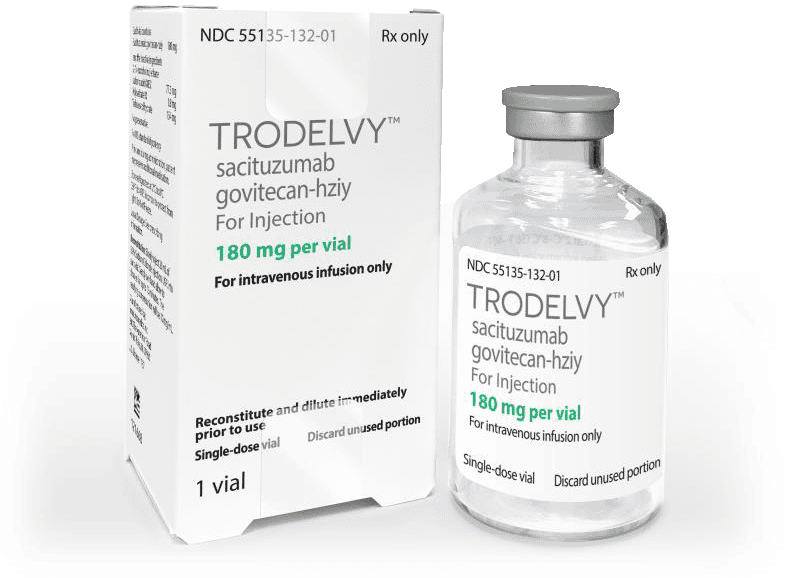
Sacituzumab Govitecan 180mg Injection — TROP-2 Targeted Antibody-Drug Conjugate for Triple-Negative Breast Cancer and HR-Positive HER2-Negative Breast Cancer
Supplied only against a valid prescription from a registered medical practitioner.
Sourced from authorised channels
Temperature-controlled packing
Hospitals, clinics, pharmacies
Delhi drug licence holder
Trodelvy® (Sacituzumab Govitecan) — TROP-2 Targeted ADC Transforming Breast Cancer Treatment
The First TROP-2 Directed Antibody-Drug Conjugate — Proven Survival Benefit in Triple-Negative and HR-Positive Breast Cancer
Trodelvy® (Sacituzumab Govitecan) is a first-in-class TROP-2 (trophoblast cell-surface antigen 2) directed antibody-drug conjugate (ADC) consisting of a humanised anti-TROP-2 IgG1 antibody coupled to SN-38 — the active metabolite of irinotecan — via a proprietary hydrolysable CL2A linker. Trodelvy is approved for triple-negative breast cancer (TNBC) — the most aggressive and difficult-to-treat breast cancer subtype — and for HR-positive HER2-negative metastatic breast cancer after endocrine therapy and prior chemotherapy, delivering meaningful survival improvements in patients with limited treatment options after multiple prior lines of therapy.
TROP-2 is a transmembrane glycoprotein overexpressed in the majority of breast cancers — including approximately 85% of TNBC and 60-70% of HR-positive HER2-negative tumours — making it an attractive ADC target. Unlike HER2 — which is expressed in only 20% of breast cancers — TROP-2 overexpression is widespread, enabling Trodelvy to target a much broader breast cancer population than HER2-directed ADCs.
A.K. Pharma is a trusted medicine distributor in Delhi supplying genuine Trodelvy (Sacituzumab Govitecan) to hospitals, oncology centres, breast cancer clinics, and pharmacies across India. Manufactured by Gilead Sciences — following Gilead’s acquisition of Immunomedics — Trodelvy represents a critically important treatment advance for Indian patients with TNBC and HR-positive HER2-negative breast cancer who have limited options after multiple prior therapies.
What is Trodelvy (Sacituzumab Govitecan)?
Trodelvy contains Sacituzumab Govitecan — an ADC with three key components:
Component 1 — Anti-TROP-2 Antibody (hRS7): A humanised IgG1 monoclonal antibody that binds with high affinity to TROP-2 — a cell surface glycoprotein overexpressed on epithelial tumour cells including breast, bladder, lung, and cervical cancers. TROP-2 overexpression correlates with tumour aggressiveness and poor prognosis — but also makes it an ideal ADC target given high tumour expression with relatively lower normal tissue expression.
Component 2 — CL2A Hydrolysable Linker: A proprietary hydrolysable linker (CL2A) connects the antibody to SN-38. This linker is deliberately designed to be partially hydrolysable in the slightly acidic tumour microenvironment — releasing some SN-38 both intracellularly (after ADC internalisation and lysosomal cleavage) and extracellularly (in the tumour microenvironment). This dual release mechanism — combined with SN-38’s membrane permeability — contributes to a potent bystander killing effect, killing TROP-2-low or TROP-2-negative tumour cells in the vicinity.
Component 3 — SN-38 Payload (Topoisomerase I Inhibitor): SN-38 is the active metabolite of irinotecan — a potent topoisomerase I inhibitor. Sacituzumab Govitecan delivers SN-38 at a drug-to-antibody ratio (DAR) of approximately 7.6 — delivering a high payload of SN-38 per antibody molecule to TROP-2-expressing tumour cells. Once inside cancer cells, SN-38 inhibits topoisomerase I — causing DNA double-strand breaks and cancer cell apoptosis.
Key pharmacological features:
Full prescribing information is available at the FDA label for Sacituzumab Govitecan.
Clinical Studies and Evidence
ASCENT Trial (Sacituzumab Govitecan vs Chemotherapy in Relapsed/Refractory TNBC) Published in the New England Journal of Medicine (2021), the landmark ASCENT trial was a Phase 3 randomised controlled trial of 529 patients with relapsed or refractory metastatic TNBC who had received at least two prior lines of therapy. This was the pivotal trial establishing Trodelvy as the standard of care for relapsed/refractory metastatic TNBC. Key results in patients without brain metastases:
TROPiCS-02 Trial (Sacituzumab Govitecan in HR-Positive HER2-Negative Metastatic Breast Cancer) Published in the Journal of Clinical Oncology (2023), TROPiCS-02 was a Phase 3 randomised controlled trial of 543 postmenopausal patients with HR-positive HER2-negative metastatic breast cancer who had received prior endocrine therapy, a CDK4/6 inhibitor, and 2-4 prior lines of chemotherapy. Key results:
EVER-132-001 Trial (Sacituzumab Govitecan in Urothelial Carcinoma) Published in the New England Journal of Medicine (2021), this trial demonstrated Trodelvy significantly improved OS vs chemotherapy in patients with locally advanced or metastatic urothelial carcinoma who had received prior platinum and checkpoint inhibitor therapy — median OS 10.9 months vs 8.9 months — establishing Trodelvy in urothelial cancer as well.
Available Strengths
Trodelvy is available as:
| Presentation | Dose | Reconstitution |
|---|---|---|
| Trodelvy 180mg powder for concentrate for solution for infusion | 180mg lyophilised powder per vial | Reconstitute with sterile water, then dilute in 500mL 0.9% NaCl |
Dosing: 10mg/kg IV on days 1 and 8 of every 21-day cycle — administered as IV infusion over 3 hours (first infusion) or 1-2 hours (subsequent infusions if tolerated).
Indications — What Trodelvy is Used For
Triple-Negative Breast Cancer (TNBC):
HR-Positive HER2-Negative Metastatic Breast Cancer:
Urothelial Carcinoma:
For detailed indication information refer to MedlinePlus Sacituzumab Govitecan.
Key Benefits of Trodelvy
Near-Doubling of Overall Survival in Relapsed/Refractory Metastatic TNBC The ASCENT trial demonstrates median OS improvement from 6.7 months to 12.1 months — nearly doubling median survival in a disease with one of the worst prognoses in all of oncology. For patients with metastatic TNBC who have exhausted prior treatment options, Trodelvy provides a meaningful survival extension with manageable tolerability.
Broad TROP-2 Target — Extensive Eligible Patient Population TROP-2 is overexpressed in approximately 85% of TNBC and 60-70% of HR-positive HER2-negative breast cancer — making Trodelvy applicable to a much broader patient population than HER2-directed therapies. TROP-2 testing is not required for prescribing — all TNBC and HR-positive HER2-negative breast cancer patients meeting the clinical criteria are eligible regardless of TROP-2 IHC result.
Bystander Killing in Heterogeneous Tumours Trodelvy’s partially hydrolysable linker releases SN-38 both intracellularly and extracellularly — the membrane-permeable SN-38 diffuses to kill adjacent tumour cells regardless of TROP-2 expression. This bystander effect is particularly important in TNBC where tumour heterogeneity is common.
First ADC Approved for HR-Positive HER2-Negative Breast Cancer TROPiCS-02 established Trodelvy as the first ADC approved for HR-positive HER2-negative metastatic breast cancer — addressing a large and underserved patient population who have exhausted endocrine and CDK4/6 inhibitor options.
Active in Multiple Tumour Types Beyond breast cancer, Trodelvy demonstrates activity in urothelial carcinoma, cervical cancer, non-small cell lung cancer, and other TROP-2-expressing tumours — with ongoing trials expanding its indications. Trodelvy represents a platform therapy applicable across multiple TROP-2-expressing solid tumours.
No Requirement for Biomarker Testing Unlike HER2-directed therapies which require HER2 testing before prescribing, Trodelvy does not require TROP-2 testing for its approved indications — simplifying the prescribing pathway and making treatment accessible without additional diagnostic workup.
How Trodelvy Works
Step 1 — TROP-2 Binding: After IV infusion, Trodelvy circulates and binds with high affinity to TROP-2 on the surface of breast cancer cells. TROP-2 overexpression in TNBC and HR-positive breast cancer ensures high tumour uptake relative to normal tissues.
Step 2 — Internalisation: The TROP-2/Trodelvy complex is internalised by receptor-mediated endocytosis — forming endosomes that fuse with lysosomes inside cancer cells.
Step 3 — Intracellular SN-38 Release: Within lysosomes, the CL2A linker is cleaved by lysosomal enzymes and the mildly acidic pH — releasing free SN-38 intracellularly in high concentrations.
Step 4 — Extracellular SN-38 Release (Bystander Effect): The CL2A linker also undergoes partial hydrolysis in the slightly acidic tumour microenvironment — releasing SN-38 extracellularly. Membrane-permeable SN-38 diffuses into adjacent TROP-2-low or TROP-2-negative tumour cells — killing heterogeneous tumour populations beyond the direct TROP-2-targeted cells.
Step 5 — Topoisomerase I Inhibition: Released SN-38 inhibits topoisomerase I — stabilising the topoisomerase I-DNA cleavage complex, preventing DNA strand religation → DNA double-strand breaks accumulate → DNA damage response → G2/M cell cycle arrest → apoptosis.
For a detailed mechanism overview refer to ESMO Breast Cancer Guidelines and ASCO Triple-Negative Breast Cancer Guidelines.
Trodelvy vs Enhertu — TROP-2 vs HER2 Targeting in Breast Cancer
| Feature | Trodelvy (Sacituzumab Govitecan) | Enhertu (Trastuzumab Deruxtecan) |
|---|---|---|
| Target | TROP-2 | HER2 |
| Target expression in TNBC | ~85% overexpression | ~20% HER2-positive; ~45-55% HER2-low |
| Target expression in HR+/HER2– | ~60-70% overexpression | ~45-55% HER2-low |
| Payload | SN-38 (topoisomerase I inhibitor) | DXd (topoisomerase I inhibitor) |
| Biomarker testing required | ❌ Not required | ✅ HER2 testing required |
| TNBC approval | ✅ Yes — ASCENT trial | ❌ No |
| HR+/HER2– approval | ✅ Yes — TROPiCS-02 | ✅ Yes — DESTINY-Breast04 |
| ILD risk | Lower (~3%) | Higher (10-15%) |
| Neutropenia | Significant — common | Moderate |
| Administration | IV days 1 and 8 Q3W | IV every 3 weeks |
| Available at A.K. Pharma | Request Quote | Request Quote |
Dosage and Administration
Standard Dose:
Infusion Schedule:
Pre-Medication:
Reconstitution:
Dose Modifications:
Full dosing guidelines available at Drugs.com Sacituzumab Govitecan Dosage.
UGT1A1 Genotyping — Clinical Consideration
UGT1A1 is the primary enzyme responsible for SN-38 glucuronidation and detoxification. Patients homozygous for the UGT1A1*28 allele (UGT1A1 7/7 genotype) — occurring in approximately 10% of patients — have reduced UGT1A1 activity → reduced SN-38 clearance → increased SN-38 exposure → increased risk of severe neutropenia and other toxicities.
UGT1A1 genotyping is recommended before starting Trodelvy — particularly in patients with Gilbert syndrome (a known UGT1A1 variant) or those at high risk of toxicity. Patients with UGT1A1*28 homozygous genotype should start at 7.5mg/kg with careful monitoring.
Who Should Use Trodelvy
Trodelvy is prescribed for:
TNBC:
HR-Positive HER2-Negative Breast Cancer:
Clinical Considerations:
Trodelvy is prescribed by medical oncologists and breast cancer specialists. A.K. Pharma supplies Trodelvy to hospitals, oncology centres, breast cancer clinics, and pharmacies across Delhi and India.
Possible Side Effects
Common side effects include neutropenia (64% — the most important haematological toxicity), nausea (64%), diarrhoea (59%), fatigue (57%), alopecia (46%), anaemia (37%), vomiting (35%), constipation (31%), decreased appetite (26%), and rash (22%).
Serious side effects include:
Severe Neutropenia — Black Box Warning: Severe neutropenia (Grade 3-4) occurs in approximately 51% of patients — the most important dose-limiting toxicity. Febrile neutropenia occurs in approximately 6%. G-CSF support is recommended for severe neutropenia. CBC monitoring before each cycle is mandatory.
Severe Diarrhoea — Black Box Warning: Severe diarrhoea (Grade 3-4) occurs in approximately 10% of patients. Both early-onset (within 24 hours of infusion — cholinergic, managed with atropine) and late-onset (>24 hours — secretory, managed with loperamide) diarrhoea occur. Patient education about early diarrhoea management is critical — initiate loperamide at first sign of loose stools. Withhold for Grade ≥3 diarrhoea.
Other serious effects:
Full side effect information available at FDA Sacituzumab Govitecan Safety Information.
Precautions
Storage and Handling
As a responsible medicine distributor in Delhi, A.K. Pharma maintains full cold chain requirements during storage and supply of Trodelvy ensuring product integrity for every unit supplied.
Manufacturer Information
Trodelvy (Sacituzumab Govitecan) is manufactured by Gilead Sciences — following Gilead’s acquisition of Immunomedics in 2020 for USD 21 billion, reflecting the strategic importance of Trodelvy in Gilead’s oncology portfolio. Sacituzumab Govitecan received FDA accelerated approval in April 2020 for relapsed/refractory metastatic TNBC with regular approval following ASCENT trial results in 2021. A.K. Pharma supplies only genuine Trodelvy sourced from authorized distributors.
Related Breast Cancer and Oncology Medicines Available at A.K. Pharma
Frequently Asked Questions
Q. What is Trodelvy used for? Trodelvy (Sacituzumab Govitecan) is used to treat unresectable locally advanced or metastatic triple-negative breast cancer (TNBC), HR-positive HER2-negative metastatic breast cancer after prior endocrine therapy and chemotherapy, and locally advanced or metastatic urothelial carcinoma. More information available at MedlinePlus.
Q. What is the generic name of Trodelvy? The generic name of Trodelvy is Sacituzumab Govitecan. It is a TROP-2 directed antibody-drug conjugate coupling a humanised anti-TROP-2 antibody to SN-38 via a hydrolysable CL2A linker.
Q. What is TROP-2 and why is it a cancer target? TROP-2 is a cell surface glycoprotein overexpressed in approximately 85% of triple-negative breast cancers and 60-70% of HR-positive HER2-negative breast cancers. It is associated with tumour aggressiveness and poor prognosis — but its high expression on tumour cells with lower expression on normal tissues makes it an ideal target for ADC-based therapy. Unlike HER2 which is expressed in only 20% of breast cancers, TROP-2 overexpression is widespread — making Trodelvy applicable to a broad breast cancer population.
Q. Does TROP-2 testing need to be done before prescribing Trodelvy? No — TROP-2 testing is not required before prescribing Trodelvy for its approved TNBC or HR-positive HER2-negative breast cancer indications. All patients meeting the clinical eligibility criteria can receive Trodelvy regardless of TROP-2 IHC result. This simplifies the prescribing pathway compared to HER2-directed therapies.
Q. What is UGT1A1 and why is genotyping important? UGT1A1 is the enzyme that detoxifies SN-38 — Trodelvy’s payload. Patients with UGT1A128 homozygous genotype (approximately 10% of patients) have reduced SN-38 clearance — leading to higher SN-38 exposure and increased risk of severe neutropenia. UGT1A1 genotyping is recommended before starting Trodelvy. Patients with Gilbert syndrome are typically UGT1A128 homozygous — start these patients at 7.5mg/kg.
Q. What are the two Black Box Warnings for Trodelvy? Trodelvy carries Black Box Warnings for severe neutropenia (Grade 3-4 in approximately 51% of patients) and severe diarrhoea (Grade 3-4 in approximately 10%). Both require mandatory monitoring, patient education, and dose modification per prescribing information.
Q. How is Trodelvy different from Enhertu? Both are ADCs targeting breast cancer but through different mechanisms. Trodelvy targets TROP-2 — expressed in most breast cancers regardless of HER2 status — making it applicable to TNBC and heavily pre-treated HR-positive HER2-negative patients. Enhertu targets HER2 — applicable to HER2-positive and HER2-low breast cancer. The two medicines target complementary patient populations and are not interchangeable.
Q. Is Trodelvy available in India? Trodelvy can be supplied to hospitals, oncology centres, and pharmacies across India through licensed pharmaceutical distributors. Contact A.K. Pharma — medicine distributor in Delhi — for availability and pricing.
Q. What is the price of Trodelvy in India? Trodelvy 180mg price in India varies. Contact A.K. Pharma at 011 4172 6999 or WhatsApp +91 9810034827 for current pricing and bulk supply rates.
Q. How to order Trodelvy from A.K. Pharma? You can request a quote directly from this page, call us at 011 4172 6999, or WhatsApp us at +91 9810034827 with your requirements and we will respond promptly.
Q. Does A.K. Pharma supply Trodelvy in bulk? Yes. A.K. Pharma supplies Trodelvy in bulk to oncology centres, breast cancer clinics, hospitals, and pharmacies across Delhi and India. Contact us for bulk pricing and availability.
Why Order Trodelvy from A.K. Pharma?
Contact A.K. Pharma for Trodelvy Supply 📍 E-2/257A, 2nd Floor, Shastri Nagar, New Delhi 110052 📞 011 4172 6999 📱 WhatsApp: +91 9810034827 🌐 akpharma.in