
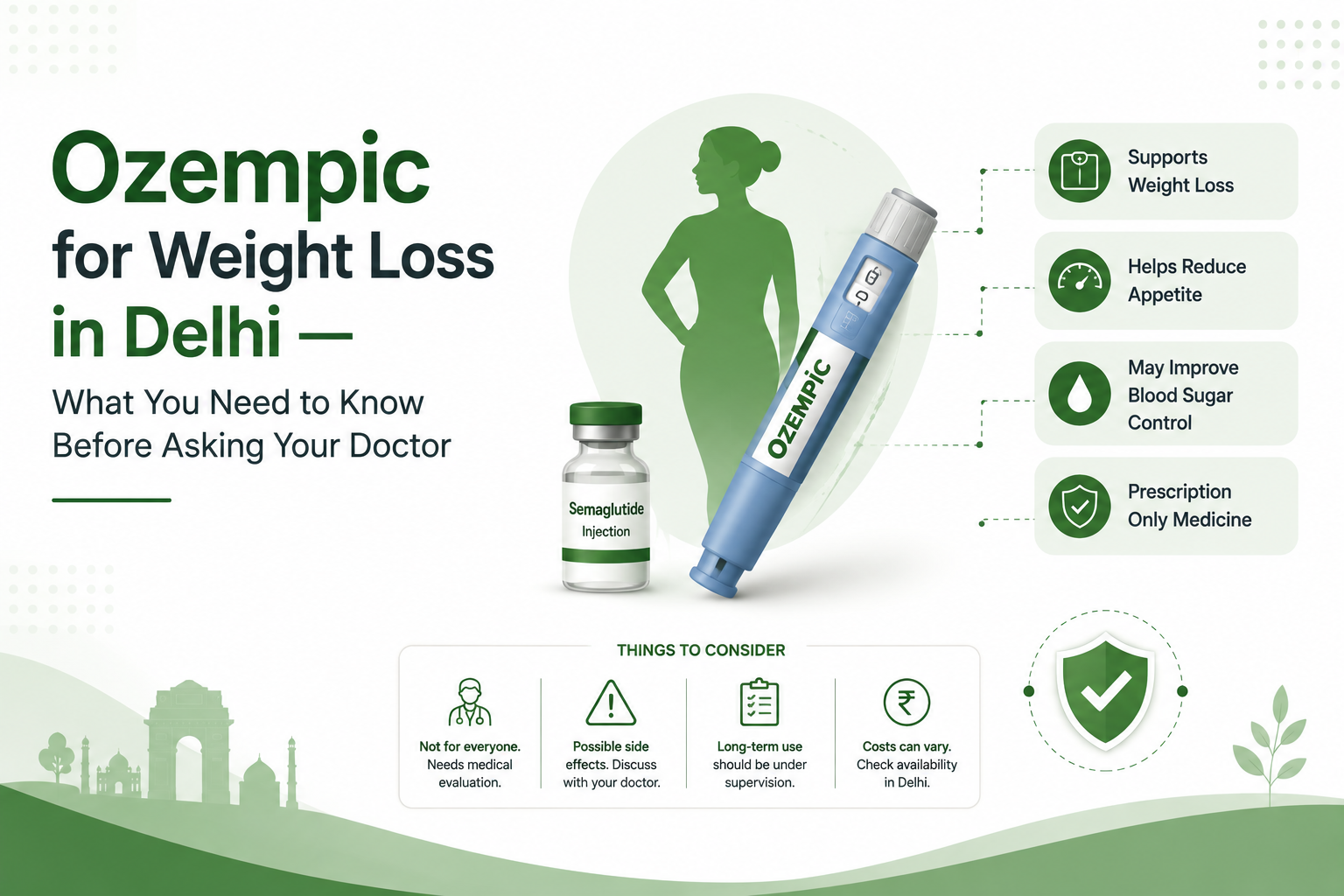
Ozempic has become one of the most searched medicine names in India over the past two years. That search volume is not coming from people with diabetes — although Ozempic is a diabetes medicine and that is what it is approved for. It is coming from people who have read about dramatic weight loss results in celebrity interviews, seen before-and-after social media posts, and started wondering whether this is the answer to a problem they have been living with for years.
If you are in Delhi and you are searching for Ozempic for weight loss, this article is for you. It will tell you what Ozempic is, what it does and does not do for weight loss, what is actually available in India, what your doctor needs to know before prescribing it, and how to make sure the medicine you receive is genuine.
What Is Ozempic?
Ozempic is the brand name for Semaglutide — a glucagon-like peptide-1 (GLP-1) receptor agonist developed by Novo Nordisk. It was originally developed and approved as a treatment for type 2 diabetes, where it works by stimulating insulin secretion, suppressing glucagon, and slowing gastric emptying to improve blood sugar control.
The weight loss effect was observed in clinical trials from the beginning — patients taking Semaglutide for diabetes consistently lost significant amounts of weight as well as improving their blood sugar. Novo Nordisk subsequently developed a higher-dose version of the same molecule specifically for weight management, which is sold under the brand name Wegovy (Semaglutide 2.4mg). Ozempic (Semaglutide 0.5mg, 1mg, and 2mg) remains the diabetes formulation.
This distinction matters practically — Ozempic is approved for type 2 diabetes management. Wegovy is approved for chronic weight management in adults with obesity or overweight with at least one weight-related condition. They contain the same active ingredient at different doses.
How Does Semaglutide Cause Weight Loss?
According to published clinical pharmacology literature and the approved prescribing information, Semaglutide causes weight loss through several mechanisms:
Appetite suppression: GLP-1 receptors are present in the brain, particularly in areas that regulate appetite and food intake. Semaglutide activates these receptors, producing a sustained reduction in appetite and food cravings that goes beyond what patients typically experience through willpower or dietary restriction alone.
Slowed gastric emptying: Semaglutide slows the rate at which food moves from the stomach into the small intestine, prolonging the feeling of fullness after eating and reducing the urge to eat again shortly after a meal.
Reduced food reward signalling: Clinical research suggests that GLP-1 receptor agonists may also reduce the hedonic or pleasure-driven component of eating — the psychological pull toward food that is separate from genuine hunger.
These mechanisms work together to produce a significant and sustained reduction in calorie intake, which drives the weight loss observed in clinical trials. The STEP trials evaluating Semaglutide 2.4mg (Wegovy) demonstrated mean weight reductions of approximately 15% of body weight over 68 weeks — a magnitude of weight loss previously only achievable through bariatric surgery.
Is Ozempic Approved for Weight Loss in India?
This is the most important practical question and the answer requires some precision.
Ozempic (Semaglutide) is approved in India for type 2 diabetes management — not specifically for weight loss as a standalone indication. The CDSCO has approved Ozempic for use in adults with type 2 diabetes to improve glycaemic control.
Wegovy (Semaglutide 2.4mg), the higher-dose formulation specifically approved for chronic weight management in the US and Europe, had not received CDSCO marketing approval for weight management in India as of mid-2026 — availability may have changed, so confirming current status with a treating physician or licensed specialty distributor is always advisable.
What this means practically: a doctor in India prescribing Ozempic for weight loss in a patient without type 2 diabetes is prescribing off-label. This is not illegal — off-label prescribing by qualified physicians is a legitimate medical practice — but it means the patient and physician are operating outside the formally approved indication, and the clinical responsibility rests entirely with the prescribing physician.
For patients with type 2 diabetes who also need to lose weight, Ozempic sits clearly within its approved indication — improving blood sugar control and producing meaningful weight loss simultaneously is exactly what it is approved to do in diabetic patients.
Ozempic vs Mounjaro for Weight Loss in Delhi — What Is the Difference?
This comparison comes up constantly, so it is worth addressing directly.
Mounjaro (Tirzepatide) is a dual GIP and GLP-1 receptor agonist — it activates two different hormone receptors rather than one. In head-to-head comparisons, Tirzepatide has consistently produced greater weight loss than Semaglutide — the SURMOUNT trials demonstrated mean weight reductions of up to 22.5% of body weight with the highest Tirzepatide dose, compared to approximately 15% with Semaglutide 2.4mg.
Both are weekly subcutaneous injections. Both work through appetite suppression and slowed gastric emptying as primary mechanisms. Both require medical supervision, dose titration, and ongoing monitoring.
From a practical availability standpoint in Delhi, both Ozempic (Semaglutide) and Mounjaro (Tirzepatide) are available through licensed specialty medicine distributors including A.K. Pharma, which supplies both to hospitals and clinics across India. The choice between them is a clinical decision made by the treating physician based on the individual patient’s medical history, concurrent conditions, and treatment goals.
What Does the Doctor Need to Know Before Prescribing Ozempic?
Ozempic is a prescription medicine and it is not appropriate for everyone. Before a physician can prescribe it, they will need to assess:
Your current medical history: Ozempic is contraindicated in patients with a personal or family history of medullary thyroid carcinoma (MTC) or Multiple Endocrine Neoplasia syndrome type 2 (MEN 2) — a boxed warning in the prescribing information. Patients with a history of pancreatitis require careful risk-benefit assessment. Renal and hepatic function should be assessed before initiating therapy.
Your current medications: Several drug interactions are clinically relevant — Ozempic slows gastric emptying, which can affect the absorption of oral medications taken concomitantly. Patients on oral diabetes medications may require dose adjustments to avoid hypoglycaemia when starting Ozempic.
Your realistic expectations: Ozempic produces meaningful weight loss in most patients, but it is not a standalone solution. The clinical trials showing 15% body weight reduction were conducted alongside lifestyle intervention — diet and exercise modification. Patients who do not make concurrent lifestyle changes see significantly smaller results. And critically, the weight loss is maintained only as long as the medicine is continued — there is substantial evidence of weight regain after stopping GLP-1 receptor agonist therapy.
Your ability to commit to regular injections and monitoring: Ozempic is a weekly subcutaneous injection that requires dose titration over several months — typically starting at 0.25mg weekly and escalating to 0.5mg, 1mg, or 2mg as tolerated. Regular follow-up with the prescribing physician is required throughout treatment.
What Are the Side Effects?
The most commonly reported side effects with Semaglutide are gastrointestinal — nausea, vomiting, diarrhoea, and constipation, particularly during the dose escalation phase. These effects typically improve as the body adjusts to the medicine, and slow dose titration minimises their severity. Taking Ozempic with a small, low-fat meal can help reduce nausea.
Serious side effects include:
Pancreatitis: Acute pancreatitis has been reported in patients taking GLP-1 receptor agonists. Patients who develop severe abdominal pain should discontinue Ozempic and seek medical assessment immediately.
Thyroid C-cell tumours: Animal studies showed an increased risk of thyroid C-cell tumours with Semaglutide at doses well above human therapeutic levels. Whether this risk translates to humans is not established, but the contraindication in patients with personal or family history of MTC or MEN 2 is based on this finding.
Diabetic retinopathy complications: Rapid improvement in blood glucose control in diabetic patients can temporarily worsen diabetic retinopathy — ophthalmological monitoring is recommended in patients with pre-existing retinopathy.
Hypoglycaemia: When used in combination with insulin or sulphonylureas, Ozempic can increase hypoglycaemia risk — dose adjustment of the concomitant diabetes medicine may be required.
Full side effect information is available at the FDA Semaglutide Prescribing Information and MedlinePlus Semaglutide.
The Supply Chain Question — Why It Matters for Ozempic
Ozempic has been subject to significant supply shortages globally since 2022, driven by demand that massively outpaced Novo Nordisk’s manufacturing capacity. This shortage created a secondary market of compounded Semaglutide products — unapproved formulations manufactured by compounding pharmacies that are not the same as the originator Ozempic product and have not undergone the same regulatory scrutiny.
In India, this creates a practical risk for patients sourcing Ozempic: the genuine originator product manufactured by Novo Nordisk, which has an established safety and efficacy profile, and unverified products of uncertain quality and concentration available through informal channels, are not equivalent. Patients have no way to distinguish genuine from counterfeit or compounded product by looking at the vial.
This is why sourcing Ozempic through a licensed specialty pharmaceutical distributor — rather than through informal channels, grey-market online sources, or unverified vendors — matters as much as getting the prescription right. A.K. Pharma is a licensed medicine distributor in Delhi and pharmaceutical distributor in Delhi supplying genuine Ozempic (Semaglutide) from authorised Novo Nordisk channels to hospitals and clinics across India, with complete batch documentation for every supply.
What About Wegovy — Is It Available in Delhi?
Wegovy (Semaglutide 2.4mg) is the higher-dose formulation of the same molecule specifically approved for chronic weight management — at a dose nearly double that of the highest Ozempic dose. It is approved by the FDA and EMA for adults with a BMI of 30 or above, or 27 or above with at least one weight-related condition.
For patients in Delhi who need the weight management-specific formulation rather than the diabetes formulation, Wegovy’s availability in India as of mid-2026 should be confirmed with a treating physician or licensed specialty distributor, as import availability through Named Patient Program or commercial channels may have evolved. Contact A.K. Pharma at 011 4172 6999 or WhatsApp +91 9810034827 to discuss current availability.
Frequently Asked Questions
Q. Can I get Ozempic for weight loss in Delhi without having diabetes?
Ozempic is approved in India for type 2 diabetes management, not as a standalone weight loss medicine. A doctor can prescribe it off-label for weight loss in a patient without diabetes — this is a legitimate medical practice — but the prescribing physician takes clinical responsibility for the off-label use. The decision to prescribe rests entirely with the treating physician based on the individual patient’s medical history and risk profile.
Q. What is the difference between Ozempic and Wegovy?
Both contain Semaglutide — the same active ingredient. Ozempic (0.5mg, 1mg, 2mg) is approved for type 2 diabetes management. Wegovy (2.4mg) is the higher-dose formulation approved specifically for chronic weight management in adults with obesity. Wegovy produces greater average weight loss due to the higher dose. Both are weekly subcutaneous injections.
Q. How much weight can I expect to lose on Ozempic?
Clinical trial data for Semaglutide 1mg in diabetic patients showed average weight loss of approximately 4-6kg. The STEP trials for Semaglutide 2.4mg (Wegovy dose) in non-diabetic patients showed average weight loss of approximately 15% of body weight over 68 weeks when combined with lifestyle intervention. Individual results vary significantly based on starting weight, diet, physical activity, and adherence to treatment.
Q. Is Ozempic available in Delhi?
Ozempic (Semaglutide) is available in Delhi through licensed specialty pharmaceutical distributors. A.K. Pharma supplies genuine Ozempic to hospitals and clinics across Delhi and India. Contact A.K. Pharma at 011 4172 6999 or WhatsApp +91 9810034827 for availability and pricing.
Q. What is the price of Ozempic in India?
Ozempic price in India varies by dose and supply channel. Contact A.K. Pharma at 011 4172 6999 or WhatsApp +91 9810034827 for current pricing.
Q. How is Ozempic taken?
Ozempic is a subcutaneous injection administered once weekly using a pre-filled pen device. The injection can be given in the abdomen, thigh, or upper arm. Dose titration starts at 0.25mg weekly for 4 weeks, then increases to 0.5mg, with further increases to 1mg or 2mg as directed by the prescribing physician.
Q. Will I regain the weight if I stop Ozempic?
Clinical evidence indicates that significant weight regain occurs after stopping GLP-1 receptor agonist therapy in most patients — the STEP 4 trial demonstrated that patients who stopped Semaglutide after achieving weight loss regained approximately two-thirds of their lost weight within 12 months. This suggests that for most patients, GLP-1 therapy may need to be continued long-term to maintain weight loss, with concurrent lifestyle changes as the sustainable foundation.
Q. Is Ozempic safe for weight loss?
Ozempic has an established safety profile from its use in millions of patients with type 2 diabetes. The most common side effects are gastrointestinal and typically improve over time. There are specific contraindications — particularly regarding personal or family history of thyroid cancers — that must be discussed with the prescribing physician before starting treatment. All treatment decisions should be made by a qualified physician.
Q. What is the difference between Ozempic and Mounjaro for weight loss?
Both are weekly injectable GLP-1-class medicines but Mounjaro (Tirzepatide) is a dual GIP and GLP-1 receptor agonist — it activates two hormone receptors. Clinical trials show Mounjaro produces greater average weight loss than Semaglutide. Both require medical supervision and prescription. The choice between them is a clinical decision made by the treating physician.
Q. Can Ozempic be taken alongside other diabetes medicines?
Yes, but with careful monitoring. When used with insulin or sulphonylureas, dose adjustments of the concomitant medicine may be required to prevent hypoglycaemia. All medicine combinations should be managed by the prescribing physician.
Related Medicines Available at A.K. Pharma
- Mounjaro (Tirzepatide) — dual GIP/GLP-1 agonist for diabetes and weight management
- Ozempic (Semaglutide) — GLP-1 agonist for type 2 diabetes
- Forxiga (Dapagliflozin) — SGLT2 inhibitor for diabetes and heart failure
- Praluent (Alirocumab) — PCSK9 inhibitor for cardiovascular risk reduction
- Browse all Heart and Metabolic Medicines at A.K. Pharma
- Browse the full Products range at A.K. Pharma
- Learn about the Patient Assistance Program for eligible patients
- Learn about the Named Patient Program for medicines requiring special import access
- Learn more About A.K. Pharma as a specialty medicine distributor
External References:
- FDA Semaglutide Prescribing Information
- MedlinePlus Semaglutide
- STEP Trial Results — NEJM
- SURMOUNT Trial Results — NEJM
- CDC Obesity Information
- American Diabetes Association Standards of Care
- Endocrine Society GLP-1 Guidelines
- WHO Obesity Factsheet
- National Institute of Diabetes — Weight Management
- GoodRx Ozempic Information
Disclaimer: This article is intended for general informational purposes only and does not constitute medical or clinical advice. All decisions about Ozempic or any other medicine for diabetes or weight management should be made by a qualified physician based on individual patient assessment. A.K. Pharma is a licensed medicine distributor and does not provide clinical guidance.