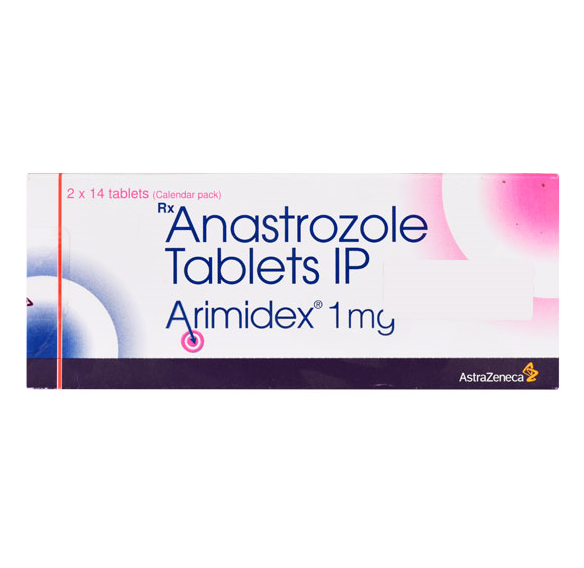
Anastrozole 1mg Film-Coated Tablets — Non-Steroidal Aromatase Inhibitor for HR-Positive Early and Advanced Breast Cancer in Postmenopausal Women
Supplied only against a valid prescription from a registered medical practitioner.
Sourced from authorised channels
Temperature-controlled packing
Hospitals, clinics, pharmacies
Delhi drug licence holder
Arimidex® (Anastrozole) — Gold Standard Non-Steroidal Aromatase Inhibitor for HR-Positive Breast Cancer
The Most Widely Prescribed Aromatase Inhibitor — First-Choice Upfront Adjuvant Endocrine Therapy for Postmenopausal HR-Positive Early Breast Cancer
Arimidex® (Anastrozole) is a selective, non-steroidal aromatase inhibitor that potently and reversibly inhibits the aromatase enzyme (CYP19A1) — suppressing the conversion of adrenal androgens (androstenedione, testosterone) to estrogens (estrone, estradiol) in peripheral tissues, thereby reducing circulating estrogen levels by >80-90% in postmenopausal women. By profoundly suppressing estrogen production — the primary growth driver for hormone receptor-positive (HR+) breast cancer cells — Anastrozole deprives ER-positive breast cancer cells of their essential mitogenic stimulus, inhibiting cancer cell proliferation and inducing apoptosis.
Anastrozole is the most widely prescribed aromatase inhibitor globally — recommended as the preferred upfront adjuvant endocrine therapy for postmenopausal women with HR-positive early breast cancer by major international guidelines including ESMO, ASCO, and the St Gallen Consensus — based on the landmark ATAC trial demonstrating superior disease-free survival vs Tamoxifen with a significantly more favourable tolerability profile (no endometrial cancer risk, no thromboembolic risk). Anastrozole is also the standard first-line endocrine therapy partner for CDK4/6 inhibitors (Palbace/Palbociclib, Kryxana/Ribociclib, Ramiven/Abemaciclib) in postmenopausal HR-positive HER2-negative metastatic breast cancer.
A.K. Pharma is a trusted medicine distributor in Delhi supplying genuine Arimidex (Anastrozole) to hospitals, oncology centres, breast cancer clinics, and pharmacies across India. Manufactured by AstraZeneca, Arimidex has been in clinical use for over three decades — with one of the most extensive evidence bases of any endocrine therapy in breast oncology.
What is Arimidex (Anastrozole)?
Arimidex contains Anastrozole — a triazole derivative that acts as a selective, competitive, reversible inhibitor of aromatase (CYP19A1) — the cytochrome P450 enzyme that catalyses the final and rate-limiting step in estrogen biosynthesis: conversion of androgens to estrogens.
Why Aromatase Inhibition Is the Preferred Approach in Postmenopausal Women:
In premenopausal women, the ovaries are the dominant source of circulating estrogens — driven by the HPG axis (GnRH → LH/FSH → ovarian estrogen synthesis). Aromatase inhibitors alone are ineffective in premenopausal women because GnRH-driven ovarian estrogen synthesis overwhelms peripheral aromatase inhibition and compensatory gonadotrophin rises further stimulate ovarian production.
In postmenopausal women, ovarian estrogen production has ceased. Circulating estrogen comes entirely from peripheral aromatisation — conversion of adrenal androgens to estrogens in adipose tissue, muscle, liver, and breast tissue (including tumour tissue itself) by aromatase. Inhibiting this peripheral aromatase completely suppresses circulating estrogen in postmenopausal women — making AIs far more effective than Tamoxifen (which blocks ER but does not reduce estrogen levels) in this setting.
Non-Steroidal vs Steroidal Aromatase Inhibitor — Key Distinction:
Anastrozole is a non-steroidal (type II) AI — it binds reversibly to the haem group of aromatase through coordinate covalent bonding, competitively preventing substrate (androstenedione) access to the enzyme active site. This reversible inhibition means aromatase activity recovers when Anastrozole levels fall.
This distinguishes Anastrozole from Aromasin (Exemestane) — a steroidal (type I) aromatase inactivator that irreversibly destroys aromatase through covalent mechanism-based inhibition. Both achieve profound estrogen suppression (>80%), but the mechanistic distinction has clinical implications:
Full prescribing information is available at the FDA label for Anastrozole.
Clinical Studies and Evidence
ATAC Trial (Anastrozole vs Tamoxifen — Landmark Upfront Adjuvant Comparison) Published in The Lancet (2002) with long-term follow-up — the pivotal ATAC (Arimidex, Tamoxifen, Alone or in Combination) trial was a Phase 3 randomised controlled trial of 9,366 postmenopausal women with early breast cancer — comparing Anastrozole 1mg/day vs Tamoxifen 20mg/day vs combination for 5 years adjuvant therapy. Key results at 10-year follow-up in HR-positive patients:
ABCSG 8 and ARNO 95 Trials (Sequential Anastrozole After Tamoxifen) These trials demonstrated that switching to Anastrozole after 2 years of Tamoxifen significantly improved event-free survival vs continuing Tamoxifen — confirming the sequential AI strategy as superior to 5 years of Tamoxifen alone.
ARIBRO and MA.17 Trials (Extended Adjuvant Anastrozole Beyond 5 Years) Extended adjuvant Anastrozole (years 6-10) after completing 5 years of adjuvant endocrine therapy demonstrated continued reduction in recurrence risk — particularly in node-positive patients — supporting extended therapy in high-risk patients.
Anastrozole as First-Line Metastatic Breast Cancer Multiple Phase 3 trials (0027 and 0030 trials published in Journal of Clinical Oncology (2001)) demonstrated Anastrozole achieved significantly longer time to progression and significantly better tolerability vs Megestrol Acetate in second-line hormone-sensitive metastatic breast cancer — with comparable activity to Tamoxifen as first-line metastatic therapy — establishing Anastrozole as the preferred endocrine monotherapy for HR-positive metastatic breast cancer.
Anastrozole as CDK4/6 Inhibitor Partner: The MONALEESA-2 trial (Ribociclib + Letrozole — a structurally similar non-steroidal AI) and PALOMA-2 trial (Palbociclib + Letrozole) established the principle of CDK4/6 inhibitor + non-steroidal AI as the standard first-line regimen for postmenopausal HR-positive HER2-negative metastatic breast cancer. Anastrozole is clinically interchangeable with Letrozole as the NSAI partner for CDK4/6 inhibitors — used in the MONARCH 3 trial (Abemaciclib + Anastrozole or Letrozole) which demonstrated OS benefit.
Available Strengths
Arimidex is available as:
| Presentation | Dose | Standard Daily Dose |
|---|---|---|
| Arimidex 1mg Film-Coated Tablets | 1mg per tablet | 1mg once daily |
Standard dose: 1mg orally once daily — taken with or without food at the same time each day.
Simple single-tablet once-daily oral dosing — one of the simplest dosing regimens in breast cancer endocrine therapy.
Indications — What Arimidex is Used For
Adjuvant Treatment — Early HR-Positive Breast Cancer (Postmenopausal):
Adjuvant Treatment — Premenopausal Women With OFS:
Advanced and Metastatic HR-Positive Breast Cancer:
Combination With CDK4/6 Inhibitors (Metastatic):
For detailed indication information refer to MedlinePlus Anastrozole.
Key Benefits of Arimidex
Superior to Tamoxifen — The Preferred Upfront Adjuvant Endocrine Therapy The ATAC trial demonstrates Anastrozole provides significantly better disease-free survival, time to recurrence, and distant recurrence vs Tamoxifen in postmenopausal HR-positive early breast cancer — with dramatically better tolerability (no endometrial cancer, no DVT/PE risk, no vaginal bleeding). These combined efficacy and safety advantages make Anastrozole the preferred first-choice upfront adjuvant therapy per ESMO, ASCO, and St Gallen guidelines.
Eliminates Tamoxifen’s Serious Adverse Effects Tamoxifen’s most serious long-term adverse effects — endometrial cancer (0.8% with Tamoxifen vs 0.2% with Anastrozole) and thromboembolic events (DVT, PE) — are eliminated with Anastrozole. For patients with risk factors for endometrial pathology or VTE, this safety advantage is clinically decisive.
Standard Partner for CDK4/6 Inhibitors in First-Line Metastatic Breast Cancer Anastrozole is one of the two standard NSAI partners (alongside Letrozole) for all three approved CDK4/6 inhibitors in first-line postmenopausal HR-positive HER2-negative metastatic breast cancer. A.K. Pharma supplies Anastrozole alongside Palbace, Kryxana, and Ramiven (Abemaciclib) — enabling complete first-line combination regimen procurement from one supplier.
Three Decades of Clinical Evidence — The Most Studied AI With over 30 years of clinical use and an evidence base spanning tens of thousands of patients across dozens of randomised trials, Anastrozole has the most comprehensive safety and efficacy characterisation of any aromatase inhibitor. This historical depth provides confidence in long-term management decisions.
Simple Once-Daily Oral Tablet — No Food Restrictions, No Monitoring Complexity One tablet once daily — with or without food — no dose titration, no pharmacodynamic monitoring, no cardiac monitoring requirements. This simplicity maximises adherence in the adjuvant setting where 5 years of continuous therapy is essential for maximum benefit.
Cost-Effective — Generic Anastrozole Available Anastrozole has been off-patent for many years — generic versions are widely available in India at highly accessible pricing. This cost-effectiveness is critical for a medicine requiring 5 years of continuous daily use in the adjuvant setting.
How Arimidex Works — Reversible Aromatase Inhibition
The Aromatase Enzyme and Peripheral Estrogen Biosynthesis:
In postmenopausal women — the sole source of circulating estrogen is peripheral aromatisation of adrenal androgens:
Adrenal cortex → androstenedione and testosterone → distributed to peripheral tissues (adipose tissue, muscle, liver, breast) → aromatase (CYP19A1) catalyses aromatisation → estrone and estradiol → circulate to ER-positive breast cancer cells → ER activation → cancer cell growth
Aromatase Reaction — Three Sequential Oxidations: Aromatase catalyses the conversion of the A-ring of androgen substrates (androstenedione, testosterone) from a non-aromatic to an aromatic ring — releasing the C-19 methyl group as formate — through three sequential CYP450-mediated monooxygenase reactions requiring NADPH and O₂. The final aromatisation creates the characteristic phenolic A-ring of estrogens.
Anastrozole’s Inhibition Mechanism:
Step 1 — Haem Iron Coordination: Anastrozole’s triazole nitrogen atoms form coordinate covalent bonds with the haem iron (Fe³⁺) in the CYP19A1 active site — preventing NADPH-driven electron transfer and blocking the oxidative reactions required for aromatisation.
Step 2 — Competitive Substrate Exclusion: Anastrozole binding to the haem iron sterically prevents the androgen substrate from properly orienting in the active site — competitive inhibition blocks substrate access. Ki approximately 15 nM — potent inhibition at clinically achieved plasma concentrations.
Step 3 — Reversible Inhibition: Unlike Exemestane (mechanism-based irreversible inactivation), Anastrozole’s coordinate bonds are reversible — aromatase activity returns as Anastrozole is cleared from the body. However at steady-state dosing, plasma levels remain sufficient for continuous >80% aromatase inhibition throughout the dosing interval.
Step 4 — Estrogen Suppression: With aromatase inhibited, androgen → estrogen conversion in peripheral tissues falls dramatically → plasma estrone and estradiol fall >80-90% below baseline postmenopausal levels → ER-positive breast cancer cells receive no estrogen signal → cell cycle arrest and eventual apoptosis.
Selectivity: Anastrozole is highly selective for aromatase — minimal significant inhibition of other CYP450 enzymes at therapeutic concentrations. This selectivity contributes to its favourable tolerability profile — no adrenal steroidogenesis suppression (unlike aminoglutethimide, the original aromatase inhibitor) and no significant corticosteroid effects.
For detailed mechanism overview refer to ESMO Breast Cancer Guidelines and ASCO Breast Cancer Treatment Guidelines.
Arimidex vs Aromasin — When to Use Which
| Feature | Arimidex (Anastrozole) | Aromasin (Exemestane) |
|---|---|---|
| Mechanism | Non-steroidal — reversible competitive inhibition | Steroidal — irreversible mechanism-based inactivation |
| Androgenic properties | ❌ None | ✅ Mild — from steroidal structure |
| Bone mineral density loss | Moderate | Slightly less (mild androgen benefit) |
| Upfront adjuvant (5 years) | ✅ First choice — ATAC trial | ✅ Yes — alternative |
| Sequential after Tamoxifen | ✅ Yes | ✅ Preferred — IES trial |
| Premenopausal + OFS | ✅ Yes (with Zoladex) | ✅ Preferred — TEXT/SOFT trial |
| Everolimus combination | ❌ No Level 1 data in post-NSAI setting | ✅ BOLERO-2 standard backbone |
| CDK4/6 inhibitor partner | ✅ Standard first-line with all three CDK4/6i | ✅ Yes (alternative to Anastrozole) |
| Food restriction | ❌ None — with or without food | ✅ Take after meals |
| Available at A.K. Pharma | Request Quote | Request Quote |
Dosage and Administration
All Indications — Standard Dose:
Duration:
Postmenopausal Status Confirmation — Critical: Anastrozole is ineffective as sole therapy in premenopausal women — active ovarian estrogen production overwhelms peripheral aromatase inhibition. Confirm postmenopausal status (FSH, LH, estradiol levels) before prescribing. For premenopausal patients — add GnRH agonist (Zoladex/Goserelin) for adequate ovarian suppression.
Bone Monitoring and Protection:
Full dosing guidelines available at Drugs.com Anastrozole Dosage.
Who Should Use Arimidex
Adjuvant Early Breast Cancer:
CDK4/6 Inhibitor Combination (Metastatic):
Endocrine Monotherapy (Metastatic):
Arimidex is prescribed by medical oncologists and breast cancer specialists. A.K. Pharma supplies Arimidex to hospitals, oncology centres, breast cancer clinics, and pharmacies across Delhi and India.
Possible Side Effects
Common side effects relate primarily to estrogen deprivation — the same mechanism that provides anti-cancer benefit:
Serious side effects:
Bone Mineral Density Loss and Fracture: The most clinically important long-term side effect — estrogen suppression causes progressive bone loss. ATAC trial reports higher fracture rate with Anastrozole vs Tamoxifen. Mandatory DEXA monitoring and calcium/Vitamin D supplementation. Consider bone-protective therapy in patients with low BMD.
Cardiovascular Effects: Mild increase in total cholesterol — monitor lipid profile periodically. The ATAC trial showed no significant increase in cardiac events with Anastrozole vs Tamoxifen — but long-term estrogen suppression warrants cardiovascular monitoring.
Embryo-Foetal Toxicity: Anastrozole can cause foetal harm — effective contraception required in perimenopausal women.
Full side effect information available at FDA Anastrozole Safety Information.
Precautions
Storage and Handling
As a responsible medicine distributor in Delhi, A.K. Pharma stores all medicines including Arimidex under manufacturer-recommended conditions ensuring product integrity for every supply.
Manufacturer Information
Arimidex (Anastrozole) is manufactured by AstraZeneca, a global biopharmaceutical company. Anastrozole received FDA approval in September 1995 for metastatic breast cancer — with subsequent approval for adjuvant early breast cancer following ATAC trial results. Generic Anastrozole is also widely available. A.K. Pharma supplies genuine Arimidex (originator brand) sourced from authorized AstraZeneca distributors.
Related Breast Cancer Medicines Available at A.K. Pharma
Frequently Asked Questions
Q. What is Arimidex used for? Arimidex (Anastrozole) is used as adjuvant endocrine therapy for postmenopausal women with HR-positive early breast cancer, as first-line treatment for postmenopausal HR-positive locally advanced or metastatic breast cancer — as monotherapy or in combination with CDK4/6 inhibitors — and as second-line treatment after Tamoxifen failure. More information at MedlinePlus.
Q. What is the generic name of Arimidex? Anastrozole. It is a non-steroidal, reversible aromatase inhibitor that suppresses estrogen production in postmenopausal women — manufactured by AstraZeneca. Generic Anastrozole is also widely available.
Q. How does Arimidex prevent breast cancer recurrence? HR-positive breast cancer cells depend on estrogen to grow and survive. In postmenopausal women, estrogen comes entirely from peripheral conversion of adrenal androgens by the aromatase enzyme. Anastrozole blocks this aromatase enzyme — reducing estrogen levels by over 80% — depriving ER-positive breast cancer cells of their essential growth stimulus and preventing recurrence.
Q. What is the ATAC trial and why does it matter? The ATAC trial compared Anastrozole vs Tamoxifen as upfront adjuvant endocrine therapy in 9,366 postmenopausal women with early breast cancer. Anastrozole showed significantly better disease-free survival, fewer distant recurrences, dramatically lower endometrial cancer rates (0.2% vs 0.8%), and fewer thromboembolic events. This trial established Anastrozole as the preferred upfront adjuvant endocrine therapy over Tamoxifen — a practice-changing result that transformed global breast cancer guidelines.
Q. Why should Arimidex not be used in premenopausal women? Anastrozole only works in postmenopausal women where peripheral aromatisation is the sole estrogen source. In premenopausal women, the ovaries produce estrogen through the HPG axis — aromatase inhibition cannot suppress this ovarian production, and the resulting loss of feedback causes compensatory gonadotrophin increases that further stimulate the ovaries. Premenopausal women requiring AI therapy must have their ovarian function suppressed first with a GnRH agonist such as Zoladex (Goserelin).
Q. How is Arimidex different from Aromasin (Exemestane)? Both are aromatase inhibitors but mechanistically distinct. Arimidex (Anastrozole) is a non-steroidal reversible inhibitor — standard first choice for upfront adjuvant therapy (ATAC) and first-line metastatic with CDK4/6 inhibitors. Aromasin (Exemestane) is a steroidal irreversible inactivator — preferred for sequential use after Tamoxifen (IES trial), the Everolimus combination (BOLERO-2), and in premenopausal patients receiving OFS (TEXT/SOFT trial).
Q. How long should Arimidex be taken? Standard adjuvant duration is 5 years. In high-risk node-positive patients, extended therapy beyond 5 years (to 10 years total) may be considered based on individual recurrence risk assessment. In metastatic breast cancer, continue until disease progression or unacceptable toxicity.
Q. Is Arimidex available in India? Arimidex can be supplied to hospitals, oncology centres, and pharmacies across India. Contact A.K. Pharma — medicine distributor in Delhi — for availability and pricing.
Q. What is the price of Arimidex in India? Arimidex 1mg price in India varies by pack size. Contact A.K. Pharma at 011 4172 6999 or WhatsApp +91 9810034827 for current pricing.
Q. How to order Arimidex from A.K. Pharma? Request a quote from this page, call 011 4172 6999, or WhatsApp +91 9810034827.
Q. Does A.K. Pharma supply Arimidex in bulk? Yes — in bulk to oncology centres, breast cancer clinics, hospitals, and pharmacies across Delhi and India. Contact us for bulk pricing.
Why Order Arimidex from A.K. Pharma?
Contact A.K. Pharma for Arimidex Supply 📍 E-2/257A, 2nd Floor, Shastri Nagar, New Delhi 110052 📞 011 4172 6999 📱 WhatsApp: +91 9810034827 🌐 akpharma.in