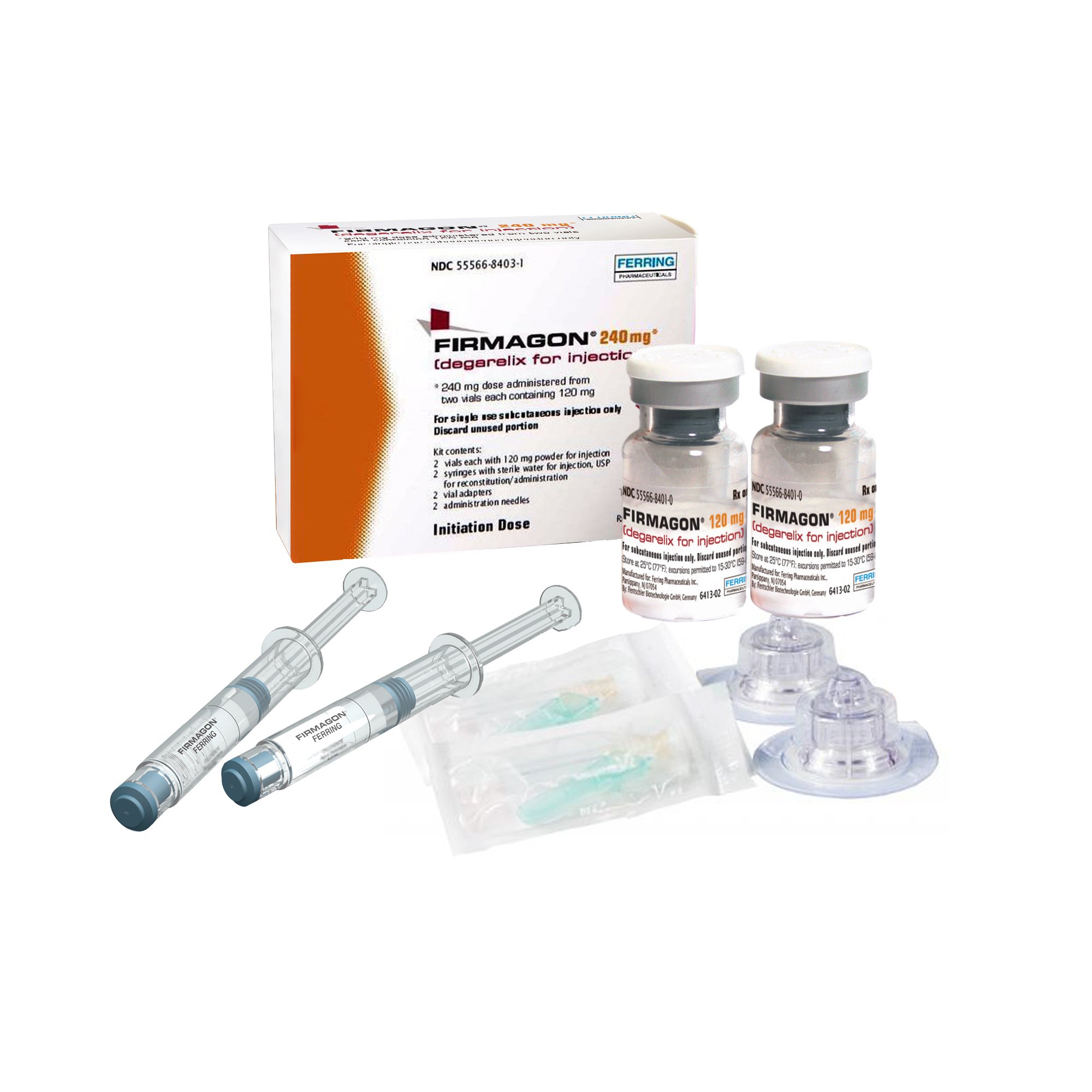
Degarelix 80mg, 120mg Injection — GnRH Receptor Antagonist for Advanced Hormone-Sensitive Prostate Cancer
Supplied only against a valid prescription from a registered medical practitioner.
Sourced from authorised channels
Temperature-controlled packing
Hospitals, clinics, pharmacies
Delhi drug licence holder
Firmagon® (Degarelix) — First-in-Class GnRH Antagonist for Prostate Cancer
Immediate Testosterone Suppression Without Testosterone Surge — Critical Advantage Over GnRH Agonists
Firmagon® (Degarelix) is a first-in-class gonadotropin-releasing hormone (GnRH) receptor antagonist used for androgen deprivation therapy (ADT) in men with advanced prostate cancer requiring testosterone suppression. Unlike GnRH agonists such as Zoladex (Goserelin) or Leuprolide — which cause an initial testosterone surge (flare) of 1-2 weeks before achieving suppression — Firmagon immediately and competitively blocks GnRH receptors in the pituitary gland, shutting down LH and FSH production within hours and achieving castration-level testosterone without any flare phenomenon.
This absence of testosterone flare is Firmagon’s most critical clinical advantage — making it the preferred androgen deprivation therapy in patients with symptomatic bone metastases, spinal cord compression, bladder outflow obstruction, or severe urinary symptoms where a testosterone surge could cause life-threatening clinical deterioration.
A.K. Pharma is a trusted medicine distributor in Delhi supplying genuine Firmagon (Degarelix) to hospitals, oncology centres, urology clinics, and pharmacies across India. Manufactured by Ferring Pharmaceuticals, Firmagon represents a significant advance in hormonal therapy for prostate cancer — offering both immediate testosterone suppression and potential cardiovascular advantages over GnRH agonist-based ADT.
What is Firmagon (Degarelix)?
Firmagon contains Degarelix — a synthetic decapeptide GnRH receptor antagonist. Unlike GnRH agonists which initially stimulate GnRH receptors before causing receptor downregulation and desensitisation, Degarelix directly and competitively blocks GnRH receptors in the anterior pituitary — immediately preventing GnRH from stimulating LH and FSH release.
The mechanism difference is clinically fundamental:
GnRH Agonists (Zoladex, Leuprolide):
Firmagon (GnRH Antagonist):
Full prescribing information is available at the FDA label for Degarelix.
Clinical Studies and Evidence
CS21 Trial (Degarelix vs Leuprolide in Prostate Cancer) Published in the Journal of Urology (2009), the pivotal CS21 trial — a Phase 3 randomised controlled trial involving 610 patients — compared Degarelix to Leuprolide (GnRH agonist) in patients with prostate cancer requiring ADT. Key findings:
CS21A Extension Study (Long-Term Degarelix Data) The CS21A extension study demonstrated sustained testosterone suppression and PSA control with continuous monthly Degarelix injections over 5 years — with a consistent safety profile supporting long-term use. PSA progression-free survival was maintained in a significant proportion of patients receiving continuous Degarelix.
Cardiovascular Safety — Meta-Analysis Evidence A landmark meta-analysis published in the European Heart Journal (2015) — pooling data from 6 randomised trials — demonstrated that Degarelix was associated with significantly fewer major adverse cardiovascular events (MACE) compared to GnRH agonists in patients with pre-existing cardiovascular disease. The hazard ratio for MACE was 0.44 (95% CI 0.26-0.74) favouring Degarelix. This cardiovascular advantage may be related to the avoidance of testosterone flare and the distinct hormonal profile with Degarelix.
PRONOUNCE Trial (Degarelix vs Leuprolide — Cardiovascular Outcomes) The PRONOUNCE trial — specifically designed to evaluate cardiovascular outcomes — compared Degarelix and Leuprolide in prostate cancer patients with pre-existing cardiovascular disease. While the trial was underpowered to show statistical significance, numerical trends supported fewer cardiovascular events with Degarelix — particularly in patients with established CVD — consistent with prior meta-analysis data.
RADICAL-PC Registry Data Real-world registry data from the RADICAL-PC programme confirmed Degarelix’s efficacy and tolerability in routine clinical practice — with consistent testosterone suppression and PSA control observed across diverse patient populations.
Available Strengths
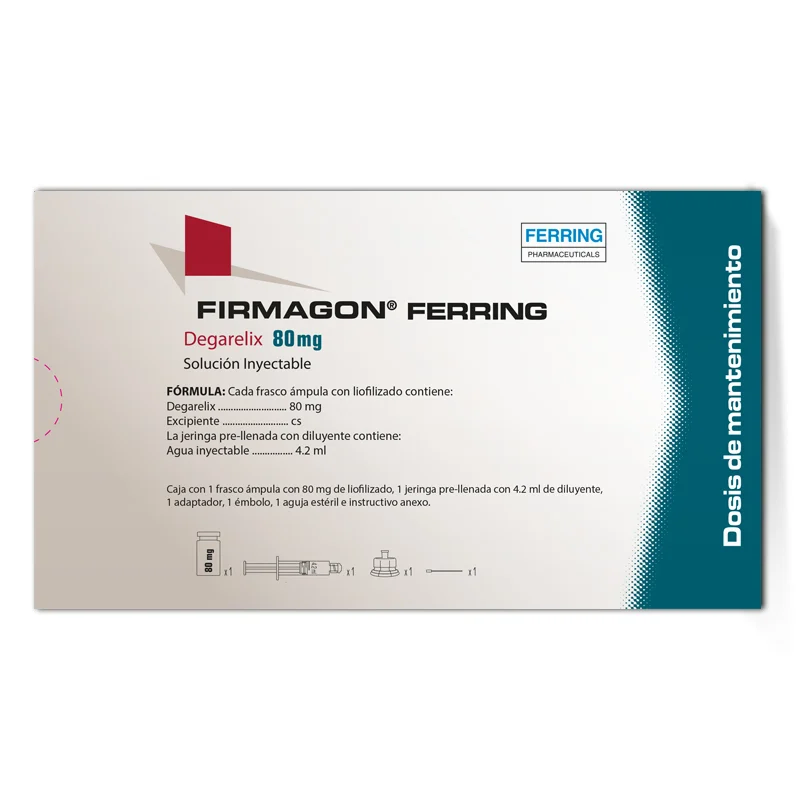
Firmagon is available in the following strengths:
| Presentation | Dose | Use |
|---|---|---|
| Firmagon 120mg | 2 × 120mg vials | Starting dose — Day 1 only |
| Firmagon 80mg | 1 × 80mg vial | Monthly maintenance dose |
Each vial contains lyophilised Degarelix powder — reconstituted with sterile water for injection immediately before subcutaneous administration into the abdominal region.
Important: The starting dose of Firmagon is 240mg — administered as two separate 120mg injections at two different abdominal sites simultaneously on day 1. Thereafter monthly 80mg maintenance doses are given as a single injection. This loading dose regimen ensures rapid achievement of castration-level testosterone from day 1.
Indications — What Firmagon is Used For
Primary Indication:
Specific Clinical Situations Where Firmagon is Strongly Preferred Over GnRH Agonists:
For detailed indication information refer to MedlinePlus Degarelix.
Key Benefits of Firmagon
No Testosterone Surge — The Most Important Advantage Firmagon’s most critical clinical benefit is the complete absence of testosterone flare — avoiding the potentially life-threatening clinical deterioration that can occur with GnRH agonist-induced testosterone surge in patients with bone metastases, spinal cord compression, or urinary obstruction. This makes Firmagon the standard of care for symptomatic advanced prostate cancer where flare cannot be tolerated.
Rapid Castration in 3 Days 97% of patients achieve castration-level testosterone (≤50 ng/dL) within 3 days of starting Firmagon — compared to 2-4 weeks with GnRH agonists. This rapid suppression is clinically valuable in patients who need urgent testosterone reduction.
Faster PSA Response Firmagon achieves significantly faster PSA reduction than GnRH agonists in the first month — with 64% PSA reduction by day 14 vs 18% with Leuprolide in the CS21 trial. Faster PSA response reflects more rapid androgen deprivation and may translate to faster symptom relief.
No Need for Antiandrogen Cover Unlike GnRH agonists which require 4 weeks of antiandrogen therapy (e.g. Bicalutamide) to cover the testosterone flare, Firmagon requires no antiandrogen cover — simplifying treatment, reducing polypharmacy, and avoiding antiandrogen side effects.
Stable Consistent Testosterone Suppression Firmagon maintains consistently low testosterone levels throughout the monthly dosing interval — without the testosterone escape or fluctuations that can occasionally occur with GnRH agonist implants.
Potential Cardiovascular Advantage Meta-analysis data suggests fewer MACE events with Degarelix vs GnRH agonists in patients with pre-existing cardiovascular disease — a clinically important consideration given the high cardiovascular risk in the prostate cancer population.
No Histamine Release Unlike some GnRH antagonists, Degarelix was specifically designed to minimise histamine-mediated reactions — making injection site reactions the main local side effect rather than systemic allergic reactions.
How Firmagon Works
The hypothalamic-pituitary-gonadal (HPG) axis controls testosterone production:
Firmagon works by:
Step 1 — Immediate GnRH Receptor Blockade: Degarelix binds competitively to GnRH receptors in the anterior pituitary with high affinity — directly blocking GnRH from binding. This is immediate and complete — unlike GnRH agonists which first stimulate these receptors before desensitising them.
Step 2 — Immediate LH and FSH Suppression: Without GnRH receptor activation, LH and FSH secretion drops rapidly — within hours of Degarelix administration. There is no initial LH/FSH surge.
Step 3 — Testosterone Falls to Castration Levels: Without LH stimulation, testicular Leydig cells stop producing testosterone — plasma testosterone falls to castration levels (≤50 ng/dL) within 3 days in 97% of patients.
Step 4 — Sustained Suppression with Monthly Dosing: Monthly 80mg maintenance injections maintain GnRH receptor blockade — sustaining castration-level testosterone suppression continuously without the fluctuations associated with GnRH agonist depot implants.
For a detailed mechanism overview refer to the European Association of Urology (EAU) Prostate Cancer Guidelines and American Urological Association (AUA) Advanced Prostate Cancer Guidelines.
Firmagon vs Zoladex — Key Comparison
| Feature | Firmagon (Degarelix) | Zoladex (Goserelin) |
|---|---|---|
| Mechanism | GnRH receptor antagonist | GnRH receptor agonist |
| Testosterone surge (flare) | ❌ No flare | ✅ Flare in ~80% patients |
| Antiandrogen cover needed | ❌ Not required | ✅ Required for 4 weeks |
| Time to castration | 3 days (97% of patients) | 2-4 weeks |
| PSA reduction at day 14 | 64% | 18% |
| Dosing | SC monthly | SC monthly or 3-monthly implant |
| Cardiovascular risk | Lower (meta-analysis) | Standard |
| Spinal metastases | ✅ Preferred | ⚠️ Flare risk |
| Urinary obstruction | ✅ Preferred | ⚠️ Flare risk |
| Available at A.K. Pharma | Request Quote | Request Quote |
Dosage and Administration
Starting Dose (Day 1 only):
Maintenance Dose (Monthly thereafter):
Administration Technique:
Monitoring:
Full dosing guidelines available at Drugs.com Degarelix Dosage.
Combination Therapy — Firmagon With Other Prostate Cancer Medicines
In metastatic hormone-sensitive prostate cancer (mHSPC) Firmagon is increasingly used as the ADT backbone in combination with:
In castration-resistant prostate cancer (mCRPC) patients initially started on Firmagon are continued on ADT while adding:
Who Should Use Firmagon
Firmagon is prescribed for:
Firmagon is prescribed by urologists, oncologists, and radiation oncologists. A.K. Pharma supplies Firmagon to hospitals, oncology centres, urology clinics, and pharmacies across Delhi and India.
Possible Side Effects
Common side effects: Injection site reactions are the most common side effect — occurring in approximately 40% of patients — including pain (28%), erythema (17%), swelling (6%), induration, and nodule formation. These are typically mild to moderate and transient — lasting days to weeks. They are less severe with maintenance 80mg doses than with the 240mg starting dose. Rotating injection sites and proper subcutaneous technique minimise reactions.
Systemic side effects related to testosterone suppression (shared with all ADT) include hot flushes (26%), weight gain, fatigue, decreased libido, erectile dysfunction, and gynaecomastia.
Serious side effects:
Full side effect information available at FDA Degarelix Safety Information.
Precautions
Storage and Handling
As a responsible medicine distributor in Delhi, A.K. Pharma stores all oncology medicines including Firmagon under manufacturer-recommended conditions ensuring product integrity for every supply to oncology centres and urology clinics.
Manufacturer Information
Firmagon (Degarelix) is manufactured by Ferring Pharmaceuticals, a privately held global biopharmaceutical company with a significant focus on urology and oncology. Degarelix received FDA approval in December 2008 for advanced prostate cancer — the first GnRH antagonist approved for this indication. A.K. Pharma supplies only genuine Firmagon sourced from authorized Ferring distributors.
Related Prostate Cancer and Oncology Medicines Available at A.K. Pharma
Frequently Asked Questions
Q. What is Firmagon used for? Firmagon (Degarelix) is used for androgen deprivation therapy in men with advanced prostate cancer requiring testosterone suppression. It is a GnRH receptor antagonist that immediately suppresses testosterone without the testosterone surge seen with GnRH agonists. More information available at MedlinePlus.
Q. What is the generic name of Firmagon? The generic name of Firmagon is Degarelix. It is a synthetic decapeptide GnRH receptor antagonist — the first in its class approved for prostate cancer.
Q. How is Firmagon different from Zoladex? Firmagon is a GnRH receptor antagonist while Zoladex is a GnRH receptor agonist. The key difference is that Firmagon immediately blocks testosterone production without any initial testosterone surge — while Zoladex causes a 1-2 week testosterone flare before achieving suppression. This makes Firmagon the preferred choice in patients with symptomatic metastases or urinary obstruction where testosterone flare could cause serious harm.
Q. Does Firmagon need antiandrogen cover like Zoladex? No — Firmagon does not require antiandrogen cover (Bicalutamide) because there is no testosterone flare. This simplifies treatment and eliminates antiandrogen-related side effects and costs.
Q. How quickly does Firmagon work? Firmagon achieves castration-level testosterone (≤50 ng/dL) in 97% of patients within 3 days — significantly faster than GnRH agonists which take 2-4 weeks. PSA reduction is also significantly faster — 64% PSA reduction by day 14 compared to 18% with Leuprolide.
Q. Is Firmagon better for patients with heart disease? Meta-analysis data suggests Degarelix is associated with significantly fewer major adverse cardiovascular events compared to GnRH agonists in patients with pre-existing cardiovascular disease — making Firmagon a preferred ADT option in this population according to evolving guideline recommendations.
Q. Is Firmagon available in India? Firmagon can be supplied to hospitals, oncology centres, and pharmacies across India through licensed pharmaceutical distributors. Contact A.K. Pharma — medicine distributor in Delhi — for availability and pricing.
Q. What is the price of Firmagon in India? Firmagon price in India varies by strength and pack size. Contact A.K. Pharma at 011 4172 6999 or WhatsApp +91 9810034827 for current pricing and bulk supply rates.
Q. How to order Firmagon from A.K. Pharma? You can request a quote directly from this page, call us at 011 4172 6999, or WhatsApp us at +91 9810034827 with your requirements and we will respond promptly.
Q. Does A.K. Pharma supply Firmagon in bulk? Yes. A.K. Pharma supplies Firmagon in bulk to oncology centres, urology clinics, hospitals, and pharmacies across Delhi and India. Contact us for bulk pricing and availability.
Why Order Firmagon from A.K. Pharma?
Contact A.K. Pharma for Firmagon Supply 📍 E-2/257A, 2nd Floor, Shastri Nagar, New Delhi 110052 📞 011 4172 6999 📱 WhatsApp: +91 9810034827 🌐 akpharma.in