
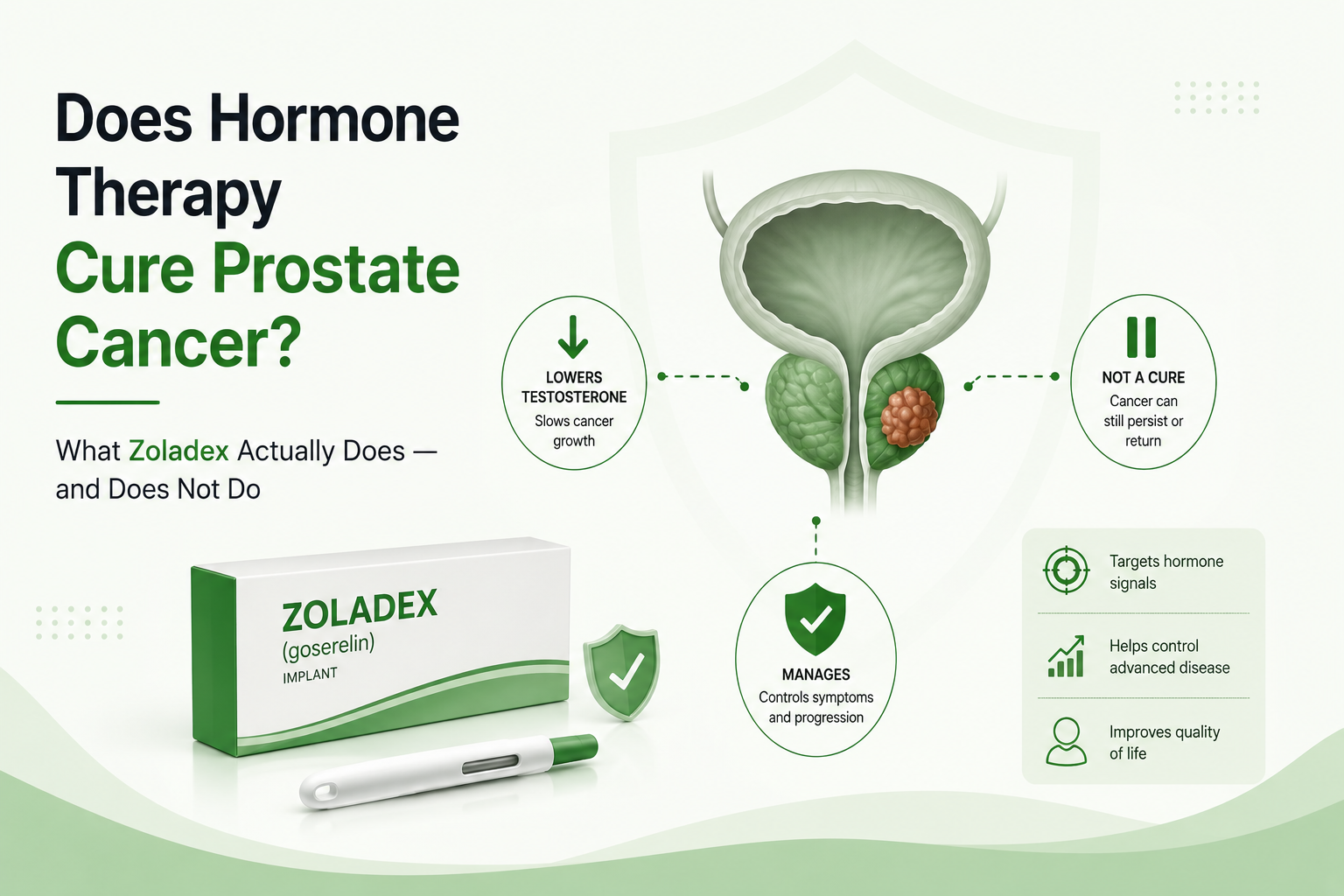
When a urologist or oncologist recommends Zoladex for prostate cancer, the word that tends to echo in the patient’s mind — and in the minds of their family — is the word they did not hear. The doctor explained what Zoladex does. They explained how it works, what to expect, what the side effects might be. What they did not say, usually, is the word “cure.”
That absence tends to generate a question that patients are sometimes afraid to ask directly: if this medicine is not a cure, what exactly is it doing?
This article answers that question plainly. No medical jargon, no false reassurance, no alarm either. Just an honest explanation of what hormone therapy for prostate cancer — specifically Zoladex (Goserelin) — actually does, what it achieves, and what it does not.
What Is Zoladex and How Does It Work?
Zoladex (Goserelin Acetate) is a GnRH agonist — a medicine that suppresses testosterone production in men by desensitising the pituitary gland to the hormonal signals that normally trigger it, until testosterone falls to castrate level. Most prostate cancer cells are hormone-sensitive — they use testosterone as a growth signal. Remove that signal and they lose their primary driver of growth and replication.
Zoladex is a small biodegradable implant injected subcutaneously into the abdominal wall once every 28 days (3.6mg) or every 12 weeks (10.8mg). It dissolves slowly, releasing Goserelin steadily throughout the dosing period.
Full clinical background on how GnRH agonists work is available from the National Cancer Institute and the FDA prescribing information for Goserelin.
So Does It Cure Prostate Cancer?
The direct answer is: in most cases, no — not as a standalone treatment, and not in the sense of permanently eliminating the cancer.
What Zoladex does — and what hormone therapy broadly achieves in prostate cancer — is control. It controls the cancer’s growth by removing the hormonal environment it depends on. That control can be extraordinarily effective, sometimes for years, producing significant measurable responses — PSA falling, tumours shrinking, symptoms improving. But control is not the same as cure.
Hormone-Sensitive vs Castration-Resistant Prostate Cancer
When prostate cancer is first treated with ADT, the vast majority of cases respond — sometimes dramatically. PSA levels fall, sometimes to undetectable levels. Tumours shrink on imaging. Symptoms like bone pain improve. This response can last for months or years.
But over time, a proportion of cells develop the ability to grow even in a low-testosterone environment — through mechanisms including androgen receptor amplification, activating mutations, or internal androgen synthesis. When this happens, the cancer is said to have become castration-resistant.
This is not a failure of the medicine in the conventional sense. It is a biological evolution that occurs in a significant proportion of men on long-term ADT. It is why oncologists monitor PSA regularly — because a rising PSA in the presence of confirmed castrate testosterone is the signal that this transition may be occurring.
When castration resistance develops, treatment options include newer hormonal agents, chemotherapy, PARP inhibitors for BRCA-mutated disease, and radioligand therapies. See NCCN Prostate Cancer Treatment Guidelines and the American Cancer Society guide on castration-resistant prostate cancer for current management options.
When Hormone Therapy IS Part of a Curative Strategy
For men with localised or locally advanced prostate cancer being treated with radical radiotherapy, hormone therapy including Zoladex is frequently used alongside radiation — and in this combined setting, the overall strategy has genuinely curative intent.
ADT serves several purposes in this context: downsizing the tumour before radiation, addressing potential micrometastatic disease, and sensitising cancer cells to radiation. Multiple large randomised trials have demonstrated that adding ADT to radiotherapy significantly improves long-term survival in men with locally advanced prostate cancer compared to radiotherapy alone.
The European Association of Urology (EAU) prostate cancer guidelines provide the most comprehensive current evidence review for this combined approach.
The key distinction is context. Zoladex as the sole treatment for metastatic prostate cancer is a disease control strategy. Zoladex as part of a combined approach in localised or locally advanced disease can be part of a strategy with curative intent.
For hospitals managing broader oncology caseloads, related medicines available through A.K. Pharma include:
- Bdenza (Enzalutamide) — for castration-resistant prostate cancer
- Firmagon (Degarelix) — GnRH antagonist, avoids the testosterone flare
- Andocur (Cyproterone Acetate) — anti-androgen for flare cover and combination ADT
What “Controlled” Actually Means in Practice
For men with metastatic prostate cancer, the honest framing of hormone therapy is disease control, not cure. But effective disease control can mean years of good quality of life — PSA remaining low, bone pain resolving, energy levels recovering, and normal daily activities continuing. The cancer is present but controlled.
The addition of newer agents to standard ADT — including Enzalutamide and Abiraterone at the time of initiating ADT in metastatic hormone-sensitive disease — has further extended effective disease control, with multiple large trials demonstrating significant improvements in overall survival. Discussing these combination options with the treating oncologist is increasingly important for men in India being treated for metastatic hormone-sensitive prostate cancer.
The SOFT and TEXT trial results published in the NEJM provide the landmark evidence base for combination endocrine therapy in hormone-sensitive cancers.
The Side Effects Are Real — and Worth Talking About
A frank discussion of what Zoladex does and does not achieve has to include the side effects, because the consequences of castrate testosterone levels are significant and affect quality of life in ways that matter enormously to patients.
- Hot flashes — experienced by the majority of men on long-term ADT, can be frequent and disruptive to sleep
- Sexual function — reduced libido and erectile dysfunction are almost universal; frequently under-discussed in clinical consultations
- Fatigue — can affect the ability to maintain previous levels of physical activity, work performance, and social engagement
- Mood and cognition — depression, emotional lability, and changes in memory and concentration are documented and worth raising with the treating team
- Bone mineral density loss — prolonged testosterone suppression increases osteoporosis and fracture risk; monitoring and supplementation are standard considerations
- Metabolic changes — weight gain, elevated blood sugar, and increased cardiovascular risk associated with long-term ADT
Complete ADT side effect management guidance is available from the American Urological Association and the American Society for Bone and Mineral Research (ASBMR) for bone health guidance during long-term ADT.
The Questions Worth Asking Your Oncologist
For patients reading this before their next oncology appointment, here are the questions that often go unasked but are worth raising:
- Is my cancer hormone-sensitive, and how will we know if it stops being sensitive to hormone therapy?
- Is my treatment intent curative (with radiotherapy) or disease control (for metastatic disease)?
- Should I be receiving any additional treatment alongside Zoladex — an anti-androgen, Enzalutamide, or Abiraterone?
- How often will PSA and testosterone be monitored, and what PSA level would prompt a change in my treatment plan?
- What is available if and when castration resistance develops?
- What can be done to protect my bone health and manage other side effects during treatment?
For patients who want to read more before their appointment, the Prostate Cancer Foundation patient guide on hormone therapy is an excellent plain-language resource. MedlinePlus also provides a detailed Goserelin patient information sheet.
Frequently Asked Questions
Q. Does Zoladex cure prostate cancer?
In most cases, no — not as a standalone treatment. Zoladex controls hormone-sensitive prostate cancer by suppressing testosterone, removing the primary growth signal the cancer cells depend on. This control can be very effective for months or years but is not the same as cure. The exception is when Zoladex is used as part of a combined approach with radical radiotherapy in localised or locally advanced disease — in this setting, the overall treatment strategy has curative intent.
Q. How long does Zoladex need to be taken for prostate cancer?
Duration varies entirely by stage and nature of the disease and is determined by the treating urologist or oncologist. For locally advanced prostate cancer treated with radiotherapy, ADT may be prescribed for 6 months to 3 years depending on the protocol. For metastatic hormone-sensitive prostate cancer, long-term continuous ADT is often the standard approach. There is no universal answer — the treating physician sets the duration based on individual disease characteristics and response.
Q. What happens when prostate cancer stops responding to Zoladex?
When prostate cancer develops the ability to grow despite castrate testosterone levels — a stage called castration-resistant prostate cancer (CRPC) — additional treatment options are available. These include newer hormonal agents like Enzalutamide and Abiraterone, chemotherapy, bone-targeting agents, PARP inhibitors for BRCA-mutated disease, and radioligand therapies. The treating oncologist will discuss these options based on the individual patient’s situation.
Q. What is the testosterone flare and how is it managed?
In the first 1-2 weeks of Zoladex treatment, testosterone temporarily spikes before falling to castrate levels. In men with advanced prostate cancer this can temporarily worsen symptoms — bone pain, urinary symptoms — and in rare cases cause serious complications. Anti-androgen medicines like Bicalutamide or Cyproterone Acetate are commonly prescribed for the first few weeks to cover this flare period. The treating urologist or oncologist will advise whether flare cover is appropriate for each patient.
Q. Can the side effects of Zoladex be managed?
Yes — many side effects of long-term ADT are manageable with appropriate monitoring and supportive measures. Hot flashes can be managed with lifestyle measures and in some cases medication. Bone mineral density loss can be monitored with DEXA scanning and addressed with calcium, vitamin D, and in some cases bisphosphonates or Denosumab. Metabolic changes can be partly offset by maintaining physical activity and healthy diet. Sexual function changes are more difficult to manage during active ADT but should be discussed openly with the treating team.
Q. What is the difference between Zoladex and Firmagon for prostate cancer?
Both are used for androgen deprivation in prostate cancer but work through different mechanisms. Zoladex is a GnRH agonist that causes an initial testosterone flare before suppressing it. Firmagon (Degarelix) is a GnRH antagonist that suppresses testosterone immediately without the initial flare — making it preferable in patients where the flare poses a clinical risk. Treatment selection is always made by the treating physician based on the individual patient.
Q. Is Zoladex used for any conditions other than prostate cancer?
Yes — Zoladex is also indicated for hormone receptor-positive breast cancer in pre-menopausal women (as part of ovarian function suppression), endometriosis, uterine fibroids, endometrial thinning before ablation surgery, and in some cases central precocious puberty. All uses are determined by the treating specialist per the approved prescribing information.
Q. What is the difference between Zoladex 3.6mg and Zoladex 10.8mg?
Both contain the same active ingredient Goserelin Acetate — the difference is the dosing interval. The 3.6mg formulation is injected every 28 days and is approved across all Zoladex indications. The 10.8mg formulation is injected every 12 weeks (3 months) and is specifically approved for prostate cancer only — it is not approved for breast cancer, endometriosis, or other gynaecological indications. The 3-monthly depot reduces clinic visit frequency for men on long-term ADT.
Q. How is Zoladex given and can patients self-administer it?
Zoladex is a biodegradable implant injected subcutaneously into the anterior abdominal wall using a preloaded single-use device. It is administered by a qualified healthcare professional — it is not suitable for self-administration at home. Patients attend a clinic or hospital for each injection appointment.
Q. Where can hospitals in India source genuine Zoladex?
Zoladex is an AstraZeneca originator product available through licensed specialty pharmaceutical distributors in India. A.K. Pharma is a licensed medicine distributor in Delhi supplying genuine Zoladex 3.6mg and 10.8mg to hospitals and oncology centres across India with complete batch documentation and authorised sourcing. Contact A.K. Pharma at 011 4172 6999 or WhatsApp +91 9810034827.
Where to Source Genuine Zoladex in India
Zoladex is an AstraZeneca originator product imported into India. A.K. Pharma is a licensed medicine distributor in Delhi and pharmaceutical distributor in Delhi supplying genuine Zoladex — both the 3.6mg and 10.8mg formulations — to hospitals, oncology centres, and gynaecology clinics across India, with complete batch documentation sourced from authorised channels.
For hospitals requiring consistent Zoladex supply, contact A.K. Pharma at 011 4172 6999 or WhatsApp +91 9810034827. Related hormone therapy medicines available at A.K. Pharma:
- Zoladex (Goserelin) — 3.6mg and 10.8mg formulations
- Luprodex (Leuprolide Acetate) — alternative GnRH agonist, 3-monthly depot
- Andocur (Cyproterone Acetate) — anti-androgen for flare cover and combination ADT
- Bdenza (Enzalutamide) — for castration-resistant prostate cancer
- Firmagon (Degarelix) — GnRH antagonist, avoids the testosterone flare
- Arimidex (Anastrozole) — aromatase inhibitor for breast cancer OFS combination
- Browse all Cancer Medicines at A.K. Pharma
- Browse all Hormone Medicines at A.K. Pharma
- Patient Assistance Program — for eligible patients
- Named Patient Program — for medicines requiring special import access
Disclaimer: This article is intended for general informational purposes only and does not constitute medical or clinical advice. All decisions about prostate cancer treatment — including whether to use hormone therapy, what to combine it with, and for how long — should be made by a qualified urologist or oncologist. A.K. Pharma is a licensed medicine distributor and does not provide clinical guidance.