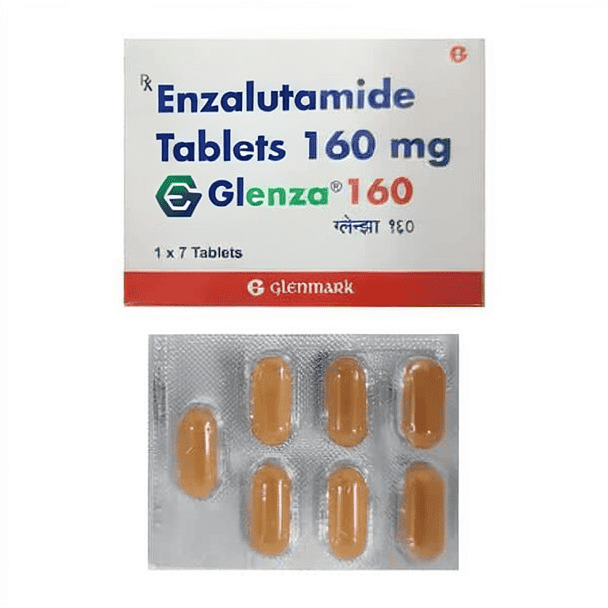
Enzalutamide 40mg, 160mg Capsules — Androgen Receptor Signalling Inhibitor for Metastatic Castration-Resistant Prostate Cancer, Metastatic Hormone-Sensitive Prostate Cancer and Non-Metastatic Castration-Resistant Prostate Cancer
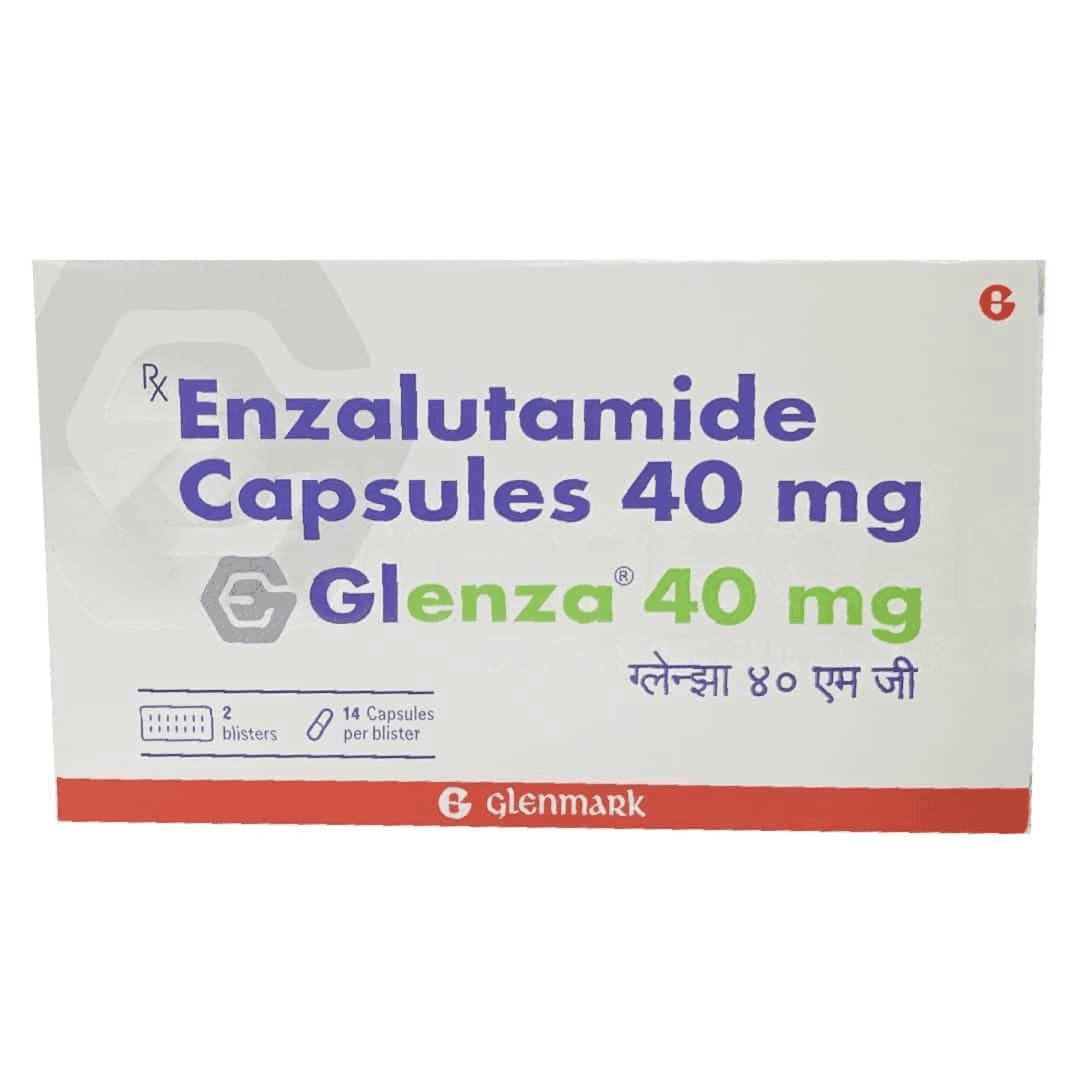
Glenza® (Enzalutamide) — Next-Generation Androgen Receptor Inhibitor for Prostate Cancer
The Most Broadly Approved ARSI — Proven Survival Benefit Across the Full Prostate Cancer Continuum
Glenza® (Enzalutamide) is a potent next-generation androgen receptor signalling inhibitor (ARSI) that inhibits multiple critical steps in the androgen receptor (AR) signalling pathway — competitively blocking androgen binding to AR, inhibiting AR nuclear translocation, and preventing AR-DNA binding and transcriptional activation. Unlike first-generation antiandrogens (Bicalutamide, Flutamide) which act only as competitive AR antagonists and can exhibit partial agonist activity in castration-resistant settings, Enzalutamide provides comprehensive AR pathway inhibition across all three key AR signalling steps — delivering more complete androgen receptor blockade with no reported agonist activity.
Glenza is approved for the broadest range of prostate cancer settings of any ARSI — metastatic castration-resistant prostate cancer (mCRPC) in both chemotherapy-naive and post-Docetaxel settings, metastatic hormone-sensitive prostate cancer (mHSPC) in combination with ADT, and non-metastatic castration-resistant prostate cancer (nmCRPC) with high PSA doubling time — making it the most versatile androgen receptor inhibitor available and an essential medicine across the entire prostate cancer treatment continuum.
A.K. Pharma is a trusted medicine distributor in Delhi supplying genuine Glenza (Enzalutamide) in both 40mg and 160mg capsule strengths to hospitals, oncology centres, urology clinics, and pharmacies across India. Glenza contains Enzalutamide — the same active ingredient as the originator Xtandi — available at accessible pricing for Indian patients requiring ARSI therapy.
What is Glenza (Enzalutamide)?
Glenza contains Enzalutamide — a diarylthiohydantoin small molecule that acts as a pure androgen receptor antagonist with inhibitory activity at multiple points in the AR signalling cascade.
Why AR Signalling Inhibition Beyond Simple Competitive Blockade Is Critical:
In hormone-sensitive prostate cancer, testosterone drives AR activation → prostate cancer cell growth. Standard ADT (castration) reduces testosterone to castration levels — initially controlling disease. However, prostate cancer cells develop mechanisms to reactivate AR signalling despite castration:
Enzalutamide was specifically engineered to overcome these resistance mechanisms — with 5-8x greater AR binding affinity than Bicalutamide, no agonist activity, and inhibition of downstream AR signalling steps beyond simple competitive binding.
Enzalutamide’s Three-Step AR Inhibition:
Full prescribing information is available at the FDA label for Enzalutamide.
Clinical Studies and Evidence
AFFIRM Trial (Enzalutamide Post-Docetaxel mCRPC) Published in the New England Journal of Medicine (2012), the landmark AFFIRM trial enrolled 1,199 patients with mCRPC who had progressed after Docetaxel chemotherapy — comparing Enzalutamide vs placebo. Key results:
PREVAIL Trial (Enzalutamide Chemotherapy-Naive mCRPC) Published in the New England Journal of Medicine (2014), the PREVAIL trial enrolled 1,717 asymptomatic or mildly symptomatic chemotherapy-naive mCRPC patients — comparing Enzalutamide vs placebo. Key results at updated analysis:
ARCHES Trial (Enzalutamide + ADT in Metastatic Hormone-Sensitive Prostate Cancer) Published in the Journal of Clinical Oncology (2019) with updated OS data, the ARCHES trial enrolled 1,150 patients with mHSPC — comparing Enzalutamide + ADT vs placebo + ADT. Key results at OS analysis:
ENZAMET Trial (Enzalutamide + ADT in mHSPC — Including Docetaxel-Eligible) Published in the New England Journal of Medicine (2019) with OS update published in The Lancet Oncology (2023), the ENZAMET trial demonstrated:
PROSPER Trial (Enzalutamide in Non-Metastatic CRPC) Published in the New England Journal of Medicine (2018), the PROSPER trial enrolled 1,401 patients with nmCRPC and PSA doubling time ≤10 months — comparing Enzalutamide vs placebo + ongoing ADT. Key results:
Available Strengths
Glenza is available in the following presentations:
| Presentation | Dose Per Capsule | Standard Daily Dose | Capsules Per Day |
|---|---|---|---|
| Glenza 40mg Capsules | 40mg | 160mg once daily | 4 capsules |
| Glenza 160mg Capsules | 160mg | 160mg once daily | 1 capsule |
Standard dose: 160mg orally once daily — with or without food.
Both strengths are available from A.K. Pharma — the 160mg capsule provides a convenient single-capsule daily dose while the 40mg capsules provide flexibility for dose reductions (120mg = three 40mg capsules; 80mg = two 40mg capsules).
Indications — What Glenza is Used For
Metastatic Castration-Resistant Prostate Cancer (mCRPC):
Metastatic Hormone-Sensitive Prostate Cancer (mHSPC):
Non-Metastatic Castration-Resistant Prostate Cancer (nmCRPC):
For detailed indication information refer to MedlinePlus Enzalutamide.
Key Benefits of Glenza
Three-Step AR Pathway Inhibition — No Partial Agonism Unlike first-generation antiandrogens that can exhibit partial agonist activity in the CRPC setting (driving tumour growth rather than inhibiting it), Enzalutamide is a pure antagonist at all AR signalling steps — no agonism even in the context of AR amplification, AR mutations, or low androgen environments. This pure antagonist profile is essential in the CRPC setting where first-generation antiandrogens fail.
Proven OS Benefit Across Three Major Prostate Cancer Settings Enzalutamide demonstrates significant overall survival benefit in mCRPC post-chemotherapy (AFFIRM), chemotherapy-naive mCRPC (PREVAIL), mHSPC (ARCHES/ENZAMET), and nmCRPC (PROSPER) — OS benefit across four major prostate cancer trial settings is unique among ARSIs.
Dramatic Metastasis-Free Survival Improvement in nmCRPC The PROSPER trial demonstrates a 21.9-month improvement in median MFS in nmCRPC — nearly tripling the MFS from 14.7 to 36.6 months. For patients with rising PSA on ADT without visible metastases, Enzalutamide provides the most robust delay in metastatic progression of any approved therapy.
No Corticosteroid Requirement Unlike Abirapro (Abiraterone) which requires mandatory Prednisone co-administration to prevent mineralocorticoid excess, Enzalutamide does not require routine corticosteroid co-administration — simplifying treatment, reducing polypharmacy, and avoiding corticosteroid-related side effects.
No Food Restriction Enzalutamide can be taken with or without food — eliminating the strict empty stomach requirement of Abiraterone and reducing the risk of dosing errors.
Convenient Once-Daily Oral Dosing Once-daily oral capsule therapy — 1 capsule (160mg) or 4 capsules (4 × 40mg) per day — maintains patient independence and quality of life without the need for regular clinical visits for parenteral therapy.
Single-Capsule 160mg Formulation Available The 160mg single capsule formulation provides the complete daily dose in one capsule — dramatically improving convenience and adherence compared to the four-capsule 40mg dosing.
How Glenza Works — Androgen Receptor Signalling in Prostate Cancer
Normal AR Signalling in Prostate Cells:
CRPC — How Prostate Cancer Escapes ADT:
Enzalutamide’s Mechanism:
Step 1 — Competitive AR Binding: Enzalutamide binds to the androgen-binding domain of AR with 5-8x higher affinity than Bicalutamide — competitively blocking testosterone and DHT from binding. Pure antagonist — no partial agonism even in the context of AR amplification or overexpression.
Step 2 — Nuclear Translocation Inhibition: Enzalutamide-bound AR cannot undergo the conformational changes required for nuclear localisation signal exposure — AR remains sequestered in the cytoplasm by heat shock proteins — preventing nuclear entry and transcriptional activity.
Step 3 — DNA Binding Inhibition: If any AR reaches the nucleus despite step 2 inhibition — Enzalutamide prevents AR from binding to androgen response elements — blocking transcription of AR target genes driving proliferation and survival.
Step 4 — Downstream Effects: Without AR-driven transcription:
For detailed mechanism overview refer to EAU Prostate Cancer Guidelines and NCCN Prostate Cancer Guidelines.
Glenza vs Abirapro — Key Comparison in Prostate Cancer
| Feature | Glenza (Enzalutamide) | Abirapro (Abiraterone) |
|---|---|---|
| Mechanism | AR signalling inhibitor — 3-step AR blockade | CYP17A1 inhibitor — blocks androgen synthesis |
| Target | Androgen receptor | Androgen biosynthesis enzyme |
| Corticosteroid required | ❌ Not required | ✅ Prednisone mandatory |
| Food restriction | ❌ With or without food | ✅ Empty stomach required |
| mCRPC (pre and post-chemo) | ✅ Approved | ✅ Approved |
| mHSPC | ✅ Approved (ARCHES, ENZAMET) | ✅ Approved (LATITUDE) |
| nmCRPC | ✅ Approved (PROSPER) | ❌ Not approved |
| LFT monitoring | Less intensive | ✅ Monthly mandatory |
| Seizure risk | Low (history of seizures — caution) | Low |
| Cross-resistance after progression | Partial — Abiraterone has reduced activity | Partial — Enzalutamide has reduced activity |
| Available at A.K. Pharma | Request Quote | Request Quote |
Dosage and Administration
All Indications — Standard Dose:
Dose Reduction for Toxicity:
Duration:
Missed Dose:
Monitoring:
Full dosing guidelines available at Drugs.com Enzalutamide Dosage.
Treatment Sequencing — Glenza in the Prostate Cancer Treatment Algorithm
Newly Diagnosed mHSPC (High-Risk or High-Volume):
nmCRPC (Rising PSA on ADT, PSA DT ≤10 months, No Metastases on Imaging):
mCRPC (First-Line — Pre-Chemotherapy):
mCRPC (Post-Docetaxel):
After Glenza Progression in mCRPC:
Who Should Use Glenza
Glenza is prescribed for:
Glenza is prescribed by urologists, medical oncologists, and radiation oncologists. A.K. Pharma supplies Glenza to hospitals, oncology centres, urology clinics, and pharmacies across Delhi and India.
Possible Side Effects
Common side effects include fatigue (51%), back pain (29%), decreased appetite (19%), constipation (23%), arthralgia (20%), diarrhoea (17%), hot flushes (20%), upper respiratory tract infection (11%), hypertension (14%), and peripheral oedema (15%).
Serious side effects include:
Seizures: Seizures occurred in 0.9% of patients in AFFIRM — Enzalutamide lowers the seizure threshold. Do not use in patients with history of seizure, predisposing factors for seizure, or concomitant medications that lower seizure threshold. Permanently discontinue if seizure occurs during treatment.
Posterior Reversible Encephalopathy Syndrome (PRES): Rare cases reported — confirm with MRI if suspected; permanently discontinue.
Cardiovascular Events: Ischaemic heart disease and ischaemic cerebrovascular events — monitor cardiovascular risk factors throughout treatment. ADT + ARSI combination increases overall cardiovascular risk.
Falls and Fractures: Increased risk of falls (4.6%) and fractures (8.8%) — particularly in elderly patients and those with pre-existing bone loss from long-term ADT. Monitor bone mineral density and consider bone-protective therapy.
Embryo-Foetal Toxicity: Enzalutamide can cause foetal harm — relevant for male patients with female partners of reproductive potential — effective contraception required.
Full side effect information available at FDA Enzalutamide Safety Information.
Precautions
Storage and Handling
As a responsible medicine distributor in Delhi, A.K. Pharma stores all oncology medicines including Glenza under manufacturer-recommended conditions ensuring product integrity for every supply.
Manufacturer Information
Glenza (Enzalutamide) contains the same active ingredient as the originator Xtandi — originally developed by Medivation Inc (now Pfizer) and Astellas Pharma. Enzalutamide received FDA approval in August 2012 for post-chemotherapy mCRPC — with subsequent approvals for pre-chemotherapy mCRPC (2014), nmCRPC (2018), and mHSPC (2019). A.K. Pharma supplies only genuine Glenza sourced from authorised distributors.
Related Prostate Cancer Medicines Available at A.K. Pharma
Frequently Asked Questions
Q. What is Glenza used for? Glenza (Enzalutamide) is used to treat metastatic castration-resistant prostate cancer (mCRPC) — both pre and post-chemotherapy — metastatic hormone-sensitive prostate cancer (mHSPC) in combination with ADT, and non-metastatic castration-resistant prostate cancer (nmCRPC) with high PSA doubling time risk. More information available at MedlinePlus.
Q. What is the generic name of Glenza? The generic name of Glenza is Enzalutamide. It is a next-generation androgen receptor signalling inhibitor (ARSI) — the same active ingredient as the originator Xtandi.
Q. How is Glenza different from Abirapro (Abiraterone)? Glenza (Enzalutamide) inhibits the androgen receptor — blocking AR at three steps. Abirapro (Abiraterone) inhibits CYP17A1 — blocking androgen synthesis. Key practical differences: Glenza does not require corticosteroids or food restrictions while Abiraterone requires mandatory Prednisone and empty stomach dosing. Both have similar OS efficacy in mCRPC and mHSPC. Glenza is additionally approved for nmCRPC.
Q. What strengths of Glenza are available? A.K. Pharma supplies both 40mg and 160mg capsule strengths. The standard daily dose is 160mg — one 160mg capsule or four 40mg capsules once daily. The 40mg capsules enable dose reductions to 120mg (three capsules) or 80mg (two capsules) for toxicity management.
Q. Does Glenza cause seizures? Enzalutamide has been associated with seizures in approximately 0.9% of patients — it lowers the seizure threshold. Glenza is contraindicated in patients with a history of seizures or significant predisposing factors. Permanently discontinue if a seizure occurs during treatment. Careful benefit-risk assessment is required in patients at risk.
Q. Can Glenza be used for hormone-sensitive prostate cancer? Yes — Glenza + ADT is approved for metastatic hormone-sensitive prostate cancer based on the ARCHES and ENZAMET trials which demonstrated significant OS benefit — 34% reduction in risk of death. It is one of the standard of care options for mHSPC alongside Abiraterone + Prednisone + ADT.
Q. Is Glenza available in India? Glenza can be supplied to hospitals, oncology centres, and pharmacies across India through licensed pharmaceutical distributors. Contact A.K. Pharma — medicine distributor in Delhi — for availability and pricing.
Q. What is the price of Glenza in India? Glenza price in India varies by strength and pack size. Contact A.K. Pharma at 011 4172 6999 or WhatsApp +91 9810034827 for current pricing and bulk supply rates.
Q. How to order Glenza from A.K. Pharma? You can request a quote directly from this page, call us at 011 4172 6999, or WhatsApp us at +91 9810034827 with your requirements and we will respond promptly.
Q. Does A.K. Pharma supply Glenza in bulk? Yes. A.K. Pharma supplies Glenza in bulk to oncology centres, urology clinics, hospitals, and pharmacies across Delhi and India. Contact us for bulk pricing and availability.
Why Order Glenza from A.K. Pharma?
Contact A.K. Pharma for Glenza Supply 📍 E-2/257A, 2nd Floor, Shastri Nagar, New Delhi 110052 📞 011 4172 6999 📱 WhatsApp: +91 9810034827 🌐 akpharma.in