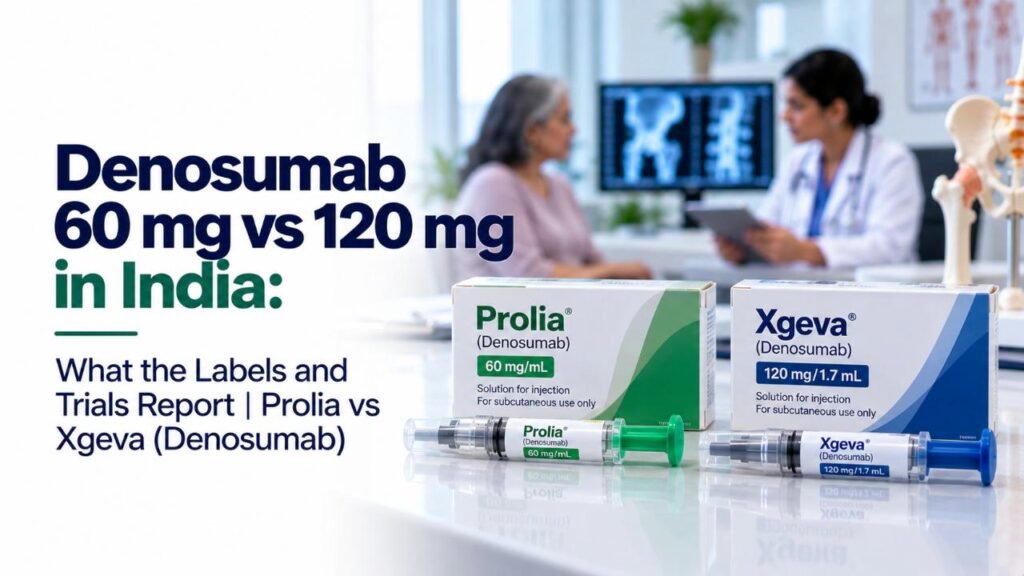
Denosumab 60 mg vs 120 mg is a comparison hospital pharmacies run into often, because the same medicine is stocked in two very different forms under two different brand names. The 60 mg product (sold as Prolia) and the 120 mg product (sold as Xgeva) contain the same antibody, yet their approved uses, labelled schedules and safety warnings are not the same. This guide sets out what the US prescribing information and the published trials report for each strength, why the two are not swapped for one another, and what that means for procurement teams in India.
In one line: according to the US labels, denosumab 60 mg is an osteoporosis and bone-loss product, while denosumab 120 mg is an oncology product for bone complications of cancer. The labels state that a patient receiving one should not receive the other.
1. Same Molecule, Two Products: The Short Answer
Both products contain denosumab, a fully human IgG2 monoclonal antibody. What separates them is the dose, how often the label says it is given, who it is approved for and what outcome it was tested against.
- Denosumab 60 mg (Prolia): according to the US label, given once every 6 months. It is approved for osteoporosis and for bone loss linked to certain hormone therapies for cancer.
- Denosumab 120 mg (Xgeva): according to the US label, given once every 4 weeks. It is approved to prevent skeletal-related events (SREs) in patients with multiple myeloma or bone metastases from solid tumours. It is also approved for giant cell tumour of bone and for hypercalcaemia of malignancy that has not responded to bisphosphonates.
Because the name on the vial or syringe is the same molecule, mix-ups are a real procurement risk. A quick check of strength and brand on every order prevents most of them.
2. How Denosumab Works
Denosumab binds RANK ligand (RANKL), a protein that osteoclasts need in order to form, work and survive. Osteoclasts are the cells that break down bone. With RANKL blocked, bone resorption falls.
The same mechanism serves two very different clinical goals:
- In osteoporosis, the aim reported in the trials is to slow age-related or hormone-related bone loss and lower fracture risk.
- In cancer that has spread to bone, tumour cells drive excess RANKL activity, which destroys bone. The Xgeva label describes increased osteoclast activity as a mediator of bone pathology in solid tumours with bone metastases. The aim in the trials was to delay fractures, spinal cord compression and the need for radiation or surgery to bone.
3. Denosumab 60 mg vs 120 mg at a Glance
The table below summarises the two US labels: the Prolia prescribing information (2024) and the Xgeva prescribing information. Indian labels for individual brands may differ, so check the pack insert of the product you stock.
| Feature | Denosumab 60 mg | Denosumab 120 mg |
|---|---|---|
| Originator brand | Prolia (Amgen) | Xgeva (Amgen) |
| Labelled interval (US label) | Every 6 months | Every 4 weeks |
| Presentation (US) | 60 mg/mL prefilled syringe | 120 mg/1.7 mL single-dose vial |
| Therapy area | Osteoporosis and treatment-related bone loss | Oncology: bone metastases, myeloma, giant cell tumour, hypercalcaemia of malignancy |
| Pivotal comparison | Placebo (FREEDOM trial) | Zoledronic acid (three phase 3 trials) |
| Boxed warning (US) | Yes: severe hypocalcaemia in advanced chronic kidney disease (added 2024) | No boxed warning; severe hypocalcaemia is a listed warning |
| Usual prescribers | Endocrinology, orthopaedics, rheumatology, geriatrics | Medical oncology, haemato-oncology, orthopaedic oncology |
One way to see the scale of the denosumab 60 mg vs 120 mg difference: at the labelled schedules, a year of the 60 mg product is two injections, or 120 mg in total. A year of the 120 mg product is about 13 injections, or roughly 1,560 mg. That is about 13 times more drug per year.
4. Denosumab 60 mg (Prolia): What the Label Covers
According to the 2024 US label, Prolia is indicated for treatment:
- of postmenopausal women with osteoporosis at high risk for fracture;
- to increase bone mass in men with osteoporosis at high risk for fracture;
- of glucocorticoid-induced osteoporosis in men and women at high risk for fracture;
- to increase bone mass in men at high risk for fracture receiving androgen deprivation therapy for nonmetastatic prostate cancer;
- to increase bone mass in women at high risk for fracture receiving adjuvant aromatase inhibitor therapy for breast cancer.
What the FREEDOM trial reported
The pivotal FREEDOM trial (Cummings et al., NEJM 2009) randomised postmenopausal women with osteoporosis to denosumab 60 mg or placebo every 6 months for 36 months.
| Outcome at 36 months | Denosumab 60 mg | Placebo | Reported relative reduction |
|---|---|---|---|
| New vertebral fracture | 2.3% | 7.2% | 68% |
| Hip fracture | 0.7% | 1.2% | 40% |
| Non-vertebral fracture | 6.5% | 8.0% | 20% |
In the 10-year FREEDOM extension (Bone et al., Lancet Diabetes & Endocrinology 2017), women who stayed on denosumab showed continued bone mineral density gains. At the lumbar spine the gain was 21.7% from the original baseline. The authors reported low rates of adverse events.
5. Denosumab 120 mg (Xgeva): What the Label Covers
According to the US label, Xgeva is indicated for:
- prevention of skeletal-related events in patients with multiple myeloma and in patients with bone metastases from solid tumours;
- treatment of adults and skeletally mature adolescents with giant cell tumour of bone that is unresectable or where surgical resection is likely to result in severe morbidity;
- treatment of hypercalcaemia of malignancy refractory to bisphosphonate therapy.
What the head-to-head trials reported
The 120 mg strength was tested against zoledronic acid, an active comparator, rather than placebo.
| Trial population | Reported result for time to first SRE | Source |
|---|---|---|
| Breast cancer with bone metastases | Superior to zoledronic acid (HR 0.82) | Stopeck et al., JCO 2010 |
| Castration-resistant prostate cancer with bone metastases | Median 20.7 vs 17.1 months; superior (HR 0.82) | Fizazi et al., Lancet 2011 |
| Other solid tumours or multiple myeloma | Non-inferior, trending towards superiority | Henry et al., JCO 2011 |
| Integrated analysis of all three trials | First SRE delayed by a median 8.21 months; 17% risk reduction | Lipton et al., EJC 2012 |
These trials measured skeletal outcomes. They were not designed to show an effect on overall survival, so claims that the 120 mg product “improves survival” go beyond what these results report.
6. Why the Dose and Schedule Differ
The denosumab 60 mg vs 120 mg split exists because the two settings need very different levels of bone suppression.
- Osteoporosis: the goal is to bring bone turnover back towards normal over years. The FREEDOM data show that a 60 mg dose twice a year was enough to cut vertebral fractures sharply compared with placebo.
- Bone metastases: the tumour drives continuous, aggressive bone destruction. The oncology programme tested a much higher, more frequent exposure against zoledronic acid, which itself is given far more often in cancer than in osteoporosis.
The higher exposure brings a different safety profile. That is why the labels carry different warnings, discussed in Section 8. Neither label supports using the oncology strength for osteoporosis, or the osteoporosis strength to prevent SREs in cancer.
7. Why the Two Strengths Are Not Interchangeable
Both US labels state the point directly. The Prolia label says it “contains the same active ingredient (denosumab) found in Xgeva” and that “patients receiving Prolia should not receive Xgeva.” The Xgeva label carries the matching statement.
What this means for hospital pharmacies
- Check that each prescription names both the strength (60 mg or 120 mg) and the brand or product, not just “denosumab”.
- Store the two products in clearly separated, labelled locations in the cold room or refrigerator.
- Flag patients on one product in the dispensing system, so a second denosumab product is not issued from a different department. An oncology patient may also see an endocrinologist, for example.
- Do not treat the 120 mg vial and the 60 mg syringe as different “pack sizes” of the same item. They are separate products with separate approvals.
Common mix-ups to watch for
- An order for “denosumab injection” with no strength specified.
- Requests from oncology clinics for the 60 mg product. Some patients on hormone therapy for non-metastatic breast or prostate cancer do appear in the 60 mg label, so the indication needs to be confirmed with the prescriber, not assumed.
- Substitution between an originator and a biosimilar of a different strength (see Section 10).
8. Safety: What Each Label Highlights
Both products share class warnings, but the labels report them at different frequencies and with different emphasis.
| Safety topic | Denosumab 60 mg (Prolia label) | Denosumab 120 mg (Xgeva label) |
|---|---|---|
| Hypocalcaemia | Boxed warning (2024) for severe hypocalcaemia in patients with advanced chronic kidney disease (eGFR <30), including those on dialysis | Severe hypocalcaemia in 3.1% vs 1.3% with zoledronic acid in the pooled trials; fatal cases reported |
| Osteonecrosis of the jaw (ONJ) | Reported in the osteoporosis trial programme | Confirmed in 1.8% vs 1.3% with zoledronic acid; label reports a higher incidence with longer exposure |
| Atypical femoral fractures | Reported | Reported; risk increased with longer treatment |
| Multiple vertebral fractures after stopping | Reported (see Section 9) | Reported following discontinuation |
| Other label warnings | Serious infections, dermatologic reactions, suppression of bone turnover | Hypercalcaemia after stopping in giant cell tumour and in growing skeletons |
| Pregnancy | Contraindicated | Can cause fetal harm |
The boxed warning was announced in a 2024 FDA Drug Safety Communication. In the FDA’s review, 8.7% of patients with severe hypocalcaemia on Prolia developed seizures or cardiac arrhythmias within 30 days, and 3.3% died. For ONJ with the 120 mg product, the label reports incidences, adjusted per 100 patient-years, of 1.1% in the first year, 3.7% in the second year and 4.6% per year after that. This is why the label describes dental examination before and during treatment.
9. What the Label Says About Stopping Denosumab
Unlike bisphosphonates, which bind to bone, denosumab’s effect wears off once dosing stops. Both labels warn about multiple vertebral fractures after discontinuation.
The Prolia label reports the following from the phase 3 postmenopausal osteoporosis trial:
- 6% of women who stopped Prolia and stayed in the study developed new vertebral fractures.
- 3% developed multiple new vertebral fractures.
- Multiple fractures appeared a mean 17 months after the last injection, with a range of 7 to 43 months.
- A prior vertebral fracture predicted multiple fractures after stopping.
The label states that if Prolia is discontinued, patients should be transitioned to another antiresorptive agent. For a distributor, this has a practical side: interrupted supply of the 60 mg product is not a minor inconvenience. Hospitals running osteoporosis programmes usually plan stock around the 6-month cycle so that doses are not delayed.
10. Biosimilars: Why They Come in Pairs
The 60 mg and 120 mg split carries through to biosimilars. When a company develops a denosumab biosimilar, it usually seeks approval for both strengths, under two separate brand names.
- United States: in March 2024 the FDA approved the first interchangeable denosumab biosimilars: Jubbonti, referencing Prolia, and Wyost, referencing Xgeva. In 2025 several more pairs followed, each with a 60 mg brand and a 120 mg brand, as GaBI Online reported.
- India: CDSCO’s list of r-DNA approvals (January 2020 to November 2024) includes several denosumab approvals:
- a 60 mg/mL prefilled syringe from Enzene Biosciences for postmenopausal osteoporosis (July 2021), with further osteoporosis indications added in April 2023;
- a 70 mg/mL vial from Intas for the oncology indications (August 2021);
- a product from Reliance Life Sciences for postmenopausal osteoporosis (December 2022).
For procurement, the rule from Section 7 applies to biosimilars too: a 60 mg biosimilar matches the 60 mg originator’s indications, not the 120 mg one’s. Our explainer on the difference between a biosimilar and a generic covers how substitution decisions are usually made in hospital formularies.
11. Sourcing Denosumab in India: A Checklist for Hospitals and Pharmacies
- Specify strength and brand on every order: for example Prolia 60 mg, Xgeva 120 mg, or Denorange.
- Cold chain: denosumab products are stored refrigerated at 2–8°C in the original carton and must not be frozen. Ask your distributor how temperature is maintained in transit and on receipt.
- Documentation: request invoices, batch numbers and import or marketing authorisation details. Our guide on verifying imported cancer medicines lists the checks that apply to the 120 mg oncology product.
- Prescription: supply is only against a valid prescription from a registered medical practitioner.
- Plan around the cycle: 60 mg programmes run on a 6-month cycle and 120 mg on a 4-week cycle, so forecast quantities accordingly.
Hospitals managing broader bone-health caseloads can also explore the bone health range, including anabolic agents such as Evenity (romosozumab) and Forteo (teriparatide). Oncology centres can browse the full oncology range.
12. Key Takeaways
- Denosumab 60 mg vs 120 mg comes down to this: both contain the same antibody, but the US labels treat them as two distinct products with different indications, schedules and warnings.
- The 60 mg product’s evidence comes from placebo-controlled osteoporosis trials led by FREEDOM. The 120 mg product’s evidence comes from trials against zoledronic acid in cancer with bone metastases.
- The labels state that a patient on one should not receive the other, which is why it helps when every prescription and stock order names both strength and brand.
- The 60 mg product carries a 2024 US boxed warning for severe hypocalcaemia in advanced CKD. ONJ incidence with the 120 mg product rises with longer exposure.
- Stopping the 60 mg product is linked to multiple vertebral fractures. The label describes moving to another antiresorptive, which makes continuity of supply important.
- Biosimilars follow the same two-strength split, both in the US and among CDSCO approvals in India.
What is the difference between denosumab 60 mg and 120 mg?
Both contain the same antibody, denosumab, but the US labels treat them as separate products. Denosumab 60 mg (Prolia) is labelled for osteoporosis and certain treatment-related bone loss, given every 6 months. Denosumab 120 mg (Xgeva) is labelled for bone complications of cancer, giant cell tumour of bone and hypercalcaemia of malignancy, given every 4 weeks.
Are Prolia and Xgeva the same medicine?
They share the same active ingredient but are different products with different strengths, indications, schedules and warnings. Both US labels state that a patient receiving one should not receive the other.
What is denosumab 60 mg (Prolia) approved for?
According to the 2024 US label, Prolia is indicated for postmenopausal women with osteoporosis at high risk for fracture, men with osteoporosis, glucocorticoid-induced osteoporosis, and bone loss in men on androgen deprivation therapy for nonmetastatic prostate cancer or women on adjuvant aromatase inhibitors for breast cancer, where fracture risk is high.
What is denosumab 120 mg (Xgeva) approved for?
According to the US label, Xgeva is indicated to prevent skeletal-related events in multiple myeloma and bone metastases from solid tumours, to treat giant cell tumour of bone that is unresectable or where surgery would cause severe morbidity, and to treat hypercalcaemia of malignancy refractory to bisphosphonates.
Can denosumab 60 mg and 120 mg be used interchangeably?
No. The labels describe them as separate products and state that patients should not receive both. Indian procurement teams usually require every prescription and order to name both the strength and the brand. Any treatment decision rests with the treating physician.
What safety warnings do the labels list for denosumab?
The Prolia label carries a 2024 US boxed warning for severe hypocalcaemia in patients with advanced chronic kidney disease. Both labels list osteonecrosis of the jaw, atypical femoral fractures and multiple vertebral fractures after stopping. The Xgeva label reports higher rates of severe hypocalcaemia and ONJ than zoledronic acid in its trials, with ONJ incidence rising with longer exposure.
What does the Prolia label say about stopping treatment?
The label reports that in the phase 3 osteoporosis trial, 6% of women who stopped Prolia developed new vertebral fractures and 3% developed multiple new vertebral fractures, a mean 17 months after the last dose. It states that patients who discontinue should be transitioned to another antiresorptive agent.
Are denosumab biosimilars available in India?
CDSCO’s list of r-DNA approvals from January 2020 to November 2024 includes denosumab products from Enzene Biosciences and Reliance Life Sciences for osteoporosis, and from Intas for the oncology indications. In the US, biosimilars have also been approved in pairs, one referencing the 60 mg product and one referencing the 120 mg product.
How can hospitals source genuine denosumab in India?
Hospitals and pharmacies usually order from a licensed distributor, specify strength and brand, check cold-chain handling at 2 to 8 degrees Celsius, and ask for invoices and batch details. A.K. Pharma supplies denosumab products in bulk and wholesale quantities against a valid prescription.
Disclaimer
A.K. Pharma is a medicine distributor and not a healthcare provider. This article is for general information only. It summarises publicly available prescribing information and published trial data, and it is not medical advice. It does not recommend any medicine, dose or treatment. Decisions about whether, how and when to use any medicine rest solely with the treating physician, based on the approved label and the individual patient. Medicines are supplied only against a valid prescription.