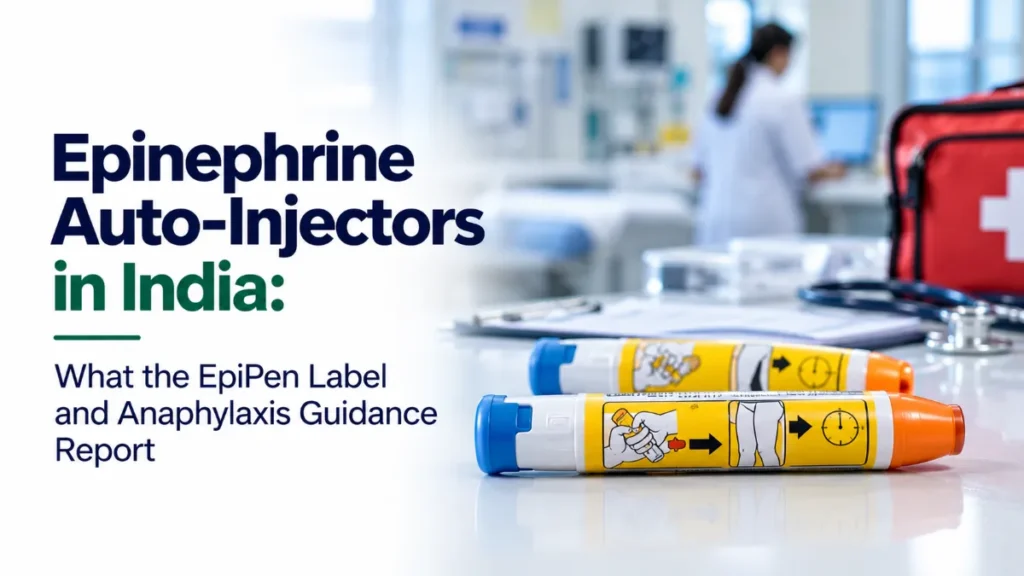
Epinephrine (adrenaline) auto-injectors such as EpiPen and EpiPen Jr are single-dose, pre-filled devices that deliver a fixed dose of epinephrine into the outer thigh. Several recent items bear on how they are discussed: the US prescribing information for EpiPen and EpiPen Jr was revised in March 2026; an international expert panel published consensus recommendations on epinephrine use and emergency-services activation in community settings in December 2025; World Allergy Organization (WAO) publications continue to document that auto-injectors are unavailable in many countries; and an Indian allergy specialist wrote in April 2026 that auto-injectors are not routinely stocked in Indian pharmacies. This article summarises what those sources and the label state, for hospital pharmacists, emergency and allergy departments, institutions and procurement teams.
A.K. Pharma, a medicine distributor in Delhi and pharmaceutical distributor in Delhi, supplies imported hospital and emergency medicines to healthcare institutions across India. We are not clinicians, and we do not advise on who should carry or use an epinephrine device, or when. What follows is reporting on published sources, with the originals linked throughout.
1. Why Epinephrine Auto-Injectors Are in the Conversation Again
The table below places the main guideline, regulatory and availability items in sequence. Older guidance is included as background; the December 2025 consensus report and the March 2026 label revision are the recent updates.
1.1 Timeline of Key Sources
| Date | Event | Source |
|---|---|---|
| Oct 2020 | WAO publishes its Anaphylaxis Guidance 2020 | WAO / PMC |
| 2020 | AAAAI practice parameter update on anaphylaxis, with systematic review and GRADE analysis | AAAAI |
| May 2021 | Resuscitation Council UK publishes guidelines on emergency treatment of anaphylaxis for healthcare providers | Resuscitation Council UK |
| Oct 2023 | WAO publishes a survey-based paper on global disparities in availability of epinephrine auto-injectors | WAO Journal |
| 9 Aug 2024 | US FDA approves neffy, the first epinephrine nasal spray for anaphylaxis | FDA |
| 10 Dec 2025 | International consensus report on epinephrine use and EMS activation in community settings published in the Journal of Allergy and Clinical Immunology | JACI / Cincinnati Children’s |
| Mar 2026 | US prescribing information for EpiPen and EpiPen Jr revised; the “Recent Major Changes” box lists section 2.2 (administration information) | FDA label |
| Apr 2026 | A paediatric pulmonologist and allergy specialist publishes an article stating that commercially available auto-injectors are not routinely available in India | Dr Ankit Parakh |
Framing note: dates are as reported by the cited sources. We have not compared the March 2026 label line by line against earlier versions; the label itself identifies only section 2.2 as changed.
2. What EpiPen and EpiPen Jr Are
According to the US prescribing information (revised 3/2026), EpiPen and EpiPen Jr are single-dose epinephrine auto-injectors and are combination products containing drug and device components. Each device is single-use and delivers the entire dose on activation. The label lists Viatris Specialty LLC as distributor and Mylan Laboratories Limited, Bangalore, India as manufacturer.
2.1 Presentations as Described in the Label
| Presentation | Strength | Weight band stated in the label | Pack described in the label |
|---|---|---|---|
| EpiPen | 0.3 mg (0.3 mg/0.3 mL) | 30 kg or greater | 2 single-dose auto-injectors and 1 trainer |
| EpiPen Jr | 0.15 mg (0.15 mg/0.3 mL) | 15 kg to less than 30 kg | 2 single-dose auto-injectors and 1 trainer |
The label states that because the doses delivered are fixed, other forms of injectable epinephrine are used if doses lower than 0.15 mg are deemed necessary, and that safety and effectiveness have not been established in paediatric patients who weigh less than 15 kg.
2.2 Composition
Each 0.3 mL contains epinephrine with edetate disodium, sodium chloride, sodium citrate, sodium metabisulfite, hydrochloric acid to adjust pH, and Water for Injection; the stated pH range is 2.2 to 5.0. The label notes that epinephrine solution deteriorates rapidly on exposure to air or light, turning pink from oxidation and brown from the formation of melanin.
2.3 Mechanism as Described in the Label
The label states that epinephrine acts on both alpha- and beta-adrenergic receptors. Through alpha-adrenergic action it lessens the vasodilation and increased vascular permeability that occur during anaphylaxis; through beta-adrenergic action it causes bronchial smooth muscle relaxation and helps alleviate bronchospasm, wheezing and dyspnoea. It also states that epinephrine alleviates pruritus, urticaria and angioedema, and that onset is rapid and duration short when given subcutaneously or intramuscularly.
3. What the Current US Label States
The label is a US document and is not the Indian prescribing information; Indian users should refer to the approved labelling supplied with the product they receive.
3.1 Indication as Worded in the Label
EpiPen and EpiPen Jr are indicated for the emergency treatment of type I allergic reactions, including anaphylaxis, in adult and paediatric patients who weigh 15 kg or greater. The label lists no contraindications.
3.2 Administration and Dosing Statements
- The label states that the product is administered intramuscularly or subcutaneously into the anterolateral aspect of the thigh, through clothing if necessary, and that it is not to be injected intravenously or into the buttocks, digits, hands or feet.
- In its instructions, the user twists off the safety cap, firmly pushes the orange tip against the outer thigh and holds it in place for 3 seconds.
- If there is no clinical improvement or symptoms worsen after the initial treatment, the label states that a second dose may be given with a new device starting 5 minutes after the first, and that more than two sequential doses should be administered under direct medical supervision.
- The label states that it is recommended that patients are prescribed, and have immediate access to, two devices at all times, and that patients be advised when to seek emergency medical assistance.
Dosing and patient selection are matters for the prescriber and the approved prescribing information; this article reports the label’s wording and does not replace it.
4. What Anaphylaxis Guidance Documents Say About Epinephrine
Three guidance documents are widely cited in this area. The table reports selected statements from each.
4.1 Selected Statements
| Source | Statement as published |
|---|---|
| WAO Anaphylaxis Guidance 2020 | “Intramuscular epinephrine (adrenaline) continues to be the first-line treatment for anaphylaxis.” The guidance describes injection into the vastus lateralis (anterolateral thigh) and states that dosing should be repeated every 5 to 15 minutes if symptoms are refractory to treatment. |
| AAAAI 2020 practice parameter update | States that epinephrine is the first-line pharmacotherapy for anaphylaxis because it has a faster onset of action and more robust pharmacologic action than antihistamines. |
| Resuscitation Council UK (2021) | States that intramuscular adrenaline is the first-line treatment for anaphylaxis in all healthcare settings, even if intravenous access is available, and that it is repeated after 5 minutes if airway, breathing or circulation problems persist. |
The manufacturer’s healthcare-professional FAQ quotes published reports that as many as 10% to 20% of individuals who receive epinephrine for anaphylaxis require more than one dose before symptoms recover, and gives this as one of its reasons for the two-device statement in the label.
4.2 What WAO Says About Antihistamines and Corticosteroids
The WAO guidance lists beta2-adrenergic agonists, glucocorticoids and antihistamines as second-line medications. It states that H1-antihistamines have a limited role in treating anaphylaxis but can help relieve cutaneous symptoms, and notes that antihistamines are now third-line in some guidelines because of concern that giving them can delay more urgent measures. On glucocorticoids, it states that there is increasing evidence that they may be of no benefit in the acute management of anaphylaxis and may even be harmful, and that their routine use is becoming controversial.
4.3 Observation and Biphasic Reactions
The WAO guidance states that patients with anaphylaxis need to be observed, especially after severe reactions and those requiring multiple doses of epinephrine, and that around half of biphasic reactions occur within the first 6 to 12 hours after the initial reaction.
5. The December 2025 International Consensus Report
A panel of 34 experts from seven countries published consensus recommendations on epinephrine and emergency medical services (EMS) activation during acute allergic reactions in community settings in the Journal of Allergy and Clinical Immunology on 10 December 2025, according to Cincinnati Children’s, whose clinician led the work.
5.1 How the Report Has Been Summarised
- A Physician’s Weekly summary reports that the recommendations reinforce that patients or caregivers should administer epinephrine if uncertainty exists, and that only two scenarios shifted toward recommending epinephrine: a history of reactions requiring two or more epinephrine doses, and a history of mast cell disorder.
- The same summary reports symptom-specific EMS activation recommendations after the first dose, covering cardiovascular, neurologic and respiratory symptoms, and reports that mild subjective symptoms that resolve after a single dose may be managed with a watch-and-wait strategy.
- Cincinnati Children’s quotes the lead author as saying that many people who feel better after one dose can stay at home if they have a second injector, a person available to use it and live within 30 minutes of a hospital.
- National Jewish Health, summarising the report, states that emergency care is still recommended if the reaction is severe, if symptoms do not resolve quickly, or if symptoms return or worsen after the first dose.
5.2 Scope of the Report
The report addresses community settings, not hospital protocols. National Jewish Health describes its goal as offering support rather than replacing individual judgement. The summaries above are secondary sources; readers should consult the original report and their local protocols.
6. Safety Information as Stated in the Label
The following is drawn from the US label for awareness and is not a substitute for the approved prescribing information.
6.1 Warnings and Precautions
| Label section | Statement in the label |
|---|---|
| 5.1 Injection-related complications | Do not inject intravenously (large doses or accidental intravenous injection may result in cerebral haemorrhage), or into the buttock, digits, hands or feet. Caregivers of young children are told to hold the leg firmly to minimise lacerations, bent needles and embedded needles. |
| 5.2 Serious infections at the injection site | Rare cases of serious skin and soft tissue infections, including necrotising fasciitis and myonecrosis caused by Clostridia (gas gangrene), have been reported following epinephrine injection for anaphylaxis. |
| 5.3 Coexisting conditions | Caution in patients with heart disease; epinephrine may aggravate angina or produce ventricular arrhythmias, and may temporarily exacerbate hyperthyroidism, Parkinson’s disease, diabetes or renal impairment. The label states that these conditions are not a contraindication in an acute, life-threatening situation. |
| 5.4 Sulfite | The product contains sodium metabisulfite; the label states that its presence should not deter administration in serious allergic or other emergency situations. |
6.2 Adverse Reactions
The label lists adverse reactions identified in postapproval use of epinephrine products, including palpitations, tachycardia, hypertension, anxiety, tremor, headache, dizziness, nausea, vomiting, sweating, pallor and transient hyperglycaemia, with more serious reports such as arrhythmias (including fatal ventricular fibrillation), cerebral haemorrhage and stress cardiomyopathy. The label notes that these are voluntarily reported from a population of uncertain size.
6.3 Drug Interactions Listed
| Effect described | Drugs named in the label |
|---|---|
| Increased risk of cardiac arrhythmias | Cardiac glycosides, diuretics, anti-arrhythmics |
| Effects of epinephrine potentiated | Tricyclic antidepressants, MAO inhibitors, levothyroxine, certain antihistamines (chlorpheniramine, tripelennamine, diphenhydramine), COMT inhibitors such as entacapone |
| Effects of epinephrine antagonised | Beta-adrenergic blockers such as propranolol; alpha-adrenergic blockers such as phentolamine; ergot alkaloids may reverse pressor effects |
6.4 Specific Populations
- Pregnancy: the label states that anaphylaxis during pregnancy can be catastrophic and that treatment should not be delayed; prolonged experience over several decades has not identified a drug-associated risk of major birth defects, miscarriage or adverse outcomes.
- Lactation: transfer into breast milk is expected to be low because of poor oral bioavailability and short half-life, and treatment should not be delayed.
- Geriatric use: the label states that elderly patients may be at greater risk of adverse reactions.
7. Storage, Handling and Expiry for Institutional Stock
Because epinephrine auto-injectors are held for emergencies rather than routine administration, storage conditions and expiry dates are an operational point for institutions. The table reports what the label states.
7.1 Storage Conditions Stated in the Label
| Item | Label statement |
|---|---|
| Temperature | Store at 20°C to 25°C (68°F to 77°F); excursions permitted to 15°C to 30°C (59°F to 86°F) |
| Light | Epinephrine is light sensitive; store in the outer carton provided |
| Refrigeration | Do not refrigerate (the patient information also says not to expose the device to extreme cold or heat or to store it in a vehicle glove box) |
| Inspection | Before use, check that the solution is clear and colourless; replace the auto-injector if the solution is discoloured (pinkish or brown), cloudy or contains particles |
| After use or cap removal | Properly dispose of all used, unwanted, expired or safety-cap-removed devices |
A.K. Pharma stores and dispatches medicines under manufacturer-labelled conditions and provides batch and expiry documentation with institutional supply. Hospital pharmacies should rely on the labelling accompanying each pack.
8. Global Availability of Epinephrine Auto-Injectors
8.1 What the WAO Reports
The WAO’s 2023 paper on global disparities in availability of epinephrine auto-injectors reports that auto-injectors were available in only 60% of countries in its survey of WAO members. It reports that among the 15 countries where auto-injectors are available through importation, only 40% have them available nationally to the general public, and that in the remaining 60% a special named-patient importation licence arrangement is required. The WAO’s 2020 guidance puts availability at 32% of the world’s countries, absent mainly in low- and middle-income countries.
8.2 What Is Used Where Auto-Injectors Are Not Available
The 2023 paper states that where auto-injectors are not nationally available, injectable adrenaline with a syringe and needle is made available by emergency department and primary care doctors, and that the WAO’s guidance suggests pre-filled syringes of adrenaline as an alternative where auto-injectors are not available. Which format is appropriate for any setting is a matter for treating physicians and local protocols.
9. The Indian Context
Reporting on India comes mainly from clinicians rather than regulators or surveillance systems, so the table below attributes each statement to its source.
9.1 Statements From Published Sources
| Statement | Source |
|---|---|
| “In India, commercially available Epinephrine auto-injectors (EPIPEN etc) are not routinely available in the market”; they are described as not commonly stocked in Indian pharmacies because of supply and regulatory limitations | Dr Ankit Parakh, April 2026 |
| Adrenaline Injection IP (1 mg/mL) is described as widely available in emergency rooms, nursing homes, larger pharmacies and ambulance services | Same article |
| Among the 15 surveyed countries where auto-injectors are available through importation, a special named-patient importation arrangement is required in 60% | WAO, 2023 |
| The EpiPen label names Mylan Laboratories Limited, Bangalore, India as manufacturer | FDA label, 3/2026 |
9.2 What This Means for Imported Supply
Where a product is not routinely stocked in the domestic market, institutions obtain it through licensed import channels. Our explainers on why some medicines are imported instead of manufactured in India, the difference between a Named Patient Program and a Patient Assistance Program, and the real cost of sourcing imported medicines from the wrong distributor cover the procurement side. The CDSCO website is the reference for the regulatory status of an imported product in India.
10. Other Epinephrine Delivery Forms Described in Labels
Epinephrine devices differ in how they are activated. The table compares what three labels or regulator statements say; it is not a comparison of effectiveness.
10.1 Comparison of Label Statements
| Product | Form | Activation and age/weight statement | Source |
|---|---|---|---|
| EpiPen / EpiPen Jr | Auto-injector, intramuscular or subcutaneous, thigh | Twist off cap, push orange tip against outer thigh, hold 3 seconds; for patients 15 kg or greater | FDA label, 3/2026 |
| Epinephrine Injection USP auto-injector (a separate label on DailyMed) | Auto-injector, thigh | Remove two blue caps, hold firmly against the outer thigh for 10 seconds; 0.15 mg version for 33 lb to less than 66 lb | DailyMed |
| neffy | Single-dose nasal spray | One nostril; second dose in the same nostril with a new device if no improvement; for patients weighing at least 30 kg; warning that nasal conditions such as polyps or prior nasal surgery may affect absorption | FDA announcement |
Both auto-injector labels direct patients and caregivers to practise with the trainer supplied for that specific device. We make no statement on whether any of these products is available in India other than the EpiPen product listed on our EpiPen product page.
11. Sourcing EpiPen in India
EpiPen is a prescription-only medicine. It is procured by hospitals, clinics, pharmacies and institutions through licensed distributors.
11.1 What A.K. Pharma Provides, and What It Does Not
- Provides: genuine, manufacturer-sourced stock in both strengths; storage and dispatch under labelled conditions; batch and expiry documentation; GST invoicing; institutional supply; pan-India delivery. See how we ensure genuine medicine supply across India.
- Does not provide: medical advice, patient selection, prescribing guidance, training in device use or emergency-response protocols. A.K. Pharma is a distributor, not a healthcare provider.
- Access programmes: information on our Patient Assistance Program is available on our site.
To check availability on the EpiPen product page or request a quote, contact A.K. Pharma at 011 4172 6999 or WhatsApp +91 9810034827.
12. Related Allergy and Immunology Medicines at A.K. Pharma
- Xolair (Omalizumab) — anti-IgE biologic
- Dupixent (Dupilumab) — anti-IL-4/IL-13 monoclonal antibody
- Histoglob
- Browse all allergy medicines at A.K. Pharma
- Browse the full product range, read more on our blog or learn about A.K. Pharma
What is EpiPen?
EpiPen is a single-dose, pre-filled epinephrine auto-injector. According to its US label (revised 3/2026), it is a combination product with drug and device components, and it delivers a fixed dose on activation. It comes as EpiPen 0.3 mg and EpiPen Jr 0.15 mg, each packed as two auto-injectors with a trainer.
What does the label say EpiPen is indicated for?
The US label states that EpiPen and EpiPen Jr are indicated for the emergency treatment of type I allergic reactions, including anaphylaxis, in adult and paediatric patients who weigh 15 kg or greater. The label lists no contraindications. Indian users should refer to the approved Indian labelling supplied with the product.
What do anaphylaxis guidelines say about epinephrine compared with antihistamines?
The WAO Anaphylaxis Guidance 2020 states that intramuscular epinephrine is the first-line treatment for anaphylaxis. It says antihistamines have a limited role, though they can help relieve skin symptoms. It also says evidence suggests glucocorticoids may be of no benefit in the acute management of anaphylaxis. The AAAAI 2020 practice parameter update and the Resuscitation Council UK 2021 guidelines also describe epinephrine as first-line.
Why does the label mention a second dose and two devices?
The label states that if there is no clinical improvement or symptoms worsen after the first dose, a second dose may be given with a new device starting 5 minutes after the first. It also states that it is recommended that patients be prescribed, and have immediate access to, two devices at all times. The manufacturer’s healthcare-professional FAQ cites reports that as many as 10% to 20% of people receiving epinephrine need more than one dose.
What did the December 2025 international consensus report cover?
A panel of 34 experts from seven countries published consensus recommendations in the Journal of Allergy and Clinical Immunology on 10 December 2025. They cover epinephrine use and emergency-services activation in community settings. Published summaries report symptom-specific EMS activation guidance after the first dose, and that mild symptoms that resolve after one dose may be managed with watchful waiting. The report addresses community settings, not hospital protocols.
What safety information does the EpiPen label list?
The label warns against injection into a vein, buttock, digits, hands or feet. It reports rare serious injection-site infections, including Clostridial gas gangrene. It advises caution in heart disease and notes that epinephrine may aggravate conditions such as hyperthyroidism, Parkinson’s disease, diabetes and renal impairment. It states that these conditions are not a contraindication in an acute, life-threatening situation. It also lists drug interactions, including with tricyclic antidepressants, MAO inhibitors and beta-blockers.
How does the label say EpiPen should be stored?
The US label states that EpiPen should be stored at 20°C to 25°C, with excursions permitted to 15°C to 30°C. It should be protected from light in the outer carton and should not be refrigerated. The label says to check that the solution is clear and colourless, and to replace the device if it is pinkish, brown, cloudy or contains particles. Hospital pharmacies should follow the labelling supplied with each pack.
Is EpiPen available in India?
An Indian paediatric pulmonologist and allergy specialist wrote in April 2026 that commercially available auto-injectors are not routinely available in the Indian market. WAO reports describe auto-injector availability as limited in many countries, often through importation. Hospitals and institutions can ask A.K. Pharma about EpiPen supply on 011 4172 6999 or WhatsApp +91 9810034827, or via the EpiPen product page. Prescription medicines are supplied only against a valid prescription.
Is A.K. Pharma giving medical advice about epinephrine auto-injectors?
No. A.K. Pharma is a licensed medicine distributor, not a hospital, clinic, doctor or healthcare provider. This article reports published guidelines, labelling and reports with the sources linked. It is not medical advice and does not recommend any medicine, device or dose. Treatment decisions rest solely with the treating physician. In a suspected anaphylaxis emergency, contact local emergency medical services immediately.
Disclaimer
A.K. Pharma is a licensed medicine distributor. It is not a hospital, clinic, doctor or healthcare provider. This article is published for general educational and informational purposes and for procurement planning by healthcare institutions. It summarises publicly available guidelines, regulatory labelling and published reports, and it cites the original sources so readers can review them directly.
This is not medical advice. Nothing in this article is a recommendation to use, carry, administer, stop or dose any medicine, and nothing here is guidance on what to do in an allergic emergency. Anaphylaxis is a medical emergency; in any suspected emergency, contact local emergency medical services immediately. Guidelines describe population-level statements, labels describe approved use in the country of approval, and none of these replaces individual clinical judgement.
Treatment decisions rest solely with the treating physician. Whether a patient is prescribed an epinephrine device, which device, and how it is used are decisions for the treating physician. Patients should consult a qualified doctor and follow the approved prescribing information. Prescription medicines are supplied only against a valid prescription.
Information is reported as of the publication date and is drawn from third-party sources that may be updated or corrected. Trademarks belong to their respective owners. A.K. Pharma makes no claim of endorsement by, or affiliation with, any manufacturer or organisation named.
About A.K. Pharma — Medicine Distributor in Delhi
A.K. Pharma is a licensed medicine distributor and pharmaceutical distributor in Delhi supplying genuine specialty and hospital medicines — including emergency and allergy medicines, biologics, oncology agents and anti-infectives — to healthcare institutions across India. Products are stored and dispatched under manufacturer-recommended conditions. Our supply network serves hospitals, clinics and pharmacies across Delhi NCR and nationwide.
📍 E-2/257A, 2nd Floor, Shastri Nagar, New Delhi 110052
📞 011 4172 6999 | 📱 WhatsApp: +91 9810034827 | 🌐 akpharma.in