
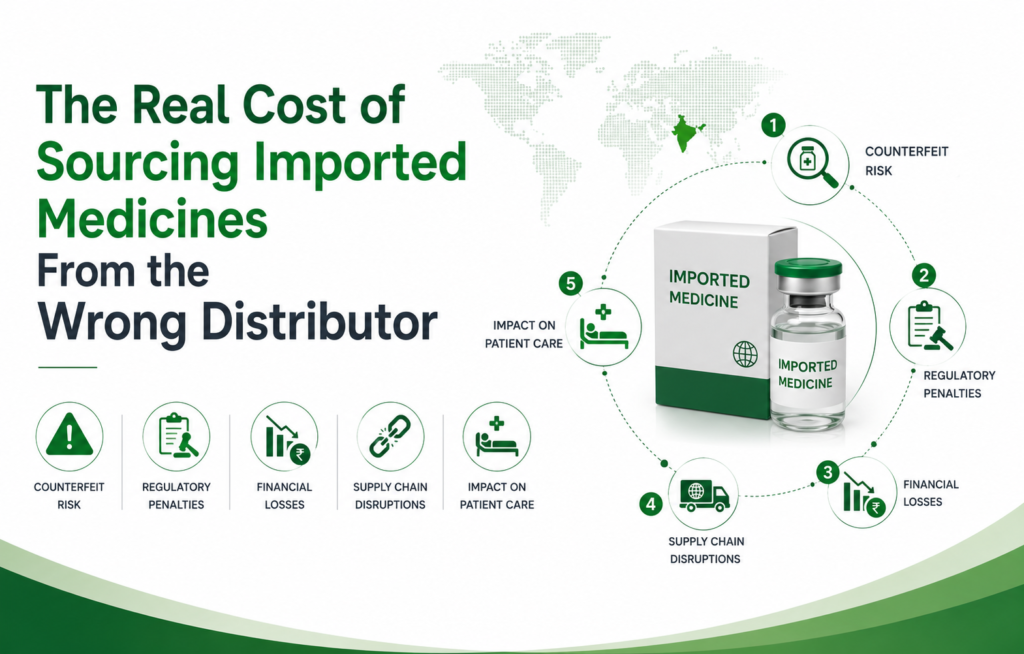
Nobody in hospital procurement sets out to source from the wrong distributor. It usually starts with a budget conversation, a vendor offering a price that seems too good to ignore, or a time-pressured order where the usual channel isn’t available. The decision gets made quickly, the medicine arrives, and for a while nothing seems wrong.
Until something does.
The real cost of sourcing specialty medicines from an unverified or unsuitable Imported medicine distributor in Delhi rarely appears as a single dramatic event. It accumulates — in compromised patient outcomes, in wasted medicine, in regulatory exposure, and in the slow erosion of a procurement team’s credibility with the clinical staff who depend on them. Here is what that cost actually looks like, broken down into the categories that matter most.
The Cost Nobody Calculates: Compromised Cold Chain
The most expensive mistake in specialty medicine procurement is often invisible at the point of purchase. A biologic that has experienced a temperature excursion during transit — meaning it has been stored or transported outside its required 2°C to 8°C window — looks identical to a compliant product. The vial is intact. The label reads correctly. The expiry date is valid. Nothing at visual inspection flags a problem.
But the medicine inside has been compromised. Proteins in biologics — monoclonal antibodies, growth factors, enzyme replacement therapies — are structurally sensitive to temperature. Even a single excursion above the permitted range during a long transit can cause partial denaturation, aggregation, or loss of potency that no pharmacy inspection will detect.
The patient receives the medicine. It either fails to work — which a clinician attributes to disease progression rather than product failure — or in rare cases triggers an infusion reaction from aggregated protein particles that should never have been in the vial. The medicine is wasted, or worse, causes harm, and nobody connects it to the cold chain failure that happened three days earlier in a poorly refrigerated delivery vehicle.
The cost here is not just the price of one vial. It is the cost of a treatment failure in a patient who may have waited months for access to that medicine. For an oncology patient receiving a checkpoint inhibitor, a treatment failure at this stage carries consequences that go well beyond the financial.
A verified specialty distributor provides temperature-monitored cold chain documentation for every shipment — not as a box-ticking exercise, but because their own regulatory standing depends on it. An unverified vendor offering a lower price almost certainly cannot offer the same assurance, because maintaining cold chain infrastructure at every point of the supply chain costs money, and that cost has to come from somewhere.
The Cost of Counterfeit and Substandard Product
India’s pharmaceutical regulatory environment has strengthened considerably over the past decade, but the reality of specialty medicine procurement is that the more expensive and difficult-to-source a medicine is, the more attractive it becomes to counterfeit or adulterate supply chains.
Specialty medicines — particularly imported oncology biologics, rare disease treatments, and newer targeted therapies — sit at the intersection of high price, limited availability, and relatively low procurement volumes per hospital. These characteristics make them precisely the category where unverified sourcing carries the highest counterfeit risk.
The consequences of dispensing a counterfeit specialty medicine to a patient are not theoretical. A cancer patient receiving a counterfeit checkpoint inhibitor receives no therapeutic benefit while their disease progresses. A patient with a rare disease receiving a substandard enzyme replacement faces potential serious harm. A hospital that dispensed that medicine faces legal, regulatory, and reputational consequences that a short-term procurement saving cannot begin to offset.
Verified specialty distributors source directly from manufacturers or their authorised regional distributors, and provide complete chain-of-custody documentation — batch numbers, manufacturer certificates of analysis, import documentation — for every product they supply. This documentation is the audit trail that protects both the patient and the hospital if a question about product authenticity ever arises.
The Cost of Regulatory Exposure
Hospital pharmacy teams in India operate under licensing frameworks that include requirements around medicine sourcing, documentation, and storage. Sourcing specialty medicines — particularly imported products — from unlicensed or inadequately licensed distributors creates regulatory exposure that can affect the hospital’s own operating licence in a worst-case scenario.
A licensed specialty distributor holds all required drug licenses under the Drugs and Cosmetics Act and operates in compliance with CDSCO requirements. Every invoice and batch document they provide is part of a traceable, regulatorily compliant supply chain. An unlicensed or inadequately licensed vendor offering the same medicine at a lower price is removing a regulatory layer that exists for reasons — and transferring that risk to the hospital that accepts the supply.
In an audit, the question is not whether the medicine helped the patient. The question is whether the hospital can demonstrate that its sourcing, storage, and dispensing processes met the required standard. A gap in the distributor documentation chain is a gap in that demonstration.
The Cost of Inconsistent Supply
Specialty medicines are not one-off purchases. Patients on Dupixent for atopic dermatitis, on Denosumab for osteoporosis, on checkpoint inhibitors for cancer, or on enzyme replacement for a rare disease are typically on continuous, long-term therapy. A supply gap — even a short one — is not an inconvenience. It is a treatment interruption with potential clinical consequences.
Distributors who offer attractive pricing on occasional or one-time specialty medicine orders frequently cannot guarantee consistent supply. They may source opportunistically from grey-market channels when primary supply is available, and disappear or fail to deliver when it is not. Procurement teams that switch to a lower-priced vendor for a one-time saving often find themselves scrambling to locate supply at crisis prices when that vendor cannot fulfil the next order.
A reliable specialty distributor maintains the manufacturer relationships and stock infrastructure to support consistent, ongoing supply — not just a single transaction. For medicines where a treatment gap has real clinical consequences, this reliability is not a nice-to-have. It is the core of what a distributor relationship is for.
The Cost to Clinical Trust
There is a less quantifiable but very real cost that accumulates when pharmacy procurement repeatedly fails clinical teams. An oncologist who prescribed a medicine that arrived late, a dermatologist whose patient received a product of uncertain integrity, a haematologist whose order was substituted without notice — each of these events creates a friction between clinical and pharmacy teams that takes time and effort to repair.
Pharmacy procurement is invisible when it works. When it fails, it is visible in the most uncomfortable way — in a ward round conversation, in a patient complaint, in a clinical audit. The long-term cost of that friction — in clinical relationships, in procurement team credibility, in the time spent managing consequences — far exceeds whatever was saved on a single order.
What Reliable Specialty Medicine Procurement Actually Looks Like
A reliable imported medicine distributor in Delhi provides a short list of verifiable commitments…: licensed operation under all applicable drug regulations, cold chain-compliant infrastructure from procurement through last-mile delivery, complete batch documentation and certificates of analysis for every shipment, genuine manufacturer-sourced or authorised distributor-sourced product, and consistent availability built on direct supply relationships rather than opportunistic grey-market sourcing.
A.K. Pharma is a licensed imported medicine distributor in Delhi supplying genuine imported and specialty medicines — across oncology, immunology, rare disease, bone health, cardiology, and anti-infective categories — to hospitals, oncology centres, and pharmacies across India. Every shipment comes with complete documentation. Every product is sourced from authorised channels. Every cold-chain biologic is stored and delivered within the required temperature range. Browse the full Products range, learn more About A.K. Pharma, or contact us at 011 4172 6999 or WhatsApp +91 9810034827.
Frequently Asked Questions
/
Q. Why can’t hospitals simply buy specialty medicines from any licensed pharmaceutical wholesaler?
General pharmaceutical wholesalers are set up for high-volume, standard medicines distributed across community pharmacies and general hospitals. Specialty and imported medicines — biologics, rare disease therapies, targeted oncology treatments — require cold chain infrastructure, import documentation, and direct manufacturer relationships that most general wholesalers do not maintain. A specialist imported medicine distributor in Delhi exists specifically to bridge this gap.
Q. How do hospitals verify that a specialty medicine has been stored correctly during transit?
A legitimate imported medicine distributor in Delhi will provide temperature monitoring logs alongside every cold-chain shipment — documenting that the product was maintained within its required storage range from the point of dispatch through to delivery. Hospitals should request this documentation as a standard part of acceptance procedure, not as an exception.
Q. Is a lower price from an alternative vendor always a warning sign?
Not automatically — but it warrants investigation. The question to ask is where the cost saving is coming from. If a vendor is offering a significantly lower price on an imported specialty biologic, the saving has to come from somewhere — reduced cold chain investment, grey-market sourcing, shorter remaining shelf life, or in the worst case, substandard or counterfeit product. Asking for complete chain-of-custody and batch documentation immediately reveals whether the saving is legitimate or not.
Q. What documentation should a hospital request from any specialty medicine distributor?
At minimum: a valid drug license, a batch-specific certificate of analysis from the manufacturer, complete import documentation for internationally sourced products, and cold chain compliance records for temperature-sensitive biologics. A licensed imported medicine distributor in Delhi should be able to provide all of these without hesitation.
Q. What is the regulatory risk to a hospital that sources from an unlicensed distributor?
Hospitals that source medicines from unlicensed or inadequately licensed distributors create a gap in their own regulatory documentation trail. In an audit, the hospital must demonstrate compliant sourcing — and a missing or incomplete distributor licence is a finding that can affect the hospital’s own operating status. Working exclusively with licensed distributors protects both the patient and the institution.
Q. How does A.K. Pharma ensure consistent supply for long-term specialty medicine therapies?
A.K. Pharma maintains direct relationships with manufacturers and authorised regional distributors across its product range, allowing consistent ongoing supply for medicines used in long-term treatment protocols — rather than opportunistic sourcing that creates gaps when primary supply is unavailable. Hospitals can contact A.K. Pharma at 011 4172 6999 or WhatsApp +91 9810034827 to discuss supply planning for specific medicines.
Disclaimer: This article is intended for informational and sourcing/procurement purposes only and does not constitute medical or clinical advice. A.K. Pharma is a licensed medicine distributor and does not provide clinical guidance.

One Response