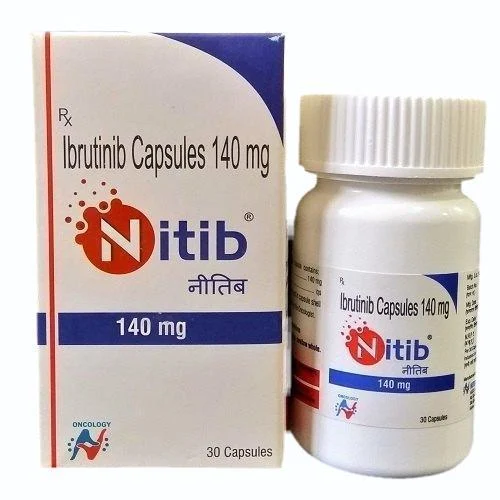
Ibrutinib 140mg Capsules — First-in-Class BTK Inhibitor for Chronic Lymphocytic Leukaemia, Mantle Cell Lymphoma, Waldenström’s Macroglobulinaemia, Marginal Zone Lymphoma and Chronic Graft-Versus-Host Disease
Supplied only against a valid prescription from a registered medical practitioner.
Sourced from authorised channels
Temperature-controlled packing
Hospitals, clinics, pharmacies
Delhi drug licence holder
Nitib® (Ibrutinib) — First-in-Class BTK Inhibitor Transforming B-Cell Blood Cancer Treatment
The World’s First Approved Bruton’s Tyrosine Kinase Inhibitor — Oral Targeted Therapy That Revolutionised CLL and B-Cell Lymphoma Management
Nitib® (Ibrutinib) is a first-in-class, selective, irreversible Bruton’s tyrosine kinase (BTK) inhibitor — the world’s first BTK inhibitor approved for clinical use — that covalently binds to the Cys481 residue in the ATP-binding site of BTK, permanently inactivating the enzyme. By irreversibly blocking BTK — a critical kinase in the B-cell receptor (BCR) signalling pathway — Ibrutinib disrupts the survival, proliferation, homing, and adhesion signals that B-cell malignancies depend on, inducing apoptosis and preventing malignant B-cell expansion across a broad range of B-cell cancers.
Ibrutinib fundamentally transformed the treatment of chronic lymphocytic leukaemia (CLL) — the most common adult leukaemia — shifting the paradigm from intravenous chemotherapy-based regimens (FCR, BR) to convenient oral targeted therapy with superior outcomes. It is approved across five distinct B-cell malignancy indications and represents one of the most clinically impactful oncology approvals of the past two decades.
A.K. Pharma is a trusted medicine distributor in Delhi supplying genuine Nitib (Ibrutinib) 140mg capsules to hospitals, haematology centres, oncology clinics, and pharmacies across India. Manufactured by Hetero Healthcare Ltd, Nitib is the Indian brand of Ibrutinib — the same active ingredient as the internationally recognised Imbruvica (Janssen/AbbVie) — providing accessible pricing for Indian patients requiring BTK inhibitor therapy.
What is Nitib (Ibrutinib)?
Nitib contains Ibrutinib — a small molecule pyrrolopyrimidine compound that acts as a potent, selective, irreversible covalent inhibitor of Bruton’s tyrosine kinase (BTK).
The B-Cell Receptor Signalling Pathway — Why BTK Drives B-Cell Cancers:
B lymphocytes (B-cells) survive, proliferate, and traffic through lymphoid organs via signals transmitted through the B-cell receptor (BCR). The BCR signalling cascade involves sequential activation of multiple kinases including LYN, SYK, PI3K, and critically BTK:
Normal BCR Signalling:
How B-Cell Cancers Exploit BCR Signalling: In CLL, MCL, WM, and other B-cell malignancies — constitutive BCR signalling (sometimes antigen-independent, sometimes driven by self-antigens in the tumour microenvironment) continuously activates BTK → NF-κB → survival gene overexpression (BCL-2, MCL-1, BCL-XL) → malignant B-cell resistance to apoptosis, continuous proliferation, and homing to protective lymphoid niches (lymph nodes, bone marrow) where survival signals are amplified.
Ibrutinib’s Irreversible Mechanism: Ibrutinib binds covalently (irreversibly) to Cys481 in the BTK ATP-binding site — forming a Michael adduct that permanently inactivates BTK. This irreversible binding means:
Full prescribing information is available at the FDA label for Ibrutinib.
Clinical Studies and Evidence
RESONATE Trial (Ibrutinib vs Ofatumumab in Relapsed/Refractory CLL) Published in the New England Journal of Medicine (2014), the landmark RESONATE trial compared Ibrutinib vs Ofatumumab in 391 patients with relapsed/refractory CLL or SLL. Key results:
RESONATE-2 Trial (Ibrutinib vs Chlorambucil — First-Line CLL in Elderly) Published in the New England Journal of Medicine (2015), RESONATE-2 enrolled 269 treatment-naive CLL patients ≥65 years — comparing Ibrutinib vs Chlorambucil. Key results at 5-year follow-up:
ALLIANCE Trial (Ibrutinib + Rituximab vs BR in Older CLL Patients) Published in the New England Journal of Medicine (2019) — demonstrated Ibrutinib ± Rituximab significantly superior PFS vs Bendamustine + Rituximab in previously untreated CLL patients ≥65 years — further establishing Ibrutinib-based therapy as standard first-line in elderly CLL.
SHINE Trial (Ibrutinib + BR in Mantle Cell Lymphoma) Published in the New England Journal of Medicine (2022) — Ibrutinib + Bendamustine/Rituximab significantly improved PFS vs BR alone in older MCL patients — HR 0.75 — establishing Ibrutinib combination as a first-line option in MCL.
iNNOVATE Trial (Ibrutinib in Waldenström’s Macroglobulinaemia) Published in the New England Journal of Medicine (2018) — Ibrutinib + Rituximab significantly improved PFS vs Placebo + Rituximab in WM — HR 0.20 — dramatically superior — with 30-month PFS of 82% vs 28%. Established Ibrutinib as the backbone of WM therapy.
Chronic Graft-Versus-Host Disease (cGVHD): Ibrutinib demonstrated clinically meaningful responses in steroid-refractory cGVHD — the first targeted therapy approved for this indication, which historically had limited effective treatment options after steroid failure.
Available Strengths
Nitib is available as:
| Presentation | Dose | Standard Daily Dose |
|---|---|---|
| Nitib 140mg Capsules | 140mg per capsule | 420mg once daily (3 capsules) for CLL/SLL/MCL/MZL/cGVHD; 560mg once daily (4 capsules) for MCL (some protocols) |
Standard doses by indication:
Indications — What Nitib is Used For
Chronic Lymphocytic Leukaemia (CLL) / Small Lymphocytic Lymphoma (SLL):
Mantle Cell Lymphoma (MCL):
Waldenström’s Macroglobulinaemia (WM):
Marginal Zone Lymphoma (MZL):
Chronic Graft-Versus-Host Disease (cGVHD):
For detailed indication information refer to MedlinePlus Ibrutinib.
Key Benefits of Nitib
First-in-Class BTK Inhibitor — Pioneer of Targeted B-Cell Cancer Therapy Ibrutinib was the first BTK inhibitor approved for any indication — pioneering covalent kinase inhibition as a treatment approach in haematological malignancies. Its approval in 2013 for MCL represented the first approved BTK inhibitor, followed rapidly by CLL (2014) — fundamentally changing how B-cell cancers are managed globally.
Transforms CLL — From Intravenous Chemotherapy to Oral Daily Tablet Before Ibrutinib, first-line CLL treatment required intravenous chemoimmunotherapy (FCR, BR) — multiple clinic visits, infusion reactions, bone marrow suppression. Ibrutinib converted CLL management to a single daily oral tablet taken at home — dramatically improving quality of life, particularly for elderly patients where intensive chemotherapy carries significant toxicity.
Dramatic Survival Improvement in CLL RESONATE-2 demonstrates a 5-year PFS rate of 70% with Ibrutinib vs 12% with Chlorambucil — transforming what was historically a disease requiring repeated chemotherapy cycles into one manageable with a single daily oral medicine for years.
Irreversible Mechanism — Once-Daily Dosing Ibrutinib’s covalent, irreversible BTK inhibition means once-daily dosing is sufficient — the BTK molecule is permanently inactivated by each dose and only recovers as new BTK protein is synthesised (requiring ~24 hours). This irreversible pharmacology enables convenient once-daily administration.
Active Across Multiple B-Cell Malignancy Types Five approved indications — CLL, MCL, WM, MZL, cGVHD — reflecting Ibrutinib’s activity across the spectrum of B-cell receptor-dependent malignancies. One medicine, multiple B-cell cancer types.
Available as Accessible Indian Generic Nitib by Hetero Healthcare provides Ibrutinib at accessible Indian pricing — enabling more patients across India to access BTK inhibitor therapy that was previously unaffordable at originator (Imbruvica) pricing.
How Nitib Works — Irreversible BTK Inhibition
Step 1 — Oral Absorption and Distribution: Ibrutinib is absorbed after oral administration — peak plasma concentration approximately 1-2 hours post-dose. Ibrutinib distributes to lymphoid tissues (lymph nodes, spleen, bone marrow) where B-cell malignancies reside — achieving high intracellular concentrations in malignant B-cells.
Step 2 — Covalent BTK Binding: Ibrutinib’s acrylamide warhead forms a covalent Michael adduct with the thiol group of Cys481 in the BTK ATP-binding site. This covalent bond is irreversible — the BTK molecule is permanently inactivated.
Step 3 — BCR Signalling Cascade Interruption: With BTK inactive, BCR stimulation can no longer activate PLCγ2 → no calcium mobilisation → no NF-κB activation via PKC pathway. Downstream survival signals from NF-κB (BCL-2, MCL-1, BCL-XL overexpression) are suppressed.
Step 4 — Malignant B-Cell Redistribution and Apoptosis: BTK inhibition also disrupts CXCR4 and CXCR5 homing signals that retain malignant B-cells in protective lymphoid niches. This causes characteristic early lymphocytosis (lymph node B-cells redistribute to blood — lymph nodes shrink, blood lymphocyte count temporarily rises) — a pharmacodynamic marker of Ibrutinib activity, not disease progression.
Step 5 — Sustained Tumour Control: With ongoing BTK inhibition — malignant B-cells are deprived of BCR-driven survival signals, cannot home back to protective lymphoid niches, and progressively undergo apoptosis → disease control sustained with continuous daily therapy.
For detailed mechanism overview refer to EHA CLL Guidelines and NCCN CLL Guidelines.
Nitib vs Acabrunat (Acalabrutinib) — BTK Inhibitor Comparison
Both Nitib (Ibrutinib) and Acabrunat (Acalabrutinib) are BTK inhibitors available from A.K. Pharma — with meaningful differences:
| Feature | Nitib (Ibrutinib) | Acabrunat (Acalabrutinib) |
|---|---|---|
| Selectivity | Less selective — inhibits ITK, TEC, EGFR, HER2 | More selective — minimal off-target |
| Atrial fibrillation | ~6-9% | ~3-4% — lower |
| Bleeding risk | Moderate | Moderate |
| Arthralgia/myalgia | Common | Less common |
| CLL indication | ✅ First-line + R/R | ✅ First-line + R/R |
| MCL indication | ✅ R/R (≥1 prior) | ✅ R/R (≥2 prior) |
| WM indication | ✅ Yes | ❌ No |
| cGVHD indication | ✅ Yes | ❌ No |
| Dosing | 420-560mg once daily | 100mg twice daily |
| Available at A.K. Pharma | Request Quote | Request Quote |
Dosage and Administration
CLL/SLL:
MCL:
WM:
MZL:
cGVHD:
Administration:
Dose Reductions:
Monitoring:
| Parameter | Frequency |
|---|---|
| CBC with differential | Monthly |
| Cardiac assessment — ECG | Baseline; if atrial fibrillation symptoms develop |
| LFTs | Baseline; periodically |
| Blood pressure | Baseline; regularly throughout |
| Bleeding assessment | At every visit |
Full dosing guidelines available at Drugs.com Ibrutinib Dosage.
Who Should Use Nitib
Nitib is prescribed for:
Patients Requiring Special Consideration:
Nitib is prescribed by haematologists and oncologists. A.K. Pharma supplies Nitib to hospitals, haematology centres, and pharmacies across Delhi and India.
Possible Side Effects
Common side effects include diarrhoea (37%), fatigue (28%), musculoskeletal pain/arthralgia (28%), upper respiratory tract infection (26%), bruising/contusion (25%), nausea (24%), rash (21%), and peripheral oedema (20%).
Serious side effects include:
Bleeding: Major haemorrhage (Grade ≥3) in approximately 3-4% — including subdural haematoma, gastrointestinal bleeding, and haemoptysis. Risk is higher in patients on anticoagulants or antiplatelet agents. Withhold Ibrutinib 3-7 days before surgery.
Atrial Fibrillation and Flutter: Atrial fibrillation in approximately 6-9% — higher rate in older patients and those with pre-existing cardiac risk factors. Monitor with ECG if atrial fibrillation symptoms (palpitations, dyspnoea) develop. Manage per cardiology guidelines.
Infections: Serious bacterial, fungal, and viral infections including pneumonia, sepsis, and Pneumocystis jirovecii pneumonia (PJP). Prophylactic antimicrobials may be warranted in high-risk patients.
Hypertension: New or worsening hypertension in approximately 14% — monitor blood pressure regularly; manage with antihypertensive therapy as needed.
Second Primary Malignancies: Including non-melanoma skin cancer — dermatological monitoring recommended.
Tumour Lysis Syndrome: Rare — monitor uric acid and renal function, particularly at treatment initiation in patients with high disease burden.
Full side effect information available at FDA Ibrutinib Safety Information.
Precautions
Storage and Handling
As a responsible medicine distributor in Delhi, A.K. Pharma stores all medicines including Nitib under manufacturer-recommended conditions ensuring product integrity for every supply.
Manufacturer Information
Nitib (Ibrutinib) is manufactured by Hetero Healthcare Ltd — an Indian pharmaceutical company producing high-quality generic oncology medicines. Ibrutinib received FDA approval in November 2013 as the world’s first BTK inhibitor — for MCL — with subsequent approvals for CLL (2014), WM (2015), MZL (2017), and cGVHD (2017). The originator brand is Imbruvica (Janssen/AbbVie). A.K. Pharma supplies only genuine Nitib sourced from authorized Hetero Healthcare distributors.
Related Blood Cancer and Haematology Medicines Available at A.K. Pharma
Frequently Asked Questions
Q. What is Nitib used for? Nitib (Ibrutinib) is used to treat chronic lymphocytic leukaemia (CLL), small lymphocytic lymphoma (SLL), mantle cell lymphoma (MCL), Waldenström’s macroglobulinaemia (WM), marginal zone lymphoma (MZL), and chronic graft-versus-host disease (cGVHD). More information at MedlinePlus.
Q. What is the generic name of Nitib? Ibrutinib. It is the world’s first approved BTK inhibitor — manufactured in India by Hetero Healthcare Ltd. The originator brand is Imbruvica (Janssen/AbbVie).
Q. How does Nitib work? Nitib permanently inactivates the BTK enzyme by forming a covalent bond with the Cys481 residue in BTK’s active site. BTK is a critical kinase in the B-cell receptor signalling pathway that drives survival, proliferation, and tissue homing of malignant B-cells in CLL, MCL, WM, and other B-cell cancers. By irreversibly blocking BTK, Nitib deprives malignant B-cells of their survival signals — causing them to undergo programmed cell death.
Q. Why does the lymphocyte count increase when starting Nitib? A temporary rise in blood lymphocyte count in the first few weeks of Nitib treatment is a known pharmacodynamic effect — not disease progression. BTK inhibition disrupts CXCR4/CXCR5-mediated homing signals that retain CLL cells in lymph nodes and bone marrow → CLL cells redistribute to blood → lymphocytosis. Simultaneously, lymph node sizes shrink. This redistribution lymphocytosis typically resolves within 6-12 months and does not require treatment modification.
Q. What is the difference between Nitib (Ibrutinib) and Acabrunat (Acalabrutinib)? Both are BTK inhibitors but Nitib (Ibrutinib) is the first-generation agent with broader off-target kinase inhibition (ITK, EGFR, TEC) while Acabrunat (Acalabrutinib) is a more selective second-generation BTK inhibitor with a lower rate of atrial fibrillation and better tolerability. Nitib has more approved indications (CLL, MCL, WM, MZL, cGVHD) vs Acabrunat (CLL, MCL). Both are available from A.K. Pharma.
Q. Why must grapefruit be avoided with Nitib? Ibrutinib is metabolised by CYP3A4. Grapefruit and Seville oranges contain furanocoumarins that inhibit intestinal CYP3A4 — significantly increasing Ibrutinib plasma levels and risk of toxicity. Avoid grapefruit, grapefruit juice, and Seville oranges throughout Nitib treatment.
Q. Is Nitib available in India? Yes — Nitib (Ibrutinib 140mg) is available in India through licensed pharmaceutical distributors. Contact A.K. Pharma — medicine distributor in Delhi — for availability and pricing.
Q. What is the price of Nitib in India? Nitib 140mg capsule price in India varies by pack size. Contact A.K. Pharma at 011 4172 6999 or WhatsApp +91 9810034827 for current pricing.
Q. How to order Nitib from A.K. Pharma? Request a quote from this page, call 011 4172 6999, or WhatsApp +91 9810034827 with your requirements.
Q. Does A.K. Pharma supply Nitib in bulk? Yes — in bulk to haematology centres, hospitals, and pharmacies across Delhi and India. Contact us for bulk pricing.
Why Order Nitib from A.K. Pharma?
Contact A.K. Pharma for Nitib Supply 📍 E-2/257A, 2nd Floor, Shastri Nagar, New Delhi 110052 📞 011 4172 6999 📱 WhatsApp: +91 9810034827 🌐 akpharma.in