- Delivering Pan India

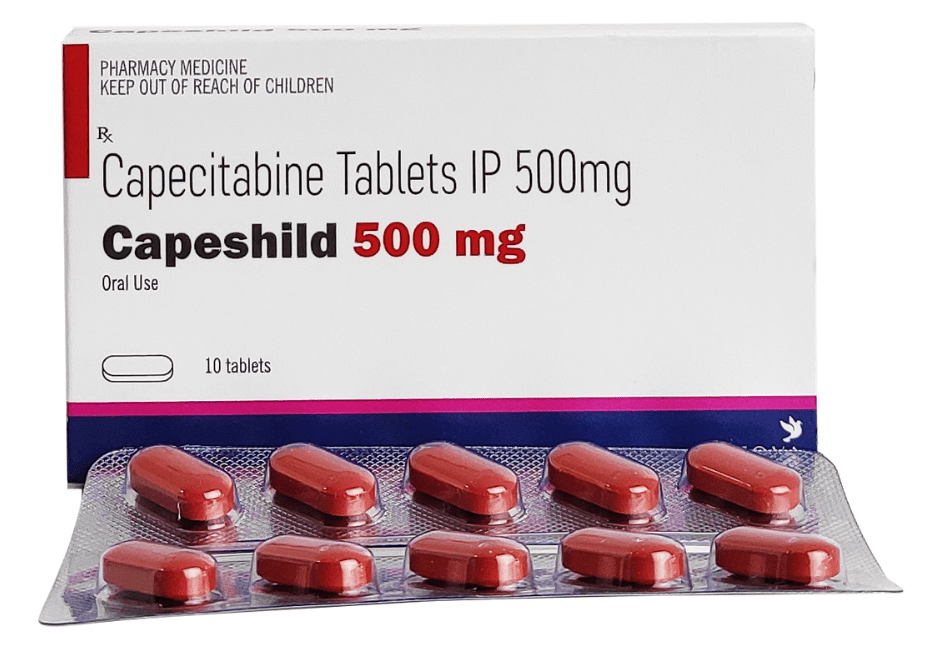
Capecitabine 500mg Tablets — Oral Antimetabolite Chemotherapy for Breast, Colorectal, and Colon Cancer
Supplied only against a valid prescription from a registered medical practitioner.
Sourced from authorised channels
Temperature-controlled packing
Hospitals, clinics, pharmacies
Delhi drug licence holder
Capecite® (Capecitabine) — Oral Fluoropyrimidine Chemotherapy for Gastrointestinal and Breast Cancers
A Sourcing Guide for Hospitals and Oncology Centres
Capecite® (Capecitabine) is an oral fluoropyrimidine antimetabolite indicated, according to its approved prescribing information, for the adjuvant treatment of Dukes’ C colon cancer following complete resection of primary tumour, and for the treatment of metastatic colorectal cancer and metastatic breast cancer. As with all chemotherapy agents, the decision to prescribe Capecite, including dosing based on body surface area and treatment cycle planning, rests entirely with the treating oncologist, in accordance with the approved label. This page provides sourcing and procurement information for hospitals and pharmacies, not clinical or treatment guidance.
As both a trusted medicine distributor in Delhi and a licensed pharma distribution company, A.K. Pharma supplies genuine Capecite (Capecitabine) 500mg tablets to hospitals, oncology centres, and pharmacies across India, manufactured by Anakaas Life Bio Science Pvt Ltd. Among pharmaceutical distribution companies operating in Delhi, A.K. Pharma maintains one of the most comprehensive oncology medicine portfolios — hospitals managing broader oncology caseloads can source companion medicines through A.K. Pharma’s full product range.
Capecite contains Capecitabine, an oral prodrug that is preferentially converted into 5-fluorouracil (5-FU) within tumour tissue through a three-step enzymatic cascade, according to the manufacturer’s prescribing information.
Capecitabine’s Tumour-Selective Activation Mechanism:
According to published oncology and pharmacology literature, Capecitabine itself is pharmacologically inactive when absorbed. It undergoes sequential enzymatic conversion — first to 5′-deoxy-5-fluorocytidine (5′-DFCR) by carboxylesterases in the liver, then to 5′-deoxy-5-fluorouridine (5′-DFUR) by cytidine deaminase, and finally to 5-fluorouracil (5-FU) by thymidine phosphorylase. Critically, thymidine phosphorylase is expressed at significantly higher levels in tumour tissue than in healthy tissue, resulting in preferential generation of cytotoxic 5-FU at the tumour site — the key pharmacological rationale for Capecitabine’s development as an oral alternative to intravenous 5-FU.
How 5-FU Works: Once generated, 5-FU exerts its cytotoxic effect through two main mechanisms, according to published clinical pharmacology literature: first, by inhibiting thymidylate synthase, blocking DNA synthesis; and second, by being incorporated into RNA, disrupting RNA processing and protein synthesis in cancer cells. This dual mechanism of action interferes with the growth and replication of cancer cells, according to the approved prescribing information.
Full prescribing information is available at the FDA label for Capecitabine, with additional background on colorectal and breast cancer chemotherapy available via the National Cancer Institute and the American Cancer Society.
X-ACT Trial (Capecitabine Adjuvant Therapy in Dukes’ C Colon Cancer)
Published in the Lancet (2005), the pivotal X-ACT trial compared Capecitabine monotherapy against bolus 5-FU/leucovorin (Mayo regimen) as adjuvant treatment in patients with Dukes’ C (stage III) colon cancer following surgery. Key findings demonstrated that Capecitabine was at least as effective as intravenous 5-FU/leucovorin in preventing cancer recurrence, with a superior safety profile for certain toxicities including neutropenia and stomatitis, supporting its approval as an oral adjuvant option in this setting.
SO14695 and SO14796 Trials (Capecitabine in Metastatic Colorectal Cancer)
These phase 3 trials compared Capecitabine against bolus 5-FU/leucovorin in patients with metastatic colorectal cancer, demonstrating equivalent overall survival with Capecitabine and a significantly higher objective response rate, supporting its approval as a first-line monotherapy option when fluoropyrimidine treatment alone is preferred.
M66001 Trial (Capecitabine Plus Docetaxel in Metastatic Breast Cancer)
This trial evaluated Capecitabine in combination with Docetaxel in patients with metastatic breast cancer following prior anthracycline-containing therapy, demonstrating significantly improved time to disease progression and overall survival compared to Docetaxel alone, supporting the combination’s approval in this setting.
For broader clinical guidance on colorectal and breast cancer chemotherapy, the American Society of Clinical Oncology (ASCO) and NCCN Guidelines publish ongoing treatment recommendations.
Capecite is supplied as:
| Presentation | Strength | Administration |
|---|---|---|
| Capecite Tablets | 500mg per film-coated tablet | Oral, twice daily within 30 minutes after a meal |
Standard Dosing (per approved prescribing information):
| Indication | Dose |
|---|---|
| Monotherapy (colon/colorectal cancer, breast cancer) | 1,250 mg/m² twice daily for 14 days, followed by 7-day rest (21-day cycle) |
| In combination with Docetaxel | 1,250 mg/m² twice daily for 14 days with Docetaxel 75mg/m² on day 1, every 3 weeks |
Dose is calculated based on body surface area by the prescribing oncologist and may be reduced for toxicity per the approved dose modification schedule. Adjuvant colon cancer treatment is typically administered for 8 cycles (24 weeks total) per the approved label.
Adjuvant Colon Cancer (Dukes’ C / Stage III):
Metastatic Colorectal Cancer:
Metastatic Breast Cancer:
For detailed indication information refer to MedlinePlus Capecitabine and the Colorectal Cancer Alliance.
Oral Administration — Reduced Hospital Visits
As an oral chemotherapy tablet taken at home, Capecitabine eliminates the need for intravenous infusion visits associated with traditional 5-FU regimens — a meaningful quality-of-life benefit for patients undergoing multi-cycle chemotherapy regimens.
Tumour-Selective 5-FU Generation
The enzymatic activation cascade preferentially generates cytotoxic 5-FU at the tumour site rather than in healthy tissue, according to the approved prescribing information, which underpins the clinical rationale for Capecitabine’s development as an oral 5-FU prodrug.
Established Evidence Across Multiple Cancer Types
Clinical trial data supporting Capecitabine’s approval spans adjuvant colon cancer, metastatic colorectal cancer, and metastatic breast cancer — reflecting its clinical versatility within the fluoropyrimidine class.
Cost-Effective Access to an Established Chemotherapy
Capecite, manufactured in India by Anakaas Life Bio Science Pvt Ltd, provides hospitals and patients access to this established oral chemotherapy at accessible pricing, supporting broader treatment uptake.
Dosing of Capecite is determined by the prescribing oncologist based on body surface area, per the approved label. General administration information from the manufacturer’s prescribing information includes:
Monitoring (per manufacturer prescribing information):
Full dosing guidelines are available in the manufacturer’s official prescribing information and should always be followed exactly as directed by the treating oncologist.
Capecite is prescribed by oncologists for:
Capecite is prescribed by oncologists specialising in gastrointestinal and breast cancer. As a licensed pharma distribution company in Delhi, A.K. Pharma supplies Capecite to hospitals and oncology centres across Delhi and India.
Common side effects reported in clinical trials include hand-foot syndrome (palmar-plantar erythrodysaesthesia), diarrhoea, nausea, fatigue, vomiting, stomatitis, abdominal pain, and decreased appetite.
Serious side effects include:
Hand-Foot Syndrome (Palmar-Plantar Erythrodysaesthesia): Numbness, tingling, swelling, redness, and blistering on the palms of the hands and soles of the feet; one of the most commonly reported adverse events with Capecitabine, requiring dose modification per the approved prescribing information based on severity grading.
Severe Diarrhoea: Grade 3 or 4 diarrhoea requires treatment interruption per the approved label; patients should be advised to contact their oncologist at the first sign of severe diarrhoea.
Cardiotoxicity: Cardiac adverse events including angina, arrhythmia, and myocardial infarction have been reported; patients with a history of coronary artery disease require careful monitoring.
Haematological Toxicity: Neutropenia, thrombocytopenia, and anaemia have been reported; regular complete blood count monitoring is recommended per the approved label.
Drug Interaction With Anticoagulants: A significant, potentially life-threatening interaction exists between Capecitabine and coumarin-derivative anticoagulants including warfarin; INR and prothrombin time must be monitored closely, as dose adjustments of the anticoagulant are frequently required.
DPD Deficiency: Patients with dihydropyrimidine dehydrogenase (DPD) deficiency are at significantly increased risk of severe, life-threatening fluoropyrimidine toxicity; DPD testing prior to initiating therapy is recommended per current clinical guidelines.
Full side effect information is available at FDA Capecitabine Safety Information.
As one of Delhi’s most trusted pharmaceutical distribution companies, A.K. Pharma stores all oncology medicines including Capecite under manufacturer-recommended conditions ensuring product integrity for every supply.
Capecite (Capecitabine) is manufactured by Anakaas Life Bio Science Pvt Ltd, an Indian pharmaceutical company. Capecitabine is the same active ingredient as the originator Xeloda (Roche), providing hospitals and patients with an accessible Indian generic of this established oral chemotherapy at more cost-effective pricing. A.K. Pharma supplies only genuine Capecite sourced from authorised distributors. Unlike general wholesale pharmaceutical distributors, A.K. Pharma maintains direct sourcing relationships with authorised channels for every oncology medicine it supplies.
Q. What is Capecite used for?
Capecite (Capecitabine) is used for the adjuvant treatment of Dukes’ C colon cancer after surgery, and for the treatment of metastatic colorectal cancer and metastatic breast cancer, as monotherapy or in combination with other agents per the approved prescribing information.
Q. What is the generic name and strength of Capecite?
The generic name of Capecite is Capecitabine, supplied as 500mg film-coated tablets, manufactured by Anakaas Life Bio Science Pvt Ltd — an Indian generic of the originator Xeloda.
Q. How does Capecite work as an oral chemotherapy?
Capecitabine is an oral prodrug that is preferentially converted into 5-fluorouracil (5-FU) within tumour tissue through a three-step enzymatic cascade, taking advantage of higher thymidine phosphorylase expression in tumours to generate cytotoxic 5-FU preferentially at the cancer site.
Q. Why is the drug interaction between Capecite and warfarin important?
Capecitabine significantly inhibits the metabolism of coumarin-derivative anticoagulants like warfarin, leading to markedly elevated INR and increased bleeding risk. Patients on warfarin require frequent INR monitoring and typically need anticoagulant dose adjustments throughout Capecitabine therapy.
Q. What is DPD deficiency and why does it matter for Capecite?
Dihydropyrimidine dehydrogenase (DPD) is the enzyme responsible for breaking down fluoropyrimidines. Patients with DPD deficiency cannot adequately metabolise Capecitabine, leading to severe, potentially life-threatening toxicity. Testing before initiating therapy is recommended per current clinical guidelines.
Q. Is Capecite available in India?
Capecite can be supplied to hospitals and oncology centres across India through licensed pharmaceutical distributors. Contact A.K. Pharma — one of Delhi’s trusted pharmaceutical distribution companies — for availability and pricing.
Q. What is the price of Capecite in India?
Capecite price in India varies by pack size and order quantity. Contact A.K. Pharma at 011 4172 6999 or WhatsApp +91 9810034827 for current pricing and bulk supply rates.
Q. How to order Capecite from A.K. Pharma?
You can request a quote directly from this page, call us at 011 4172 6999, or WhatsApp us at +91 9810034827 with your requirements and we will respond promptly.
Q. Does A.K. Pharma supply Capecite in bulk?
Yes. As one of Delhi’s established pharmaceutical distribution companies, A.K. Pharma supplies Capecite in bulk to hospitals and oncology centres across Delhi and India.
📍 E-2/257A, 2nd Floor, Shastri Nagar, New Delhi 110052
📞 011 4172 6999
📱 WhatsApp: +91 9810034827
🌐 akpharma.in
Disclaimer: This page is intended for informational and sourcing/procurement purposes only and does not constitute medical or clinical advice. All treatment decisions, including drug selection and dosing, should be made by a qualified healthcare professional in accordance with the approved prescribing information. A.K. Pharma is a licensed medicine distributor and does not provide clinical guidance.