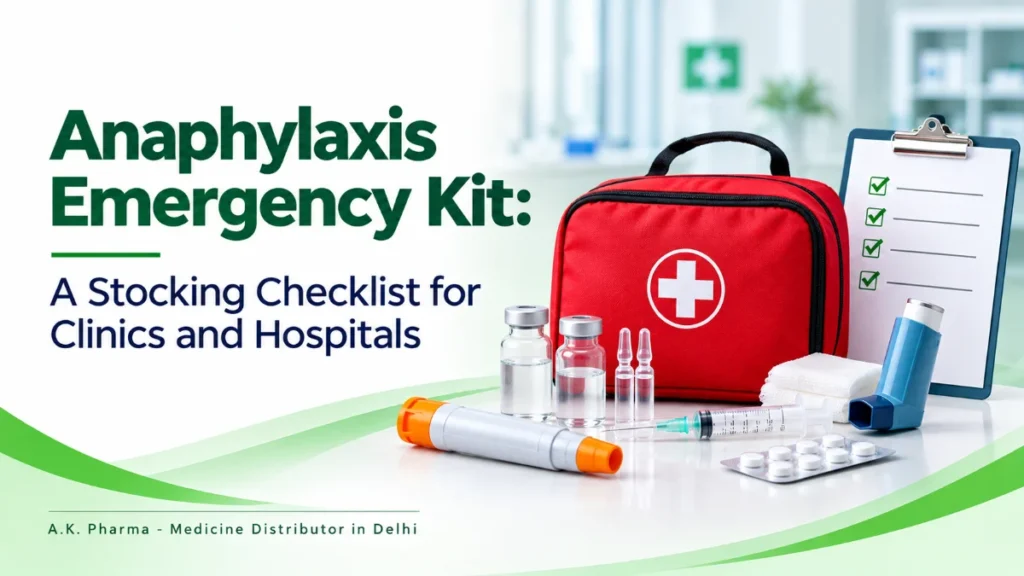
Anaphylaxis can develop within minutes of exposure to a food, an insect sting or a medicine, and a clinic or ward may have very little time to respond. Published guidelines are consistent on one point: the equipment and medicines need to be in one known place, in date, and checked on a schedule. This guide summarises what the guideline documents list for an anaphylaxis emergency kit, and how institutional pharmacies can keep one stocked. It reports what the guidelines say. It is not clinical advice. For the label-level picture of one auto-injector, see our earlier post, Epinephrine Auto-Injectors in India: What the EpiPen Label and Anaphylaxis Guidance Report.
Why a dedicated anaphylaxis kit matters in a clinic or hospital
Guideline bodies such as the World Allergy Organization (WAO Anaphylaxis Guidance 2020), the European Academy of Allergy and Clinical Immunology (EAACI guideline, 2021 update) and the Resuscitation Council UK (emergency treatment guidelines for healthcare providers) all describe anaphylaxis as a time-critical emergency. Their documents also note that delays often come from practical problems rather than from clinical uncertainty: the kit is locked away, an item has expired, or nobody knows who checks it. A single named kit, kept in a fixed place, removes most of those problems.
What the guidelines list for an anaphylaxis kit
1. First-line medicine
- Adrenaline (epinephrine) is named as the first-line medicine in the major anaphylaxis guidelines, given by intramuscular injection.
- Facilities typically stock it in more than one format, such as auto-injectors and ampoules with syringes, so that the format matches the staff trained to use it.
- Strengths, pack types and age or weight bands are set by the product label and the facility’s own protocol, so they are decided by the treating physician and not by the supplier.
2. Administration supplies
- Syringes and needles of suitable length for intramuscular use
- Alcohol swabs, gloves and a sharps container
- Spare auto-injector units, so a second injection can be prepared if the facility protocol calls for it
3. Airway and breathing support
- Oxygen supply with masks of appropriate sizes
- Bag-valve-mask device and airway adjuncts
- Pulse oximeter
- Nebuliser or inhaler device for bronchodilator medicines named in the facility protocol
4. Circulatory support
- IV cannulas, giving sets and crystalloid fluids
- Blood pressure monitor with suitable cuff sizes
5. Adjunct medicines named in guidelines
Guideline documents describe antihistamines and corticosteroids as adjunct (second-line) medicines. They are not a substitute for adrenaline. Which adjuncts a facility holds, and in what form, is a protocol decision for its physicians.
6. Documentation
- A laminated emergency protocol card, approved by the facility’s medical lead
- An event record form and an expiry and inspection log
- Emergency contact numbers, including the ambulance and the nearest hospital
Storage and expiry management
- Follow the label. Each product states its storage temperature and light protection. Auto-injectors are generally kept at room temperature within the labelled range and away from heat and direct light, so a locked car or a sunny window shelf is a common cause of premature discard.
- Check the solution. Labels advise inspecting the liquid for discolouration or particles through the viewing window, where one is provided.
- Log expiry dates. Record each unit’s expiry date and lot number, and set a reminder 90 days before the earliest date so replacements can be ordered in time.
- Use one inspection routine. A monthly check by a named person, signed in the log, is the pattern most institutional protocols use.
A simple checklist for the pharmacy or procurement team
- Kit location marked, unlocked and known to all clinical staff
- Every item present against the facility’s approved list
- Expiry dates and lot numbers recorded; earliest expiry flagged
- Storage conditions match the label
- Replacement stock ordered before expiry, not after
- Protocol card current and signed off by the medical lead
Who owns the kit, and what training guidelines mention
Guideline documents and hospital policies generally treat the kit as a shared responsibility with named owners:
- Medical lead: approves the kit contents and the protocol card.
- Pharmacy in-charge: keeps stock, expiry and lot records and orders replacements.
- Nurse in charge of each area: performs the monthly check and signs the log.
- All clinical and front-desk staff: know where the kit is and who to call.
The World Allergy Organization guidance and other bodies describe regular staff training and drills as part of anaphylaxis preparedness. The content and frequency of that training are set by the facility’s medical lead and its accredited trainers, not by a supplier. Where a facility stocks auto-injectors, the manufacturer’s own instructions and training devices are normally the reference for how the device is used.
Common gaps found when kits are audited
These are practical problems that institutional audits and guideline documents repeatedly describe. They are not clinical findings.
- Expired or soon-to-expire units sitting in a kit because nobody owned the monthly check.
- A single format only. The kit holds one type of device, but staff on the floor are trained on another.
- Missing consumables. Syringes, needles or swabs absent, or needles of the wrong length for the formats stocked.
- Kit kept locked or in a distant store room, so staff lose time finding the key.
- Heat and light exposure. Kits stored on a window sill, near a heater or in a vehicle.
- No protocol card, or a card that names staff who have since left.
- One kit for a whole building, with no kit in the areas where reactions are most likely.
- No record of use. A unit is used, not replaced, and nobody logs it.
A quarterly mock check, where a staff member finds the kit and reads out its contents, catches most of these within a few minutes.
Receiving a delivery: what to check before it goes into the kit
A delivery is the last point where a problem can be caught cheaply. A receiving check usually covers:
- Outer carton. Intact, dry and undamaged, with the product name and batch details legible.
- Product identity. Brand, strength and format match the purchase order and the facility’s approved list.
- Expiry date. Read on every unit. Many facilities set a minimum remaining shelf life at receipt, which the pharmacy sets in its own policy.
- Lot number. Recorded against the invoice so a recall notice can be traced to a shelf.
- Tamper evidence. Seals and caps intact, and the viewing window clear where the pack has one.
- Storage during transit. Any temperature or light conditions on the label were respected, and the supplier can confirm how the shipment travelled.
- Paperwork. Invoice, batch details and the supplier’s licence information on file.
Anything that fails a check is set aside and recorded, not placed in the kit.
Planning quantities and reorder cycles
Institutions usually plan stock by site and by kit, not by patient numbers. The facility’s medical lead sets the quantities. The pharmacy then works from a few simple counts:
- Number of kits. One kit per clinical area where a reaction could occur, such as OPD, injection or vaccination rooms, day-care wards, radiology and the emergency room.
- Units per kit. Set by the facility protocol and the formats it has chosen. Procurement does not decide this.
- Spare stock. A small reserve held centrally, so that a unit used or expired in one kit is replaced the same day it is flagged.
- Reorder trigger. Order when the earliest expiry is about 90 days away or when reserve stock falls below the minimum the facility has set, whichever comes first.
- Lead time. Imported specialty medicines can take longer to arrive than domestic stock, so the lead time should be confirmed with the supplier before the reorder trigger is fixed.
A short written reorder rule, signed by the pharmacy in-charge and the medical lead, avoids the common situation where every unit in a facility expires in the same month.
Sourcing considerations for institutions
For bulk purchases, procurement teams typically check that the batch is traceable, the pack is sealed and unexpired on arrival, and the supplier can document its source. A.K. Pharma is a Delhi-based pharmaceutical distributor supplying hospitals, clinics and pharmacies on a bulk and wholesale basis. Availability, pack types and lead times depend on the product and the import or supply schedule, so they are confirmed at the time of enquiry. To discuss institutional requirements, see our contact page, our guide to imported medicines in India, or the EpiPen auto-injector product page.
Frequently asked questions
What should an anaphylaxis emergency kit contain?
Guideline documents list adrenaline (epinephrine) as the first-line medicine, with administration supplies, airway and oxygen equipment, IV fluids, a pulse oximeter, a BP monitor and a protocol card. The exact list is set by the facility’s medical lead.
Who decides which medicines and strengths are stocked?
The treating physician and the facility’s protocol. A distributor supplies what is requested and does not recommend treatment.
How often should the kit be checked?
Many institutional protocols use a monthly check by a named person, recorded in a log. The facility sets its own schedule.
How should auto-injectors be stored?
As the product label states: within the labelled temperature range, protected from light and heat.
What should be checked on delivery?
Sealed packs, expiry dates, lot numbers, the storage conditions during transit, and the supplier’s documentation.
When should replacements be ordered?
Before expiry. Many teams flag the earliest expiry date 90 days ahead.
Do guidelines name medicines other than adrenaline?
Yes. Antihistamines, corticosteroids and bronchodilators are described as adjuncts, not as replacements for adrenaline.
Does A.K. Pharma supply hospitals and clinics?
Yes, on a bulk and wholesale basis. Availability and lead times are confirmed at the time of enquiry.
Is this article medical advice?
No. It summarises published guidelines and labels. Treatment decisions rest with the treating physician.
Disclaimer: A.K. Pharma is a pharmaceutical distributor and is not a healthcare provider. This article summarises what published guidelines and product labels state and is for informational purposes only. It is not medical advice and does not recommend any treatment. All decisions about the choice, use and stocking of medicines rest solely with the treating physician and the facility’s medical lead.