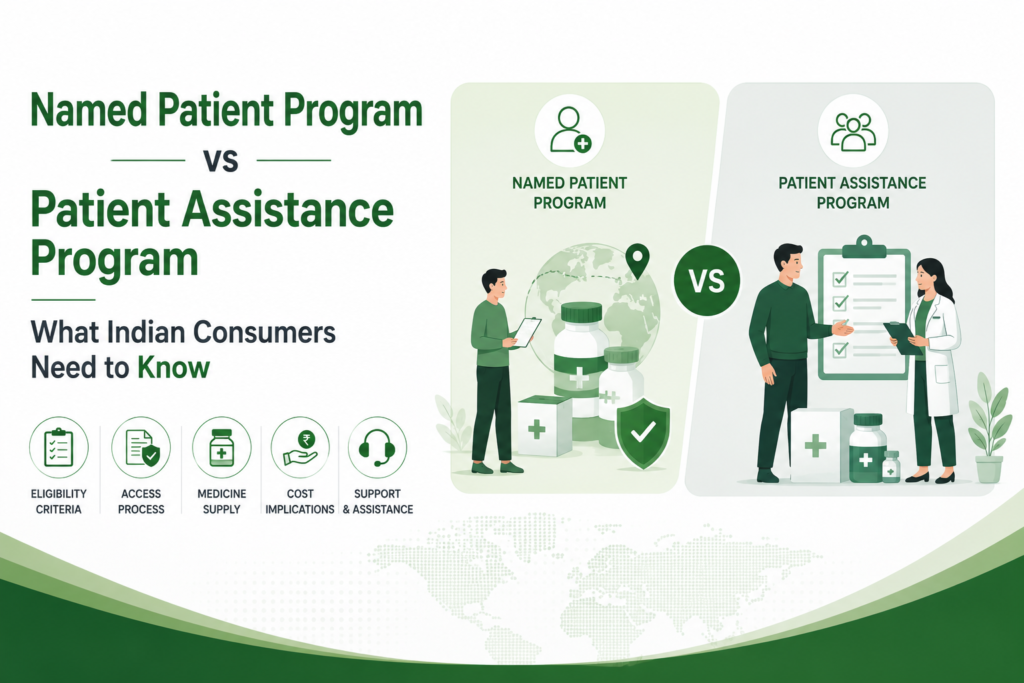
Two programs. Two very different purposes. And yet, for patients and families navigating serious illness in India, the terms Named Patient Program and Patient Assistance Program come up in the same conversations, recommended by the same doctors, and processed through the same hospital pharmacy counters — which is exactly why so many people end up confused about which one applies to them.
The confusion matters. For a patient who needs a medicine that either is not yet available in India or is available but completely out of reach financially, applying to the wrong program means weeks or months of delay. At a stage of treatment where every week counts, that delay has real consequences.
Here is what each program actually is, how they differ, and what patients and families need to understand to get the right help faster.
What Is a Patient Assistance Program — And Who Is It For?
A Patient Assistance Program (PAP) is a scheme run by a pharmaceutical manufacturer — or its Indian affiliate — that provides a medicine already available and approved in India at reduced or zero cost to patients who cannot afford it at market price.
The medicine exists in India. It is approved. It is in the distribution system. The only barrier is cost — and the PAP is designed specifically to remove that barrier for patients who meet the eligibility criteria, which typically centre on financial need, the absence of adequate health insurance, and a confirmed medical prescription from a qualified specialist.
Every PAP is different. Some manufacturers offer the medicine completely free for the duration of treatment. Others offer a “buy some get some” model — a patient purchases a defined number of doses and receives additional doses free. Others operate on income-based sliding scale pricing. The specific terms depend entirely on which manufacturer is running the program and which medicine is involved.
What patients need to do: Ask the treating specialist or the hospital pharmacy whether a PAP exists for the prescribed medicine. If it does, the hospital will typically facilitate the application on the patient’s behalf, submitting income documentation and prescription details directly to the manufacturer or its authorised access partner. A.K. Pharma supports hospitals in navigating PAP access for medicines across its range — full details are available on the Patient Assistance Program page.
What Is a Named Patient Program — And Who Is It For?
A Named Patient Program (NPP) is an entirely different type of access pathway, and it applies in a completely different situation.
Where a PAP addresses affordability for a medicine that already exists in India, an NPP addresses availability for a medicine that does not yet exist in India at all — or has not yet received marketing approval from India’s Central Drugs Standard Control Organisation (CDSCO) for a specific indication.
Under an NPP, a specific, named patient — hence the name — can access a medicine that has been approved internationally (typically by the US FDA or European EMA) but has not yet completed the Indian regulatory approval process. The medicine is imported on a compassionate use or named patient basis, specifically for that individual, under the supervision of a qualified specialist who takes clinical responsibility for the prescription.
This is the program that applies when a doctor says something like “this medicine is approved in the US but not yet in India” or “there is a newer treatment available internationally that we can try to get access to for you.” The NPP is the formal pathway through which that access happens.
What patients need to do: The treating specialist initiates the NPP process, since the clinical justification and prescription are required before import can be arranged. The hospital pharmacy or a specialist distributor like A.K. Pharma then manages the sourcing and import documentation. The process takes longer than a standard medicine order — timelines vary depending on the medicine and the regulatory documentation involved — so patients and families should initiate the conversation with their doctor as early as possible rather than waiting until all other options are exhausted. Full details are available on the Named Patient Program page.
The Single Most Important Difference
If there is one thing to take away from this article, it is this:
- PAP — the medicine is available in India, the barrier is cost
- NPP — the medicine is not available in India yet, the barrier is access
These two problems require two completely different solutions, and mixing them up costs patients time they cannot afford to lose.
Common Questions Patients and Families Ask
My doctor prescribed a medicine and said it is very expensive — which program applies?
If the medicine is commercially available in India and the issue is purely affordability, a Patient Assistance Program is the right pathway. Ask the hospital pharmacy whether the manufacturer of that specific medicine runs a PAP, and if so, what documentation is needed to apply.
My doctor said the medicine I need isn’t approved in India yet — does that mean I can’t get it?
Not necessarily. If the medicine has been approved internationally and a qualified specialist is willing to prescribe it under clinical supervision, a Named Patient Program pathway may allow it to be imported specifically for you. This is a more complex process than a standard prescription, but it is a legitimate and established access route. Speak to your treating specialist about whether an NPP is appropriate for your situation.
How long does a Named Patient Program application take?
Timelines vary considerably depending on the medicine, the completeness of documentation submitted, and current import logistics. The most important thing patients and families can do is start the conversation with their specialist as early as possible — NPP is not a pathway to initiate in a crisis; it works best when there is enough lead time for the process to complete without a treatment gap.
Does A.K. Pharma help with both PAP and NPP applications?
Yes. A.K. Pharma supports hospitals and patients in navigating both pathways — PAP for medicines available in India where cost is the barrier, and NPP for medicines not yet available in India where import access is required. Contact A.K. Pharma at 011 4172 6999 or WhatsApp +91 9810034827, or visit the Patient Assistance Program and Named Patient Program pages for more information.
What documents are typically needed for a PAP application?
Most PAP applications require a valid prescription from a qualified specialist, proof of income or financial need (such as income tax returns or a below-poverty-line certificate where applicable), and confirmation that the patient does not have adequate insurance coverage for the medicine in question. The exact requirements vary by manufacturer and program.
What documents are needed for an NPP application?
NPP applications typically require a detailed clinical justification from the treating specialist, a valid prescription, confirmation that no approved equivalent is available in India for the specific indication, and patient consent documentation. The hospital pharmacy or specialist distributor managing the import will guide the specialist through the specific requirements for the medicine in question.
A Note on Timing
Both programs require preparation and documentation, and neither works well under last-minute pressure. The families who navigate these pathways most successfully are the ones whose specialist raised the question early — before treatment options ran out — and who engaged with the hospital pharmacy and their distributor with enough lead time for the process to complete without a crisis driving the timeline.
If you are reading this because a family member has recently been diagnosed and you are trying to understand your options, the most useful thing you can do right now is bring this article to your next appointment with the treating specialist and ask directly: is there a PAP or NPP for the medicine you are recommending, and how do we start that process?
Disclaimer: This article is intended for general informational purposes only and does not constitute medical, legal, or regulatory advice. PAP and NPP eligibility criteria, processes, and timelines vary by medicine and manufacturer. Patients and families should always work with their treating specialist and hospital pharmacy team to navigate these programs. A.K. Pharma is a licensed medicine distributor and does not provide clinical guidance.