- Delivering Pan India

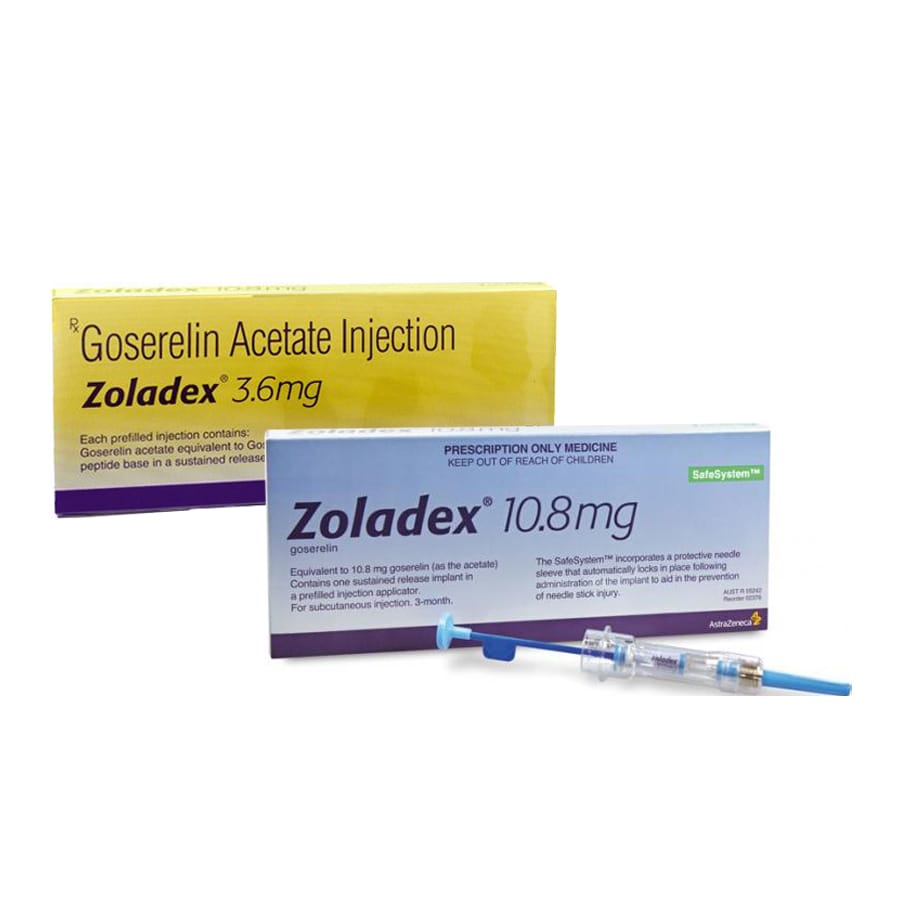
Goserelin 3.6mg, 10.8mg Implant — GnRH Agonist for Hormone-Sensitive Prostate Cancer and Premenopausal Breast Cancer
Supplied only against a valid prescription from a registered medical practitioner.
Sourced from authorised channels
Temperature-controlled packing
Hospitals, clinics, pharmacies
Delhi drug licence holder
Zoladex® (Goserelin) — Gold Standard GnRH Agonist for Hormone-Sensitive Cancers
Three Decades of Clinical Evidence in Prostate and Breast Cancer Hormonal Therapy
Zoladex® (Goserelin) is a synthetic gonadotropin-releasing hormone (GnRH) agonist delivered as a biodegradable subcutaneous implant — used for androgen deprivation therapy (ADT) in hormone-sensitive prostate cancer and for estrogen suppression in premenopausal women with hormone receptor-positive breast cancer. After an initial testosterone or estrogen surge lasting 1-2 weeks — a phenomenon known as flare — Zoladex causes profound and sustained suppression of sex hormone production, achieving medical castration equivalent to surgical orchiectomy or oophorectomy without the irreversibility of surgery.
With over three decades of clinical use and one of the most extensive evidence bases of any hormonal therapy in oncology, Zoladex remains the most widely prescribed GnRH agonist globally — available in both a convenient monthly 3.6mg implant and a 3-monthly 10.8mg implant for prostate cancer patients requiring long-term ADT.
A.K. Pharma is a trusted medicine distributor in Delhi supplying genuine Zoladex (Goserelin) to hospitals, oncology centres, urology clinics, radiation oncology departments, and pharmacies across India. Manufactured by AstraZeneca, Zoladex is an essential medicine for both prostate and breast cancer hormonal management.
What is Zoladex (Goserelin)?
Zoladex contains Goserelin — a synthetic decapeptide analogue of natural GnRH that acts as a GnRH agonist. Goserelin is delivered as a sterile, biodegradable cylindrical implant pre-loaded in a specially designed syringe — the implant dissolves slowly over 28 days (3.6mg) or 12 weeks (10.8mg) releasing Goserelin at a controlled rate.
Why GnRH Agonists Initially Cause a Flare: Natural GnRH is released from the hypothalamus in pulses — pulsatile stimulation of pituitary GnRH receptors drives LH and FSH release. When Goserelin — a continuous GnRH agonist — first stimulates GnRH receptors, it causes an initial LH and FSH surge → testosterone surge in men (prostate cancer flare) or estrogen surge in women (breast cancer flare) lasting 1-2 weeks.
Why GnRH Agonists Eventually Suppress: Continuous (non-pulsatile) GnRH receptor stimulation causes receptor downregulation and desensitisation — pituitary GnRH receptors are internalised and degraded — LH and FSH secretion falls profoundly — testosterone and estrogen fall to castration levels after 2-4 weeks.
Clinical implication: The initial flare requires antiandrogen cover (Bicalutamide) for 4 weeks in prostate cancer patients — particularly those with bone metastases, spinal cord compression, or urinary obstruction where testosterone surge could cause serious clinical deterioration. For patients where flare cannot be tolerated, Firmagon (Degarelix) — a GnRH antagonist — should be used instead.
Full prescribing information is available at the FDA label for Goserelin.
Clinical Studies and Evidence
EORTC 22863 Trial (Goserelin + Radiotherapy in Locally Advanced Prostate Cancer) Published in The Lancet Oncology (2002), EORTC 22863 demonstrated that 3 years of GnRH agonist therapy (Goserelin) combined with radiotherapy significantly improved overall survival, disease-specific survival, clinical progression-free survival, and local control compared to radiotherapy alone in locally advanced prostate cancer — establishing long-term ADT combined with radiotherapy as the standard of care for this patient group, with OS benefit maintained at 10-year follow-up.
RTOG 92-02 Trial (Goserelin Duration in High-Risk Prostate Cancer) Published in the Journal of Clinical Oncology (2003), RTOG 92-02 demonstrated that 28 months of Goserelin (long-term ADT) combined with radiotherapy significantly improved disease-free survival, local progression, distant metastasis, and disease-specific survival compared to 4 months (short-term ADT) — particularly in Gleason 8-10 patients where overall survival benefit was also demonstrated, supporting long-term ADT for high-risk localised prostate cancer.
ZIPP Trial (Goserelin in Premenopausal Breast Cancer) The ZIPP trial — a large multicentre randomised trial — demonstrated that adjuvant Goserelin significantly improved relapse-free survival and overall survival in premenopausal women with hormone receptor-positive early breast cancer when added to standard adjuvant chemotherapy — establishing ovarian suppression as a clinically meaningful adjuvant treatment in this population.
SOFT and TEXT Trials (Ovarian Suppression in Premenopausal Breast Cancer) Published in the New England Journal of Medicine (2014 and 2015), the landmark SOFT and TEXT trials demonstrated that ovarian function suppression — achieved with GnRH agonists including Goserelin — combined with either Aromasin (Exemestane) or Tamoxifen significantly improved disease-free survival compared to Tamoxifen alone in premenopausal women with hormone receptor-positive early breast cancer. At 8-year follow-up the TEXT and SOFT trials demonstrated significant breast cancer-free interval improvement — particularly in high-risk premenopausal patients — firmly establishing ovarian suppression + AI as the recommended approach for high-risk premenopausal HR-positive breast cancer.
ABCSG-12 Trial (Goserelin + Anastrozole or Tamoxifen in Premenopausal Breast Cancer) Published in the New England Journal of Medicine (2009), ABCSG-12 demonstrated that Goserelin + Anastrozole or Tamoxifen provided effective adjuvant endocrine therapy in premenopausal women with HR-positive breast cancer — supporting the combination of ovarian suppression with aromatase inhibitors in this setting.
Meta-Analysis — Goserelin in Early Breast Cancer The Early Breast Cancer Trialists’ Collaborative Group (EBCTCG) meta-analysis published in The Lancet (2022) demonstrated that adding ovarian suppression to adjuvant endocrine therapy significantly reduced breast cancer recurrence and mortality in premenopausal women with ER-positive breast cancer — particularly in younger patients and those at higher recurrence risk.
Available Strengths
Zoladex is available in two presentations:
| Presentation | Dose | Dosing Frequency | Primary Use |
|---|---|---|---|
| Zoladex 3.6mg | Goserelin 3.6mg implant | Every 28 days | Prostate cancer, breast cancer, endometriosis |
| Zoladex 10.8mg | Goserelin 10.8mg implant | Every 12 weeks (3-monthly) | Prostate cancer long-term ADT |
Each implant is a small white to cream coloured cylindrical rod approximately 1mm in diameter contained within a specially designed syringe with a 16-gauge needle for subcutaneous administration. The implant dissolves completely over the dosing interval — no removal is required.
Indications — What Zoladex is Used For
Prostate Cancer:
Breast Cancer:
Other Indications:
For detailed indication information refer to MedlinePlus Goserelin.
Key Benefits of Zoladex
Medical Castration Without Surgery Zoladex achieves testosterone suppression equivalent to surgical orchiectomy (castration) — providing fully reversible medical castration that can be discontinued if required clinically. This reversibility is particularly important in breast cancer patients where long-term fertility preservation may be desired after completing treatment.
Three-Monthly Implant for Long-Term ADT The 10.8mg 3-monthly implant dramatically reduces treatment burden for prostate cancer patients requiring long-term ADT — reducing injection frequency to 4 times per year vs 12 times for monthly injections. This convenience advantage significantly improves adherence in long-term treatment settings.
Most Extensively Studied GnRH Agonist Zoladex has the most extensive clinical evidence base of any GnRH agonist — with landmark trials including EORTC 22863, RTOG 92-02, SOFT, TEXT, and ABCSG-12 specifically conducted with Goserelin. This depth of evidence provides confidence in its clinical effectiveness across all approved indications.
Established Standard of Care in Premenopausal Breast Cancer The SOFT and TEXT trials — conducted with Goserelin — established ovarian suppression + aromatase inhibitor as the recommended adjuvant endocrine therapy for high-risk premenopausal HR-positive breast cancer. Goserelin is the most evidence-supported GnRH agonist for premenopausal breast cancer ovarian suppression.
Long-Term Safety Profile Over 30 years of post-marketing experience provides comprehensive long-term safety data — enabling confident clinical decision-making particularly in long-duration ADT settings.
Cost-Effective Hormonal Therapy Compared to newer hormonal agents (Abiraterone, Enzalutamide), Zoladex provides cost-effective testosterone suppression as the ADT backbone — remaining an essential component of prostate cancer treatment even when combined with newer agents.
How Zoladex Works
Prostate Cancer:
The HPG axis controls testosterone production: Hypothalamic GnRH → pituitary LH and FSH → testicular Leydig cell testosterone production.
Zoladex works by:
Breast Cancer:
In premenopausal women, ovarian estrogen production (via the HPG axis — GnRH → LH/FSH → ovarian theca and granulosa cell estrogen synthesis) is the primary source of circulating estrogen driving ER-positive breast cancer growth.
Zoladex suppresses ovarian estrogen production by the same mechanism — receptor downregulation → LH/FSH fall → ovarian estrogen production ceases → plasma estradiol falls to postmenopausal levels → ER-positive breast cancer cells deprived of estrogen.
This chemical oophorectomy is reversible — ovarian function resumes after discontinuing Zoladex — important for younger premenopausal patients who wish to preserve fertility options after completing adjuvant treatment.
For detailed mechanism overview refer to EAU Prostate Cancer Guidelines and ESMO Breast Cancer Guidelines.
Zoladex vs Firmagon — When to Use Which
| Feature | Zoladex (Goserelin) | Firmagon (Degarelix) |
|---|---|---|
| Mechanism | GnRH agonist — receptor downregulation | GnRH antagonist — receptor blockade |
| Testosterone surge (flare) | ✅ Yes — 1-2 weeks | ❌ No flare |
| Antiandrogen cover needed | ✅ Yes — 4 weeks Bicalutamide | ❌ Not required |
| Time to castration | 2-4 weeks | 3 days (97% of patients) |
| Breast cancer indication | ✅ Yes | ❌ No |
| 3-monthly implant | ✅ Yes (10.8mg) | ❌ Monthly only |
| Cardiovascular risk (CVD patients) | Standard | Lower (meta-analysis) |
| Spinal metastases / urinary obstruction | ⚠️ Flare risk — cover required | ✅ Preferred |
| Long-term evidence base | ✅ Extensive (30+ years) | ✅ Growing (15 years) |
| Available at A.K. Pharma | Request Quote | Request Quote |
Dosage and Administration
Prostate Cancer:
Breast Cancer:
Important — Antiandrogen Cover for Prostate Cancer: Start Bicalutamide 50mg daily 3 days BEFORE first Zoladex injection and continue for 4 weeks total — to cover the testosterone flare period. Do NOT omit antiandrogen cover in patients with bone metastases, spinal disease, or urinary obstruction.
Administration Technique:
Monitoring During ADT:
Full dosing guidelines available at Drugs.com Goserelin Dosage.
Who Should Use Zoladex
Prostate Cancer:
Breast Cancer:
Zoladex is prescribed by urologists, oncologists, radiation oncologists, and breast cancer specialists. A.K. Pharma supplies Zoladex to hospitals, oncology centres, urology clinics, and pharmacies across Delhi and India.
Possible Side Effects
In Men (Prostate Cancer): Common side effects include hot flushes (50-60% of patients — the most common ADT side effect), decreased libido, erectile dysfunction, fatigue, and gynaecomastia.
Serious long-term effects of testosterone suppression include:
In Women (Breast Cancer): Common side effects include hot flushes, vaginal dryness, decreased libido, headache, mood changes, and decreased bone mineral density.
In premenopausal women using Zoladex for ovarian suppression — menopausal symptoms are the primary side effect class.
Full side effect information available at FDA Goserelin Safety Information.
Precautions
General:
Prostate Cancer Specific:
Breast Cancer Specific:
Storage and Handling
As a responsible medicine distributor in Delhi, A.K. Pharma stores all oncology medicines including Zoladex under manufacturer-recommended conditions ensuring product integrity for every supply to oncology centres and urology clinics.
Manufacturer Information
Zoladex (Goserelin) is manufactured by AstraZeneca, a global biopharmaceutical company with a major oncology portfolio. Goserelin received initial FDA approval in 1989 — making Zoladex one of the longest commercially available GnRH agonists in oncology. A.K. Pharma supplies only genuine Zoladex sourced from authorized AstraZeneca distributors.
Related Prostate and Breast Cancer Medicines Available at A.K. Pharma
Frequently Asked Questions
Q. What is Zoladex used for? Zoladex (Goserelin) is used for androgen deprivation therapy in hormone-sensitive prostate cancer and for ovarian suppression in premenopausal women with hormone receptor-positive breast cancer. It is also used for endometriosis and uterine fibroids. More information available at MedlinePlus.
Q. What is the generic name of Zoladex? The generic name of Zoladex is Goserelin. It is a synthetic GnRH agonist delivered as a biodegradable subcutaneous implant.
Q. What is the difference between Zoladex 3.6mg and 10.8mg? Both contain Goserelin — the same active ingredient. Zoladex 3.6mg is a monthly implant injected every 28 days. Zoladex 10.8mg is a 3-monthly implant injected every 12 weeks — significantly reducing injection frequency for prostate cancer patients requiring long-term ADT. The 10.8mg presentation is only licensed for prostate cancer — not breast cancer.
Q. How is Zoladex different from Firmagon? Zoladex is a GnRH agonist that causes an initial testosterone surge (flare) before suppression — requiring antiandrogen cover. Firmagon (Degarelix) is a GnRH antagonist that immediately suppresses testosterone without any flare — preferred in patients with symptomatic bone metastases, spinal cord compression, or urinary obstruction where testosterone surge would be harmful.
Q. Does Zoladex need antiandrogen cover? Yes — for prostate cancer patients, Bicalutamide 50mg daily should be started 3 days before the first Zoladex injection and continued for 4 weeks to cover the testosterone flare period. This is particularly important in patients with bone metastases, spinal cord compression, or urinary obstruction.
Q. Can Zoladex be used in premenopausal women with breast cancer? Yes — Zoladex is used to suppress ovarian estrogen production in premenopausal women with HR-positive breast cancer. The SOFT and TEXT trials established ovarian suppression with Goserelin combined with an aromatase inhibitor or Tamoxifen as the recommended adjuvant approach for high-risk premenopausal HR-positive breast cancer.
Q. Is ovarian function restored after stopping Zoladex in breast cancer? Yes — ovarian function typically resumes within 3-6 months of stopping Zoladex in premenopausal women — making it a reversible ovarian suppression option that preserves fertility potential after completing treatment, subject to age and individual factors.
Q. Is Zoladex available in India? Zoladex can be supplied to hospitals, oncology centres, urology clinics, and pharmacies across India through licensed pharmaceutical distributors. Contact A.K. Pharma — medicine distributor in Delhi — for availability and pricing.
Q. What is the price of Zoladex in India? Zoladex 3.6mg and 10.8mg implant price in India varies by presentation. Contact A.K. Pharma at 011 4172 6999 or WhatsApp +91 9810034827 for current pricing and bulk supply rates.
Q. How to order Zoladex from A.K. Pharma? You can request a quote directly from this page, call us at 011 4172 6999, or WhatsApp us at +91 9810034827 with your requirements and we will respond promptly.
Q. Does A.K. Pharma supply Zoladex in bulk? Yes. A.K. Pharma supplies Zoladex in bulk to oncology centres, urology clinics, radiation oncology departments, hospitals, and pharmacies across Delhi and India. Contact us for bulk pricing and availability.
Why Order Zoladex from A.K. Pharma?
Contact A.K. Pharma for Zoladex Supply 📍 E-2/257A, 2nd Floor, Shastri Nagar, New Delhi 110052 📞 011 4172 6999 📱 WhatsApp: +91 9810034827 🌐 akpharma.in