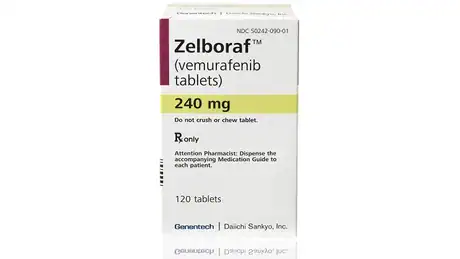
Vemurafenib 240mg Film-Coated Tablets — BRAF V600E Kinase Inhibitor for Unresectable or Metastatic BRAF V600E-Mutated Melanoma and BRAF V600E Mutation-Positive Erdheim-Chester Disease
Supplied only against a valid prescription from a registered medical practitioner.
Sourced from authorised channels
Temperature-controlled packing
Hospitals, clinics, pharmacies
Delhi drug licence holder
Zelbaoraf® (Vemurafenib) — The Original BRAF Inhibitor That Established Targeted Therapy in Melanoma
The First BRAF Inhibitor to Demonstrate Overall Survival Benefit in BRAF V600E-Mutated Metastatic Melanoma — Pioneer of Precision Oncology in Skin Cancer
Zelbaoraf® (Vemurafenib) is a selective oral BRAF V600E kinase inhibitor — the first BRAF inhibitor to receive regulatory approval for any cancer indication and the first targeted therapy to demonstrate significant overall survival benefit in BRAF V600E-mutated metastatic melanoma. Vemurafenib selectively inhibits constitutively active BRAF V600E kinase — blocking downstream MAPK/ERK signalling that drives uncontrolled melanoma cell proliferation and survival — transforming metastatic melanoma from a disease where median survival was less than 9 months on dacarbazine chemotherapy to one where targeted therapy can achieve median overall survival exceeding 13 months and durable responses in a significant subset of patients.
Although Rafinlar (Dabrafenib) + Meqsel (Trametinib) combination therapy has superseded Vemurafenib monotherapy as the standard first-line approach for BRAF V600E-mutated metastatic melanoma — based on the superior PFS and OS demonstrated in the COMBI-v trial — Zelbaoraf remains clinically relevant as a BRAF inhibitor option and retains its unique approval for BRAF V600E mutation-positive Erdheim-Chester disease (ECD) — a rare, non-Langerhans cell histiocytic neoplasm where Vemurafenib is the only approved targeted therapy.
A.K. Pharma is a trusted medicine distributor in Delhi supplying genuine Zelbaoraf (Vemurafenib) to hospitals, oncology centres, and pharmacies across India. Manufactured by Roche, Zelbaoraf is an essential medicine for BRAF V600E-mutated melanoma and Erdheim-Chester disease — requiring mandatory companion diagnostic BRAF V600E testing before prescribing.
What is Zelbaoraf (Vemurafenib)?
Zelbaoraf contains Vemurafenib — a selective, ATP-competitive small molecule inhibitor of BRAF V600E kinase that binds to and inhibits the constitutively active mutant BRAF V600E kinase — blocking the continuous MAPK pathway signalling that drives melanoma cell proliferation.
BRAF V600E in Melanoma — The Central Oncogenic Driver:
Approximately 50% of cutaneous melanomas harbour BRAF V600 mutations — with V600E (valine → glutamate at codon 600) accounting for approximately 80% of BRAF-mutated melanomas. BRAF V600E creates a constitutively active BRAF kinase that:
Vemurafenib’s Mechanism: Vemurafenib was designed using structure-based drug design — binding selectively to the ATP-binding cleft of BRAF V600E in its active (DFG-in) conformation. This conformational selectivity (active conformation binding) provides selectivity for constitutively active mutant BRAF V600E over wild-type BRAF.
The Paradoxical Activation Problem — Why Vemurafenib Monotherapy Is No Longer Preferred: In RAS wild-type cells (including normal keratinocytes), BRAF inhibition paradoxically activates the MAPK pathway through CRAF dimerisation — causing cutaneous squamous cell carcinoma (cuSCC) in 15-20% of patients and driving early acquired resistance in melanoma cells through various downstream reactivation mechanisms. This paradoxical activation is the key pharmacological limitation of BRAF inhibitor monotherapy — addressed by adding MEK inhibition (Meqsel/Trametinib) in the combination approach.
Full prescribing information is available at the FDA label for Vemurafenib.
Clinical Studies and Evidence
BRIM-3 Trial (Vemurafenib vs Dacarbazine in BRAF V600E-Mutated Metastatic Melanoma) Published in the New England Journal of Medicine (2011) — the landmark BRIM-3 trial was a Phase 3 randomised controlled trial of 675 patients with previously untreated BRAF V600E-mutated unresectable Stage IIIC or IV melanoma — comparing Vemurafenib vs Dacarbazine chemotherapy. This was the pivotal trial that established BRAF inhibition as a treatment paradigm in melanoma. Key results:
The BRIM-3 trial represented one of the most dramatic treatment advances in oncology at the time of publication — demonstrating that a molecularly targeted therapy could nearly halve the risk of death in metastatic melanoma vs the established chemotherapy standard.
COMBI-v Trial (Dabrafenib + Trametinib vs Vemurafenib — Establishing Combination Superiority) Published in the New England Journal of Medicine (2015) — the COMBI-v trial directly compared Rafinlar (Dabrafenib) + Meqsel (Trametinib) vs Vemurafenib monotherapy in 704 patients with BRAF V600E/K-mutated metastatic melanoma:
Vemurafenib in Erdheim-Chester Disease (ECD) Published in Blood (2018), the pivotal VE-BASKET trial basket study specifically evaluated Vemurafenib in BRAF V600E-mutated non-melanoma histiocytic disorders — including Erdheim-Chester disease. Key results:
Erdheim-Chester Disease — Why Vemurafenib is Critical: ECD is a rare non-Langerhans cell histiocytosis characterised by pathological foamy macrophage (histiocyte) infiltration of multiple organs — most commonly bones, retroperitoneum, lungs, skin, and the central nervous system. BRAF V600E mutations occur in approximately 55-60% of ECD patients. Before Vemurafenib, treatment was limited to interferon-alpha (poorly tolerated) and cytotoxic chemotherapy — Vemurafenib is the first and currently only targeted therapy approved specifically for BRAF V600E ECD and represents a paradigm shift in management.
Cobimetinib + Vemurafenib (BRAF + MEK Combination Using Vemurafenib): The coBRIM trial demonstrated Vemurafenib + Cobimetinib (a MEK inhibitor) was superior to Vemurafenib monotherapy in BRAF V600E-mutated metastatic melanoma — providing an alternative BRAF + MEK combination regimen using Vemurafenib as the BRAF inhibitor backbone.
Available Strengths
Zelbaoraf is available as:
| Presentation | Dose | Standard Daily Dose |
|---|---|---|
| Zelbaoraf 240mg Film-Coated Tablets | 240mg per tablet | 960mg twice daily (four 240mg tablets twice daily — 1920mg total daily) |
Standard dose: 960mg (four 240mg tablets) orally twice daily — with or without food — approximately 12 hours apart.
The 240mg tablet strength requires four tablets per dose (four tablets twice daily = eight tablets per day total) — this high pill burden is worth noting for patient counselling. The tablets are film-coated and may be taken whole.
Indications — What Zelbaoraf is Used For
Unresectable or Metastatic BRAF V600E-Mutated Melanoma:
BRAF V600E Mutation-Positive Erdheim-Chester Disease:
Mandatory BRAF V600E Testing — Companion Diagnostic: BRAF V600E mutation testing by a validated diagnostic test is mandatory before prescribing Zelbaoraf for either indication. The cobas 4800 BRAF V600 Mutation Test (Roche Diagnostics) is the FDA-approved companion diagnostic for the melanoma indication. NGS-based testing can also identify BRAF V600E mutations for either indication.
For detailed indication information refer to MedlinePlus Vemurafenib.
Key Benefits of Zelbaoraf
Historical Pioneer — First BRAF Inhibitor and First Precision Oncology Advance in Melanoma Vemurafenib was the first molecularly targeted therapy to demonstrate significant OS benefit in metastatic melanoma — fundamentally transforming a disease with historically dismal outcomes. BRIM-3’s demonstration of 63% reduction in risk of death vs dacarbazine at interim analysis remains one of the most dramatic efficacy signals ever seen in a randomised oncology trial — establishing BRAF inhibition as a transformative melanoma treatment concept.
High and Rapid Response Rates Vemurafenib achieves objective response in approximately 48% of BRAF V600E-mutated metastatic melanoma patients — including complete responses — with responses often occurring within the first 2-4 weeks of treatment. This rapid tumour shrinkage is clinically important for patients with symptomatic high-burden metastatic disease requiring urgent response.
First and Only Approved Targeted Therapy for Erdheim-Chester Disease Vemurafenib’s ECD indication is unique — it is the only approved targeted therapy for this rare but serious condition. For BRAF V600E-mutated ECD patients — who previously had no approved targeted option — Zelbaoraf provides a 54% response rate and disease control in 85% of patients. This ECD indication makes Zelbaoraf irreplaceable in the rare disease oncology portfolio.
Oral Twice-Daily Dosing — Outpatient Management Oral administration twice daily — no infusions required — allows complete outpatient management and maintains patient independence.
Room Temperature Storage — No Cold Chain Required Unlike Rafinlar (Dabrafenib) and Meqsel (Trametinib) which require refrigeration — Vemurafenib is stored at room temperature — simplifying storage and supply logistics.
Extensive Real-World Evidence — Over a Decade of Clinical Experience With regulatory approval since 2011, Vemurafenib has over a decade of real-world clinical data — providing comprehensive safety characterisation and enabling informed management of its known toxicity profile including cutaneous toxicity, hepatotoxicity, and QT prolongation.
How Zelbaoraf Works — Selective BRAF V600E Inhibition
Normal vs Mutant BRAF Signalling:
Normal BRAF is activated transiently by upstream RAS-GTP → BRAF dimerises → activates MEK → ERK → promotes proliferation transiently in response to growth factor stimulation → RAS-GTP hydrolysis turns off the signal.
BRAF V600E mutation — valine to glutamate at position 600 in the activation loop → stabilises BRAF in the active DFG-in conformation → constitutively active BRAF kinase that does not require RAS activation → continuous MEK → ERK signalling → continuous melanoma cell proliferation regardless of growth factor input.
Vemurafenib’s Mechanism:
Step 1 — Selective Active Conformation Binding: Vemurafenib was specifically designed to bind BRAF V600E in its constitutively active DFG-in conformation — occupying the ATP-binding cleft and forming critical hydrogen bonds with the hinge region. The glutamate at position 600 (V600E) directly stabilises the active conformation that Vemurafenib preferentially binds — contributing to selectivity for mutant over wild-type BRAF.
Step 2 — BRAF V600E Kinase Inhibition: With Vemurafenib occupying the ATP-binding cleft, BRAF V600E cannot bind ATP and therefore cannot phosphorylate MEK → MEK → ERK signalling cascade is interrupted in melanoma cells.
Step 3 — ERK Pathway Suppression: Without MEK → ERK activation — ERK-dependent transcription factors (ETS, AP-1, MYC) are not activated → proliferation genes (cyclin D1, CDK4, etc.) are not transcribed → melanoma cell cycle arrests in G1.
Step 4 — Tumour Response: Melanoma cells deprived of BRAF V600E-driven ERK signalling undergo cell cycle arrest and eventually apoptosis → tumour volume reduces → PSA-equivalent response (lactate dehydrogenase, S100B) and radiological tumour shrinkage.
The Paradox — Why Acquired Resistance and cuSCC Occur: In RAS-activated cells (including cancer cells that develop RAS mutations, and normal keratinocytes which have intermittent RAS activity), Vemurafenib binding to one BRAF molecule paradoxically drives transactivation of the other BRAF molecule in the obligate BRAF dimer → activates downstream signalling through CRAF → ERK reactivation → resistance in cancer, keratinocyte hyperproliferation → cuSCC in skin.
This paradoxical activation is blocked by MEK inhibition — explaining why Rafinlar + Meqsel combination provides superior outcomes and dramatically reduces cuSCC.
For detailed mechanism overview refer to ESMO Melanoma Guidelines and NCCN Melanoma Guidelines.
Zelbaoraf vs Rafinlar + Meqsel — When Is Each Used?
| Feature | Zelbaoraf (Vemurafenib) | Rafinlar + Meqsel (Dabrafenib + Trametinib) |
|---|---|---|
| Mechanism | BRAF V600E inhibitor monotherapy | BRAF inhibitor + MEK inhibitor combination |
| First-line melanoma OS | Median 13.6 months (BRIM-3) | Median 25.6 months (COMBI-v) — significantly superior |
| cuSCC incidence | 15-20% | <1% — dramatically reduced |
| Pyrexia | Low | 51% — major Dabrafenib side effect |
| Storage | ✅ Room temperature — no cold chain | ❌ Refrigerator 2-8°C — cold chain required |
| Pill burden | 4 tablets × 2 daily = 8 tablets/day | 2 capsules × 2 daily + 1 tablet = 5 doses/day |
| ECD indication | ✅ Yes — only approved targeted therapy | ❌ No — no ECD approval |
| Standard of care (melanoma) | Second-line option / ECD | ✅ First-line preferred |
| BRAF V600K activity | ✅ Some (V600E primarily) | ✅ Both V600E and V600K |
| Available at A.K. Pharma | Request Quote | Rafinlar + Meqsel |
Dosage and Administration
Standard Dose — Melanoma and ECD:
Missed Dose:
Dose Reduction Schedule:
Monitoring Schedule:
| Parameter | Frequency |
|---|---|
| Dermatological assessment — cuSCC, keratoacanthoma, new primary melanoma | Before starting; every 2 months during treatment; 6 months after stopping |
| ECG (QTc) | Before starting; monthly for first 3 months; then every 3 months |
| LFTs | Before starting; monthly for first 6 months; then every 3 months |
| Renal function | Before starting; then periodically |
| Ophthalmological assessment | At any new visual symptoms — uveitis risk |
| Electrolytes (K+, Mg²+) | Before starting and with QTc monitoring |
Full dosing guidelines available at Drugs.com Vemurafenib Dosage.
Who Should Use Zelbaoraf
Zelbaoraf is prescribed for:
Melanoma:
Erdheim-Chester Disease (ECD):
Zelbaoraf is prescribed by medical oncologists, dermatologists (for melanoma), and haematologists/immunologists (for ECD). A.K. Pharma supplies Zelbaoraf to hospitals, oncology centres, and pharmacies across Delhi and India.
Possible Side Effects
Common side effects include arthralgia/joint pain (53%), rash (52%), fatigue (54%), alopecia (45%), nausea (35%), photosensitivity reaction (33%), pruritus (30%), skin papilloma (21%), and constipation (21%).
Cutaneous Toxicity — The Most Distinctive Vemurafenib Side Effect:
Cutaneous Squamous Cell Carcinoma (cuSCC) and Keratoacanthoma: The most clinically significant cutaneous adverse effect — occurring in approximately 15-20% of patients. Due to paradoxical MAPK activation in BRAF wild-type keratinocytes. Generally well-differentiated, low-grade cuSCC that can be managed surgically without stopping Vemurafenib. Monthly or bimonthly dermatological monitoring is mandatory. Continue Vemurafenib while managing cuSCC surgically.
Photosensitivity: Severe photosensitivity in approximately 10-12% — patients must use broad-spectrum SPF 30+ sunscreen, protective clothing, and avoid prolonged sun exposure throughout treatment.
Rash: Diffuse, sometimes severe maculopapular or lichenoid rash in approximately 37% of patients — usually manageable with topical corticosteroids.
Serious side effects include:
QT Prolongation: Vemurafenib prolongs the QTc interval — Grade 3 (QTc >500ms) in approximately 3.3%. Mandatory ECG monitoring (monthly for first 3 months, then quarterly). Correct electrolytes before starting. Avoid concomitant QT-prolonging medicines. Withhold for QTc >500ms; permanently discontinue for recurrent Grade 3 or any Grade 4.
Hepatotoxicity: LFT elevation in approximately 11-15% — Grade 3-4 in 1-7%. Monthly LFT monitoring for first 6 months. Withhold for Grade 3; permanently discontinue for Grade 4.
Uveitis: Uveitis occurs in approximately 2.1% — ophthalmological evaluation for any visual symptoms (eye pain, redness, blurred vision, photophobia). Treat with topical corticosteroids; withhold Vemurafenib for severe uveitis.
DRESS Syndrome: Drug reaction with eosinophilia and systemic symptoms — rare but potentially fatal; permanently discontinue.
New Primary Melanoma: New primary melanoma tumours (BRAF wild-type) have occurred during Vemurafenib treatment — due to paradoxical MAPK activation. Manage per standard melanoma protocols; continue Vemurafenib.
Embryo-Foetal Toxicity: Vemurafenib can cause foetal harm. Effective contraception required during treatment and for 2 weeks after last dose.
Full side effect information available at FDA Vemurafenib Safety Information.
Precautions
Storage and Handling
As a responsible medicine distributor in Delhi, A.K. Pharma stores all medicines including Zelbaoraf under manufacturer-recommended conditions ensuring product integrity for every supply.
Manufacturer Information
Zelbaoraf (Vemurafenib) is manufactured by Roche / Genentech, a global pharmaceutical company with a leading oncology portfolio. Vemurafenib received FDA approval in August 2011 — the first BRAF inhibitor approved for any cancer indication — for BRAF V600E-mutated unresectable or metastatic melanoma. The ECD indication was approved in November 2017. A.K. Pharma supplies only genuine Zelbaoraf sourced from authorized Roche distributors.
Related Cancer Medicines Available at A.K. Pharma
Frequently Asked Questions
Q. What is Zelbaoraf used for? Zelbaoraf (Vemurafenib) is used to treat unresectable or metastatic BRAF V600E-mutated melanoma and BRAF V600E mutation-positive Erdheim-Chester disease (ECD). BRAF V600E testing is mandatory before prescribing for either indication. More information available at MedlinePlus.
Q. What is the generic name of Zelbaoraf? The generic name of Zelbaoraf is Vemurafenib. It is a selective BRAF V600E kinase inhibitor — the world’s first approved BRAF inhibitor — manufactured by Roche/Genentech.
Q. What is Erdheim-Chester Disease and why is Zelbaoraf important for it? Erdheim-Chester disease (ECD) is a rare non-Langerhans cell histiocytosis — a condition where pathological histiocyte (macrophage-derived) cells infiltrate multiple organs including bones, retroperitoneum, lungs, skin, and brain. BRAF V600E mutations occur in approximately 55-60% of ECD patients and drive disease through constitutive MAPK pathway activation. Before Vemurafenib, no targeted therapy was approved for ECD — treatment was limited to interferon-alpha and chemotherapy. Vemurafenib is the first and only FDA-approved targeted therapy for BRAF V600E ECD, achieving responses in 54% and disease control in 85% of patients.
Q. Is Vemurafenib still used for melanoma when Dabrafenib + Trametinib is available? Current guidelines recommend Rafinlar (Dabrafenib) + Meqsel (Trametinib) combination as the preferred first-line approach for BRAF V600E-mutated metastatic melanoma — based on the COMBI-v trial demonstrating significantly superior OS (25.6 vs 18.0 months) and dramatically reduced cuSCC rates (<1% vs 15-20%). Vemurafenib monotherapy is an alternative in settings where the combination is not feasible or accessible. Zelbaoraf remains the only approved targeted therapy for Erdheim-Chester disease — its unique ECD indication is not shared by Dabrafenib or the combination.
Q. Why does Vemurafenib cause skin tumours (cuSCC)? BRAF inhibitors in BRAF wild-type cells (including normal keratinocytes) paradoxically activate the MAPK pathway through CRAF dimerisation — causing excessive ERK signalling in skin cells, driving keratinocyte hyperproliferation → cutaneous squamous cell carcinoma and keratoacanthoma in 15-20% of patients. This paradoxical activation is blocked by MEK inhibition — which is why the Dabrafenib + Trametinib combination dramatically reduces cuSCC to <1%. Regular dermatological monitoring every 2 months is mandatory with Vemurafenib.
Q. Is BRAF testing required before prescribing Zelbaoraf? Yes — BRAF V600E mutation testing by a validated companion diagnostic is mandatory. Zelbaoraf must NOT be used in BRAF wild-type melanoma — paradoxical MAPK activation from BRAF inhibitors in wild-type tumours can accelerate cancer progression rather than inhibit it.
Q. Does Zelbaoraf need refrigeration? No — Vemurafenib is stored at room temperature below 30°C. This is a significant practical advantage over Rafinlar (Dabrafenib) and Meqsel (Trametinib) which both require refrigerator storage (2-8°C).
Q. Is Zelbaoraf available in India? Zelbaoraf can be supplied to hospitals, oncology centres, and pharmacies across India through licensed pharmaceutical distributors. Contact A.K. Pharma — medicine distributor in Delhi — for availability and pricing.
Q. What is the price of Zelbaoraf in India? Zelbaoraf 240mg price in India varies by pack size. Contact A.K. Pharma at 011 4172 6999 or WhatsApp +91 9810034827 for current pricing and bulk supply rates.
Q. How to order Zelbaoraf from A.K. Pharma? You can request a quote directly from this page, call us at 011 4172 6999, or WhatsApp us at +91 9810034827 with your requirements and we will respond promptly.
Q. Does A.K. Pharma supply Zelbaoraf in bulk? Yes. A.K. Pharma supplies Zelbaoraf in bulk to oncology centres, hospitals, and pharmacies across Delhi and India. Contact us for bulk pricing and availability.
Why Order Zelbaoraf from A.K. Pharma?
Contact A.K. Pharma for Zelbaoraf Supply 📍 E-2/257A, 2nd Floor, Shastri Nagar, New Delhi 110052 📞 011 4172 6999 📱 WhatsApp: +91 9810034827 🌐 akpharma.in