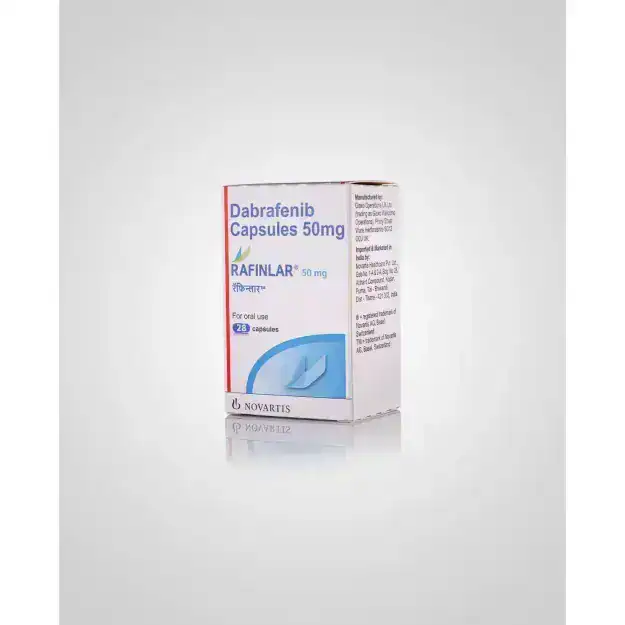
Dabrafenib 50mg, 75mg Capsules — BRAF V600 Kinase Inhibitor for BRAF V600-Mutated Metastatic Melanoma, NSCLC, Anaplastic Thyroid Cancer and Other BRAF V600E-Mutated Solid Tumours — Used in Combination With Meqsel (Trametinib)
Supplied only against a valid prescription from a registered medical practitioner.
Sourced from authorised channels
Temperature-controlled packing
Hospitals, clinics, pharmacies
Delhi drug licence holder
Rafinlar® (Dabrafenib) — BRAF Inhibitor for BRAF V600-Mutated Cancers
The Essential BRAF Inhibitor Backbone — Used in Combination With Meqsel (Trametinib) for Dual MAPK Pathway Blockade Across Multiple BRAF V600-Mutated Tumour Types
Rafinlar® (Dabrafenib) is a selective, potent ATP-competitive inhibitor of BRAF kinase — specifically targeting BRAF V600E and V600K mutant kinases — used in combination with Meqsel (Trametinib) as the Dabrafenib + Trametinib dual MAPK pathway blockade regimen for treatment of BRAF V600-mutated unresectable or metastatic melanoma, BRAF V600E-mutated metastatic non-small cell lung cancer (NSCLC), BRAF V600E-mutated locally advanced or metastatic anaplastic thyroid cancer (ATC), and other BRAF V600E-mutated unresectable or metastatic solid tumours after prior therapy.
As the BRAF inhibitor component of the Dabrafenib + Trametinib combination — the most comprehensively evidenced dual MAPK pathway blockade regimen in oncology — Rafinlar directly inhibits the mutant BRAF V600 kinase that constitutively drives MAPK pathway signalling in BRAF-mutated cancers. Combined with Meqsel (Trametinib) — the MEK inhibitor that blocks downstream MAPK pathway reactivation — the Dabrafenib + Trametinib combination provides synergistic and sustained MAPK pathway suppression that significantly outperforms either agent alone across all BRAF V600-mutated indications.
A.K. Pharma is a trusted medicine distributor in Delhi supplying genuine Rafinlar (Dabrafenib) in both 50mg and 75mg capsule strengths alongside Meqsel (Trametinib) — enabling complete procurement of both Dabrafenib + Trametinib combination regimen components from a single distributor. Manufactured by Novartis India Ltd, Rafinlar is an essential precision oncology medicine for BRAF V600-mutated cancers requiring mandatory companion diagnostic BRAF testing before prescribing.
What is Rafinlar (Dabrafenib)?
Rafinlar contains Dabrafenib — a selective, ATP-competitive small molecule inhibitor that targets the BRAF V600E and V600K mutant kinase — blocking its constitutive kinase activity and suppressing downstream MAPK signalling in BRAF-mutated cancer cells.
BRAF V600 Mutations — The Oncogenic Driver:
The BRAF proto-oncogene encodes a serine/threonine kinase that is a critical component of the RAS/RAF/MEK/ERK (MAPK) signalling cascade — controlling cell proliferation, survival, and differentiation in response to growth factor stimulation.
BRAF V600 mutations — most commonly V600E (valine → glutamate substitution at codon 600) and V600K — occur in the BRAF kinase domain activation loop, disrupting the autoinhibitory DFG-in conformation → constitutively active BRAF kinase that drives continuous MEK → ERK signalling independent of upstream RAS activation.
Consequences of constitutive BRAF V600 activation:
BRAF V600 Mutation Frequencies:
Dabrafenib vs Vemurafenib — Key Structural Distinctions: Dabrafenib and Vemurafenib are both BRAF V600 inhibitors but differ structurally:
Full prescribing information is available at the FDA label for Dabrafenib.
Clinical Studies and Evidence
COMBI-d Trial (Dabrafenib + Trametinib vs Dabrafenib Monotherapy in Melanoma) Published in the New England Journal of Medicine (2014) with 5-year OS data in The Lancet (2019), COMBI-d was a Phase 3 randomised controlled trial of 423 patients with BRAF V600E/K-mutated unresectable or metastatic melanoma — comparing Dabrafenib + Trametinib vs Dabrafenib + placebo. Key results at 5-year follow-up:
COMBI-v Trial (Dabrafenib + Trametinib vs Vemurafenib in Melanoma) Published in the New England Journal of Medicine (2015) with 5-year OS data, COMBI-v was a Phase 3 randomised controlled trial of 704 patients with BRAF V600E/K-mutated metastatic melanoma — comparing Dabrafenib + Trametinib vs Vemurafenib (BRAF inhibitor monotherapy). Key results:
Pooled COMBI-d and COMBI-v 5-Year Analysis: The pooled 5-year analysis of 563 patients from both COMBI trials — published in the New England Journal of Medicine (2019) — demonstrated:
BRF113928 Trial (Dabrafenib + Trametinib in BRAF V600E NSCLC) Published in the New England Journal of Medicine (2017), this Phase 2 trial demonstrated:
BRF117019 Trial (Dabrafenib + Trametinib in BRAF V600E Anaplastic Thyroid Cancer) Published in the Journal of Clinical Oncology (2018):
ROAR and NCI-MATCH Basket Trials (Tumour-Agnostic BRAF V600E): These tumour-agnostic basket trials demonstrated Dabrafenib + Trametinib activity across multiple BRAF V600E-mutated solid tumours — including biliary tract cancer, colorectal cancer, glioma, and others — leading to the first tumour-agnostic approval for any BRAF V600E-mutated solid tumour after prior therapy.
Available Strengths
Rafinlar is available in the following capsule strengths:
| Strength | Use |
|---|---|
| Rafinlar 50mg Capsules | Dose reduction — two 50mg = 100mg per dose (reduced dose) |
| Rafinlar 75mg Capsules | Standard dose — two 75mg = 150mg per dose (standard dose) |
Standard dose: 150mg (two 75mg capsules) orally twice daily — approximately 12 hours apart — on an empty stomach.
Storage — Critical: Rafinlar capsules must be stored in a refrigerator at 2°C to 8°C — protected from moisture and light. This cold chain storage requirement is the same as Meqsel (Trametinib) — both components of the combination regimen require cold chain management.
Both strengths are available from A.K. Pharma — enabling standard dosing and dose reduction as required for toxicity management.
Indications — What Rafinlar is Used For
BRAF V600E/K-Mutated Unresectable or Metastatic Melanoma:
BRAF V600E-Mutated Metastatic NSCLC:
BRAF V600E-Mutated Locally Advanced or Metastatic Anaplastic Thyroid Cancer:
BRAF V600E-Mutated Unresectable or Metastatic Solid Tumours (Tumour-Agnostic):
Mandatory BRAF V600 Mutation Testing: BRAF V600 mutation testing by a validated diagnostic test is mandatory before prescribing Rafinlar. BRAF V600E testing is required for all non-melanoma indications. Both V600E and V600K testing is recommended for melanoma (as V600K also responds to Dabrafenib + Trametinib). NGS-based comprehensive genomic profiling is the preferred testing approach.
For detailed indication information refer to MedlinePlus Dabrafenib.
Key Benefits of Rafinlar
34% 5-Year Survival in Metastatic Melanoma — A Historic Achievement The pooled COMBI 5-year analysis demonstrates 34% of BRAF V600-mutated metastatic melanoma patients treated with Dabrafenib + Trametinib are alive at 5 years — compared to historically <5% 5-year survival in metastatic melanoma before targeted therapy. This represents one of the most dramatic improvements in long-term cancer survival ever achieved — transforming metastatic melanoma from a near-uniformly fatal disease to one with meaningful long-term survival for a significant proportion of patients.
Superior to BRAF Inhibitor Monotherapy — Combination is Mandatory COMBI-d and COMBI-v demonstrate that Dabrafenib + Trametinib is significantly superior to Dabrafenib monotherapy and Vemurafenib monotherapy — in PFS, OS, and 5-year survival. BRAF inhibitor monotherapy is now clinically obsolete for BRAF V600-mutated melanoma. Rafinlar should always be used in combination with Meqsel (Trametinib).
Dramatically Reduced Cutaneous Toxicity vs BRAF Monotherapy BRAF inhibitor monotherapy causes paradoxical ERK activation in RAS wild-type keratinocytes → cutaneous squamous cell carcinoma (cuSCC) in 15-20% of patients. Adding Trametinib blocks this paradoxical ERK activation in skin → cuSCC rate falls from 15-20% to <1% with the combination. This is one of the most clinically important safety advantages of the combination over BRAF inhibitor monotherapy.
First Targeted Therapy for ATC — Transforming a Fatal Disease Anaplastic thyroid cancer historically had median survival of 3-5 months with no effective systemic therapy. Dabrafenib + Trametinib achieves 69% ORR and 14.5-month median OS in BRAF V600E ATC — fundamentally changing the natural history of this rapidly fatal cancer.
Tumour-Agnostic Activity — Applicable Across BRAF V600E-Mutated Tumours The tumour-agnostic approval reflects the oncogene-driven nature of BRAF V600 signalling — the same mutation driving the same pathway in melanoma, lung cancer, thyroid cancer, and other solid tumours all respond to the same targeted combination. Rafinlar + Meqsel can be used across any BRAF V600E solid tumour after prior therapy.
Both BRAF and MEK Components Available From A.K. Pharma A.K. Pharma supplies both Rafinlar (Dabrafenib) and Meqsel (Trametinib) — both components of the Dabrafenib + Trametinib combination regimen from a single distributor. This simplifies procurement logistics for oncology centres managing BRAF-mutated cancer patients.
How Rafinlar Works — BRAF Inhibition in BRAF V600-Mutated Cancers
Normal MAPK Pathway Regulation:
Growth factor → receptor tyrosine kinase → RAS activation (RAS-GTP) → RAF kinase recruitment and dimerisation → MEK1/2 phosphorylation → ERK1/2 phosphorylation → nucleus translocation → transcription factor activation → proliferation gene expression → cell cycle entry.
This pathway is tightly regulated — RAS-GTP is quickly hydrolysed to RAS-GDP → pathway is switched off after transient growth factor stimulation.
BRAF V600 Mutation — Constitutive “On” Switch:
BRAF V600E/K mutations destabilise the inactive DFG-out conformation of BRAF → BRAF adopts a constitutively active DFG-in conformation → continuous kinase activity independent of upstream RAS. Mutant BRAF V600 can signal as a monomer (unlike wild-type BRAF which requires dimerisation) — this monomeric signalling is key to the pharmacology of BRAF inhibitors.
Dabrafenib’s Mechanism:
Step 1 — ATP-Competitive BRAF Binding: Dabrafenib binds to the ATP-binding cleft of BRAF V600E/K — with selectivity for the active (DFG-in) conformation stabilised by the V600 mutation. This selective binding for the active mutant conformation (vs the inactive conformation of wild-type BRAF) contributes to Dabrafenib’s selectivity for mutant over wild-type BRAF.
Step 2 — Mutant BRAF Kinase Inhibition: Without ATP binding, mutant BRAF V600 cannot phosphorylate MEK → MEK → ERK signalling cascade is interrupted → ERK phosphorylation falls → ERK-driven transcription of proliferation genes is suppressed.
Step 3 — Cancer Cell Growth Arrest: Without ERK-driven transcription:
The Paradox — Why BRAF Inhibitors Fail as Monotherapy:
Paradoxical MAPK Reactivation (the key resistance mechanism):
Why Combination With Trametinib (Meqsel) Overcomes This: Adding MEK inhibition (Trametinib) blocks MEK activation regardless of the upstream driver — whether by mutant BRAF (initial driver) or by CRAF-driven paradoxical reactivation (resistance mechanism). This comprehensive MAPK pathway suppression:
For detailed mechanism overview refer to ESMO Melanoma Guidelines and NCCN Melanoma Guidelines.
The Dabrafenib + Trametinib Combination — Complete Protocol
At A.K. Pharma both components are available:
| Medicine | Brand | Dose | Storage | Available |
|---|---|---|---|---|
| Dabrafenib (BRAF inhibitor) | Rafinlar | 150mg twice daily — empty stomach | Refrigerator 2-8°C | Request Quote |
| Trametinib (MEK inhibitor) | Meqsel | 2mg once daily — empty stomach | Refrigerator 2-8°C | Request Quote |
Standard Combination Dosing:
BRAF Testing Before Starting: BRAF V600 mutation testing is mandatory. Appropriate testing platforms:
Dosage and Administration
Standard Dose:
Dose Reduction Schedule (for toxicity):
Missed Dose:
Duration:
Monitoring Schedule:
| Parameter | Frequency |
|---|---|
| Dermatological assessment — cuSCC, new primary melanoma | Before starting; every 2 months during treatment; 6 months after stopping |
| Echocardiogram/LVEF | Before starting; then every 3 months (Trametinib-driven monitoring) |
| Ophthalmological assessment — RPED, uveitis | Before starting; any new visual symptoms — urgent assessment |
| Blood pressure | Before starting; regularly throughout |
| Blood glucose | Before starting; monthly during treatment |
| LFTs | Baseline; monthly for first 6 months; then every 3 months |
| CBC | Baseline; as clinically indicated |
Full dosing guidelines available at Drugs.com Dabrafenib Dosage.
Who Should Use Rafinlar
Rafinlar is prescribed for:
Pre-Treatment Requirements:
Rafinlar is prescribed by medical oncologists, dermatologists (for melanoma), thoracic oncologists, and thyroid cancer specialists. A.K. Pharma supplies Rafinlar alongside Meqsel to hospitals, oncology centres, and pharmacies across Delhi and India.
Possible Side Effects
Common side effects include pyrexia/fever (51% — the most distinctive Dabrafenib-specific side effect), fatigue (41%), nausea (35%), headache (29%), arthralgia (27%), alopecia (24%), palmar-plantar erythrodysaesthesia (22%), and rash (17%).
Dabrafenib-Specific Side Effects:
Pyrexia (Fever) — The Most Common and Distinctive Toxicity: Fever occurs in approximately 51% of patients on Dabrafenib + Trametinib — the most common reason for dose interruption. Fever often occurs within the first few weeks of treatment. Management:
Cutaneous Squamous Cell Carcinoma (cuSCC): cuSCC occurs in approximately 9-11% of patients on Dabrafenib monotherapy — but drops to <1% with Dabrafenib + Trametinib combination (Trametinib blocks paradoxical ERK activation in skin). Dermatological monitoring every 2 months is mandatory. New skin lesions should be biopsied; cuSCC excised; continue Dabrafenib (cuSCC is managed surgically, not by stopping treatment).
Hyperglycaemia: Blood glucose elevation in approximately 58% of patients — dose-dependent. Monitor blood glucose monthly. Manage with anti-diabetic therapy as needed. Dose reduce or interrupt for severe hyperglycaemia.
Haemorrhage: Major haemorrhagic events reported — predominantly CNS haemorrhage and gastrointestinal haemorrhage. Monitor for signs of bleeding.
Full side effect information available at FDA Dabrafenib Safety Information.
Precautions
Storage and Handling
As a responsible medicine distributor in Delhi, A.K. Pharma maintains full cold chain requirements during storage and supply of Rafinlar ensuring product integrity for every unit supplied.
Manufacturer Information
Rafinlar (Dabrafenib) is manufactured by Novartis India Ltd — the Indian subsidiary of Novartis AG, which acquired the Dabrafenib and Trametinib portfolio through its acquisition of GlaxoSmithKline’s oncology assets. Dabrafenib received FDA approval in May 2013 for BRAF V600E/K-mutated unresectable or metastatic melanoma. A.K. Pharma supplies only genuine Rafinlar sourced from authorized Novartis distributors.
Related Cancer Medicines Available at A.K. Pharma
Frequently Asked Questions
Q. What is Rafinlar used for? Rafinlar (Dabrafenib) is used in combination with Meqsel (Trametinib) for BRAF V600E or V600K-mutated unresectable or metastatic melanoma, BRAF V600E-mutated metastatic NSCLC, BRAF V600E-mutated anaplastic thyroid cancer, and other BRAF V600E-mutated solid tumours. BRAF testing is mandatory. More information available at MedlinePlus.
Q. What is the generic name of Rafinlar? The generic name of Rafinlar is Dabrafenib. It is a selective BRAF V600 kinase inhibitor manufactured by Novartis India Ltd — the same active ingredient as the originator Tafinlar.
Q. Can Rafinlar be used without Meqsel (Trametinib)? No — Dabrafenib monotherapy is clinically obsolete. The COMBI-d and COMBI-v trials demonstrate Dabrafenib + Trametinib is significantly superior to Dabrafenib alone in both PFS and OS. Current guidelines mandate the combination for all BRAF V600-mutated indications. Rafinlar should always be prescribed alongside Meqsel (Trametinib). Both are available from A.K. Pharma.
Q. Why does Rafinlar cause fever and how is it managed? Fever (pyrexia) occurs in approximately 51% of patients on Dabrafenib — it is the most distinctive and common side effect, often occurring in the first weeks of treatment. The mechanism is not fully understood but involves inflammatory cytokine release. Management: withhold Dabrafenib at fever ≥38.5°C, perform infection workup, use paracetamol for symptom relief, and restart at the same dose once fever resolves. For recurrent fever, prophylactic corticosteroids before restarting and dose reduction may be needed.
Q. What is the difference between Rafinlar and Zelbaoraf (Vemurafenib)? Both are BRAF V600 inhibitors but Rafinlar (Dabrafenib) is specifically used with Meqsel (Trametinib) as the Dabrafenib + Trametinib combination — the most extensively evidenced dual MAPK blockade regimen with 5-year OS data in melanoma. Zelbaoraf (Vemurafenib) is another BRAF inhibitor for BRAF V600E melanoma and hairy cell leukaemia. Dabrafenib + Trametinib has demonstrated superior OS vs Vemurafenib monotherapy in the COMBI-v trial.
Q. Does Rafinlar need to be stored in a fridge? Yes — Rafinlar (Dabrafenib) requires refrigeration between 2°C and 8°C — the same cold chain requirement as Meqsel (Trametinib). Do not leave at room temperature for extended periods. A.K. Pharma maintains cold chain storage for both Rafinlar and Meqsel throughout storage and supply.
Q. Is BRAF testing required before prescribing Rafinlar? Yes — BRAF V600 mutation testing is mandatory before prescribing Rafinlar. Melanoma requires V600E and V600K testing. All other indications require V600E testing specifically. NGS-based comprehensive genomic profiling is the preferred testing approach. Patients without confirmed BRAF V600 mutations should not receive Dabrafenib.
Q. Is Rafinlar available in India? Rafinlar can be supplied to hospitals, oncology centres, and pharmacies across India through licensed pharmaceutical distributors. Contact A.K. Pharma — medicine distributor in Delhi — for availability and pricing.
Q. What is the price of Rafinlar in India? Rafinlar price in India varies by strength (50mg or 75mg) and pack size. Contact A.K. Pharma at 011 4172 6999 or WhatsApp +91 9810034827 for current pricing and bulk supply rates.
Q. How to order Rafinlar from A.K. Pharma? You can request a quote directly from this page, call us at 011 4172 6999, or WhatsApp us at +91 9810034827. Please also enquire about Meqsel (Trametinib) when ordering Rafinlar to procure both combination components together.
Q. Does A.K. Pharma supply Rafinlar in bulk? Yes. A.K. Pharma supplies Rafinlar in bulk alongside Meqsel (Trametinib) to oncology centres, hospitals, and pharmacies across Delhi and India. Contact us for bulk pricing and availability.
Why Order Rafinlar from A.K. Pharma?
Contact A.K. Pharma for Rafinlar Supply 📍 E-2/257A, 2nd Floor, Shastri Nagar, New Delhi 110052 📞 011 4172 6999 📱 WhatsApp: +91 9810034827 🌐 akpharma.in