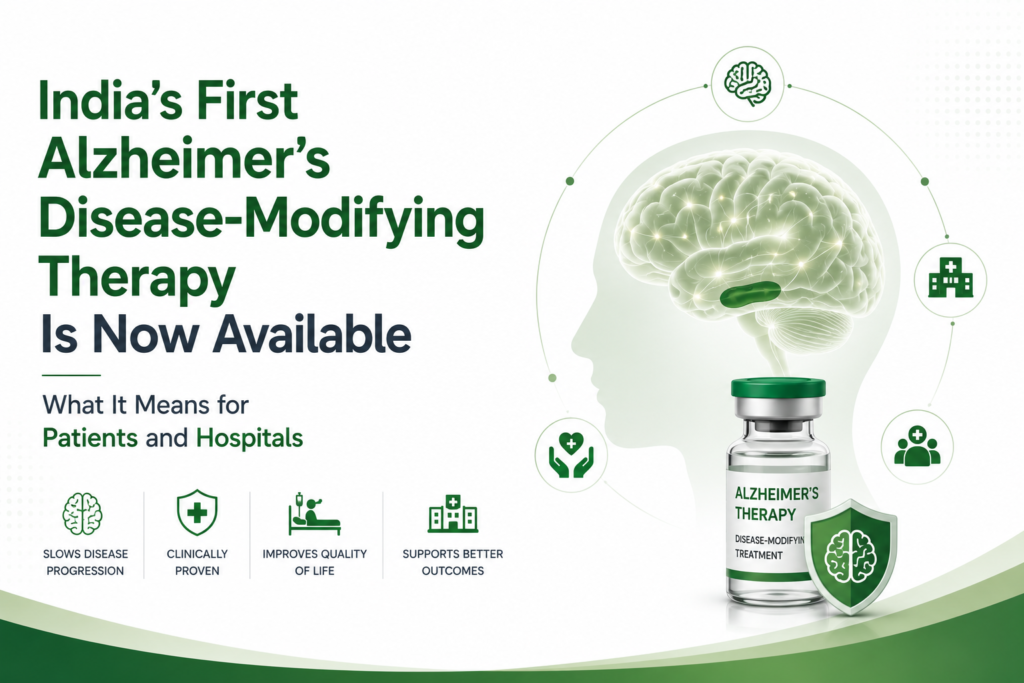
For decades, treating Alzheimer’s disease in India meant managing symptoms. Medications like rivastigmine and donepezil could slow cognitive decline for a period, but nothing available in the Indian market could actually target the disease process itself — the accumulating amyloid plaques in the brain that are understood to drive the neurodegeneration underlying Alzheimer’s.
That changed in May 2026.
Lormalzi (Donanemab), developed by Eli Lilly and Company and approved in India by the Central Drugs Standard Control Organisation (CDSCO), became the first anti-amyloid therapy available in the Indian market — and with it, the first medicine in India’s history that directly targets a pathological hallmark of Alzheimer’s disease rather than only managing its symptoms.
This is a genuine inflection point for Indian neurology. Here is what it means for patients, families, and hospitals by medicine distributors in Delhi.
What Lormalzi Actually Does — And What It Does Not
Before getting into what this launch means, it is worth being precise about what Donanemab is and is not, because the word “cure” tends to appear in media coverage of any Alzheimer’s breakthrough, and it does not apply here.
Lormalzi (Donanemab) is a humanised monoclonal antibody that targets a specific modified form of amyloid beta — the protein that accumulates in plaques in the brains of Alzheimer’s patients. By binding to this form of amyloid, Donanemab is understood to facilitate the immune system’s clearance of amyloid plaques from the brain, according to Eli Lilly’s published prescribing information and the clinical data supporting its approval.
What the pivotal TRAILBLAZER-ALZ 2 trial, published in the Journal of the American Medical Association in 2023, demonstrated was a statistically significant slowing of clinical decline — not a reversal of it. Patients treated with Donanemab declined more slowly on validated cognitive and functional rating scales over a 76-week period compared to patients receiving placebo. The difference was meaningful in clinical terms, but it was a slowing, not a stopping or reversing, of the disease.
This distinction matters enormously for patients and families approaching Lormalzi with the hope that it will restore what has already been lost. It will not. What it may do — for patients who start treatment early enough, in the right clinical stage, with amyloid pathology confirmed — is give them more time at a functional level they would otherwise have left sooner.
For a disease where time and quality of life are precisely what families are fighting to preserve, that matters.
Who Can Actually Receive Lormalzi
This is the most important practical question for Indian patients and families reading about this launch, because not every patient with an Alzheimer’s diagnosis is a candidate for Lormalzi.
According to the approved prescribing information, Lormalzi is indicated for adults with early symptomatic Alzheimer’s disease — specifically mild cognitive impairment (MCI) due to Alzheimer’s disease, or mild dementia stage of the disease. This means:
- Patients with moderate or severe Alzheimer’s dementia are not currently within the approved indication
- Patients must have confirmed amyloid pathology before treatment can begin — demonstrated either through a PET scan that shows amyloid accumulation in the brain, or through cerebrospinal fluid (CSF) biomarker analysis
- Treatment decisions, including eligibility assessment, rest entirely with the treating neurologist following comprehensive clinical evaluation
The testing requirement is a significant practical consideration for Indian hospitals. Amyloid PET scanning is available at a relatively small number of centres in India — primarily in major metro hospitals — and CSF biomarker testing requires a lumbar puncture performed in a specialist neurology setting. This means the pathway to Lormalzi treatment begins with a neurologist at a centre equipped to perform and interpret these diagnostic tests, not simply with a general practitioner or even a general neurologist.
For families whose loved ones are already in moderate or advanced stages of Alzheimer’s disease, this launch — while historic — does not represent an immediately accessible treatment option under the current approved indication.
The Monitoring Requirement — What Families Need to Understand
Lormalzi carries a Boxed Warning in its prescribing information for a category of side effects called amyloid-related imaging abnormalities (ARIA) — changes visible on MRI that include brain swelling (ARIA-E) and microhaemorrhages (ARIA-H). These occur in a proportion of patients treated with anti-amyloid therapies and can in some cases cause symptoms including headache, confusion, dizziness, and visual disturbances.
The approved prescribing information requires MRI scans before treatment begins and at defined intervals during the early months of treatment — before the second, third, fourth, and seventh infusions — with treatment decisions dependent on what these scans show.
This monitoring requirement means that starting Lormalzi is not simply a matter of a prescription and a monthly infusion appointment. It requires a neurology centre with the MRI capacity and specialist expertise to interpret these scans, and the clinical infrastructure to manage any ARIA that occurs.
Families considering Lormalzi for a loved one should discuss this monitoring pathway with the treating neurologist in full before making any treatment decisions.
What This Launch Means for Indian Hospitals and Neurology Centres
From a hospital and procurement perspective, Lormalzi represents a new category of medicine in India’s specialty injectables landscape — one that sits closest to oncology biologics in terms of its supply chain complexity:
- Cold chain requirement: Lormalzi requires refrigerated storage between 2°C and 8°C throughout transit and storage, making it unsuitable for general pharmaceutical wholesale distribution
- Administered as an IV infusion: The current approved dosing schedule requires a monthly intravenous infusion following a titration schedule (350mg, 700mg, 1050mg, then 1400mg per month) — which means a dedicated infusion setting within the treating facility
- High unit cost: Lormalzi has been priced at approximately ₹91,688 per 350mg vial — a treatment cost that places it firmly in the specialty biologic category and raises immediate questions about patient access and support programs
- Specialist centre dependency: Given the MRI monitoring requirement and the amyloid testing prerequisite, Lormalzi demand will initially concentrate in tertiary neurology centres and memory clinics at major hospitals in metro cities
For neurology departments beginning to prepare for Lormalzi cases, establishing a supply relationship with a licensed medicine distributor in Delhi or other major city distributor who specialises in specialty injectables — rather than attempting to navigate import or cold chain logistics independently — is the practical starting point.
The Patient Access Question
At ₹91,688 per vial — with multiple vials required per infusion as the dose escalates through the titration schedule — the total monthly treatment cost for Lormalzi at the maintenance dose of 1400mg runs to approximately ₹3.67 lakh per month. Over a 12-month treatment course, that is a cost well beyond the reach of most Indian families without insurance coverage or manufacturer support.
Eli Lilly has historically operated patient assistance programs for its specialty medicines in India, and the availability of any such program for Lormalzi in the Indian market is a question families should raise directly with the treating neurologist and with licensed specialty distributors who maintain relationships with the manufacturer’s access programs.
A.K. Pharma, as a licensed medicine distributors in Delhi, supports hospitals and patients in navigating both Patient Assistance Programs and Named Patient Program pathways for specialty medicines — and supplies genuine Lormalzi (Donanemab) to hospitals and neurology centres across India with cold chain-compliant delivery and complete batch documentation.
What Families Should Do Now
If a family member has received an Alzheimer’s diagnosis and you are reading about Lormalzi wondering whether it applies to them, the most useful immediate step is a conversation with a specialist neurologist — not a general practitioner — at a centre with amyloid diagnostic capability.
The questions worth asking at that appointment:
- Is the diagnosis at the mild cognitive impairment or mild dementia stage, rather than moderate or severe?
- Is amyloid testing (PET scan or CSF biomarkers) available at this centre, and is there evidence of amyloid pathology?
- Does the centre have the infusion and MRI monitoring infrastructure required for Lormalzi treatment?
- Is there a patient assistance or access program available for Lormalzi?
If all of those answers are yes, Lormalzi represents a genuinely new option — the first of its kind in India — that a qualified neurologist can assess for suitability. If any of those answers is no, the right step is a referral to a centre that can address them, rather than pursuing the medicine outside of the appropriate clinical pathway.
A Note on What Comes Next
Lormalzi’s approval in India is the beginning of a new chapter in Alzheimer’s treatment, not a conclusion. Anti-amyloid therapy as a class will continue to evolve — additional agents, refined patient selection criteria, longer-term efficacy data, and potentially treatments that can be used at earlier stages of disease are all areas of active research. The landmark of this launch is that for the first time, Indian patients with early Alzheimer’s disease have a medicine available in their own market that treats the underlying biology of the disease rather than only its symptoms.
That is a meaningful milestone, even with all the caveats about who can currently access it, what it can and cannot do, and what the practical and financial pathway looks like.
Disclaimer: This article is intended for general informational purposes only and does not constitute medical advice. All decisions about Alzheimer’s treatment, including eligibility for Lormalzi, should be made by a qualified neurologist following comprehensive clinical evaluation. A.K. Pharma is a licensed medicine distributor and does not provide clinical guidance.