
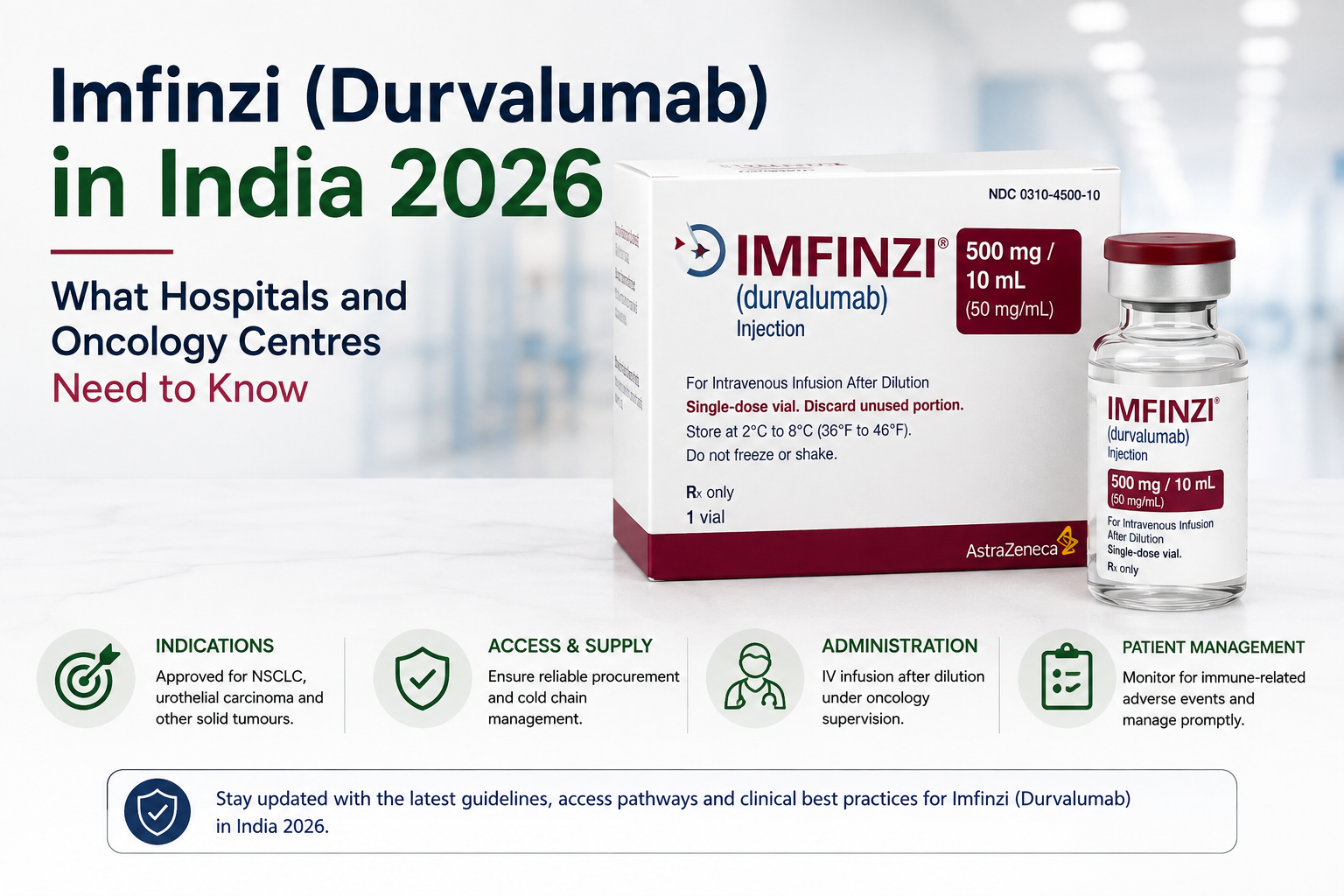
Imfinzi is one of the most searched oncology medicines on akpharma.in — generating over 1,400 impressions per month at position 6 on Google, with a click-through rate that suggests the page is being found but not telling visitors enough to bring them through. This article fills that gap. Whether you are a hospital pharmacist managing oncology procurement, an oncologist looking for sourcing context, or a patient or family member trying to understand what Imfinzi is and why it has been recommended, here is what you need to know.
What Is Imfinzi?
Imfinzi is the brand name for Durvalumab — a fully human monoclonal antibody developed by AstraZeneca that belongs to the checkpoint inhibitor class of cancer immunotherapy. Specifically, Durvalumab is a PD-L1 (programmed death-ligand 1) inhibitor — it works by blocking the interaction between PD-L1 on tumour cells and PD-1 on T lymphocytes, restoring the immune system’s ability to recognise and attack cancer cells.
Imfinzi is supplied as a 500mg/10mL concentrate for solution for infusion, administered intravenously at a licensed infusion centre under clinical supervision. It is not an oral medicine and is not self-administered.
The Checkpoint Inhibitor Mechanism — How Imfinzi Works
To understand how Durvalumab works, it helps to understand how cancer evades the immune system in the first place.
The immune system is designed to identify and eliminate abnormal cells — including cancer cells. T lymphocytes are the primary effectors of this anti-tumour immune response. However, tumour cells have developed mechanisms to evade immune recognition — one of the most important being the upregulation of PD-L1 on their surface.
PD-L1 binds to PD-1 receptors on T cells and effectively sends a “do not attack” signal — suppressing T cell activity and allowing the tumour to grow undetected. This checkpoint mechanism evolved to prevent excessive immune activation in normal tissue, but cancer cells exploit it to hide from immune surveillance.
According to the manufacturer’s approved prescribing information and published oncology immunology literature, Durvalumab works by binding to PD-L1 and blocking its interaction with both PD-1 and CD80 (B7.1) — freeing T cells from tumour-imposed suppression and restoring their ability to mount an anti-tumour immune response. Unlike PD-1 inhibitors such as Tishtha (Nivolumab) and Pembrolizumab, which block the receptor on the T cell, Durvalumab blocks the ligand on the tumour cell — a slightly different point of intervention in the same pathway.
Full prescribing information is available from the FDA label for Durvalumab, with additional clinical background available from the National Cancer Institute and the American Society of Clinical Oncology (ASCO).
What Is Imfinzi Approved For?
According to the approved prescribing information, Imfinzi (Durvalumab) is indicated for:
Unresectable Stage III Non-Small Cell Lung Cancer (NSCLC):
Adults with unresectable Stage III NSCLC whose disease has not progressed following concurrent platinum-based chemoradiation therapy. This is the landmark PACIFIC indication — the use of Durvalumab as consolidation immunotherapy following definitive chemoradiation in locally advanced unresectable NSCLC — and represents one of the most significant advances in lung cancer management in the past decade.
Extensive-Stage Small Cell Lung Cancer (ES-SCLC):
Adults with extensive-stage small cell lung cancer, in combination with etoposide and either carboplatin or cisplatin, as first-line treatment. This is the CASPIAN indication — Durvalumab added to standard platinum-based chemotherapy in first-line ES-SCLC.
Biliary Tract Cancer (BTC):
Adults with locally advanced or metastatic biliary tract cancer, in combination with gemcitabine and cisplatin, as first-line treatment. This is the TOPAZ-1 indication — a particularly significant approval for Indian oncology given the higher incidence of biliary tract cancers in the Indian population compared to Western markets.
Hepatocellular Carcinoma (HCC):
Adults with unresectable hepatocellular carcinoma, in combination with tremelimumab (Imjudo), as first-line treatment. This is the HIMALAYA indication — the combination of Durvalumab and the CTLA-4 inhibitor Tremelimumab in first-line unresectable HCC.
For detailed indication information refer to MedlinePlus Durvalumab and the NCCN Lung Cancer Guidelines.
Clinical Evidence — The Key Trials
PACIFIC Trial — Durvalumab in Unresectable Stage III NSCLC
Published in the New England Journal of Medicine (2017) with long-term follow-up data subsequently published in the Journal of Clinical Oncology, the pivotal PACIFIC trial evaluated Durvalumab as consolidation immunotherapy in patients with unresectable Stage III NSCLC who had not progressed after concurrent chemoradiation. Key findings demonstrated a significant improvement in progression-free survival (median 16.8 months vs 5.6 months with placebo) and a landmark improvement in overall survival — with 5-year overall survival rates of 42.9% in the Durvalumab arm versus 33.4% with placebo. The PACIFIC trial is widely considered one of the most important lung cancer trials of the past decade, establishing consolidation immunotherapy as standard of care in this setting.
CASPIAN Trial — Durvalumab in Extensive-Stage SCLC
Published in The Lancet (2019), the CASPIAN trial evaluated Durvalumab plus platinum-etoposide chemotherapy versus chemotherapy alone as first-line treatment in extensive-stage small cell lung cancer. Key findings demonstrated a significant improvement in overall survival with the addition of Durvalumab — median OS of 13.0 months versus 10.3 months with chemotherapy alone — supporting Durvalumab as an active agent in this historically difficult-to-treat cancer.
TOPAZ-1 Trial — Durvalumab in Biliary Tract Cancer
Published in the New England Journal of Medicine Evidence (2022), the TOPAZ-1 trial evaluated Durvalumab plus gemcitabine-cisplatin chemotherapy versus chemotherapy alone in patients with advanced biliary tract cancer. Key findings demonstrated a significant improvement in overall survival — 24-month overall survival of 24.9% with Durvalumab versus 10.4% with chemotherapy alone — establishing Durvalumab-based combination therapy as a new first-line standard in this indication. Given the relatively higher incidence of biliary tract cancer in India, the TOPAZ-1 data is particularly relevant for Indian oncology practice.
HIMALAYA Trial — Durvalumab Plus Tremelimumab in HCC
Published in JAMA Oncology (2022), the HIMALAYA trial evaluated the STRIDE regimen (a single priming dose of Tremelimumab followed by Durvalumab) versus Sorafenib as first-line treatment in unresectable hepatocellular carcinoma. Key findings demonstrated a significant improvement in overall survival with the STRIDE regimen — 36-month overall survival of 30.7% versus 24.0% with Sorafenib — supporting the dual checkpoint inhibition approach in this setting.
For broader clinical guidance on checkpoint inhibitor therapy in lung cancer, biliary tract cancer, and HCC, the European Society for Medical Oncology (ESMO) and NCCN guidelines publish updated treatment recommendations.
Available Strength and Dosing Reference
Imfinzi is supplied as:
| Presentation | Strength | Administration |
|---|---|---|
| Concentrate for solution for infusion | 500mg/10mL (50mg/mL) | Intravenous infusion over 60 minutes |
Standard Dosing (per approved prescribing information — dosing by treating oncologist):
| Indication | Dose | Frequency |
|---|---|---|
| Stage III NSCLC (PACIFIC) | 10mg/kg | Every 2 weeks for up to 12 months |
| ES-SCLC (CASPIAN) | 1,500mg | Every 3 weeks with chemotherapy, then every 4 weeks |
| Biliary Tract Cancer (TOPAZ-1) | 1,500mg | Every 3 weeks with gemcitabine-cisplatin, then every 4 weeks |
| HCC (HIMALAYA) | 1,500mg + Tremelimumab 300mg (priming dose) | Tremelimumab single dose at cycle 1, then Durvalumab every 4 weeks |
All dosing decisions including weight-based vs flat dosing, pre-medication, infusion rate, and any dose modifications are determined by the treating oncologist in accordance with the approved prescribing information.
Key Benefits of Imfinzi
PACIFIC — A Paradigm Shift in Stage III NSCLC
Before the PACIFIC data, unresectable Stage III NSCLC patients completing chemoradiation had limited options — the disease typically progressed within months. Durvalumab consolidation has transformed outcomes in this population, with 5-year survival rates nearly doubling compared to the pre-immunotherapy era in this setting.
Clinically Significant Benefit in Biliary Tract Cancer
The TOPAZ-1 data is particularly meaningful for Indian oncology — biliary tract cancers including cholangiocarcinoma and gallbladder cancer have a higher incidence in India than in Western populations, and historically had very poor prognosis with chemotherapy alone. The addition of Durvalumab to standard chemotherapy has produced clinically meaningful survival improvements in this patient population.
Dual Checkpoint Inhibition in HCC
The HIMALAYA STRIDE regimen represents a novel approach in hepatocellular carcinoma — combining PD-L1 and CTLA-4 blockade with a single priming dose of Tremelimumab followed by ongoing Durvalumab — providing a meaningful alternative to Sorafenib in first-line unresectable HCC.
PD-L1 Inhibition vs PD-1 Inhibition — a Distinct Mechanism
While the clinical differentiation between PD-L1 and PD-1 inhibitors in practice remains an area of ongoing research, Durvalumab’s PD-L1 blocking mechanism means it leaves the PD-1/PD-L2 pathway partially intact — a theoretical advantage in terms of maintaining certain aspects of normal immune regulation that may translate to a different toxicity profile compared to PD-1 inhibitors in some settings.
Side Effects
Imfinzi, like all checkpoint inhibitors, can cause immune-related adverse events (irAEs) — side effects that arise from the immune system becoming overactivated and attacking normal tissues. These can affect virtually any organ system and range from mild to severe.
Common side effects include:
Fatigue, musculoskeletal pain, constipation, decreased appetite, nausea, peripheral oedema, pyrexia, cough, and dyspnoea.
Serious immune-related adverse events include:
Immune-mediated pneumonitis: Inflammation of the lung — one of the most clinically significant irAEs with checkpoint inhibitors in lung cancer patients where underlying lung disease may already be present. Monitoring for new or worsening respiratory symptoms is essential.
Immune-mediated hepatitis: Liver inflammation — liver function monitoring is required before and during treatment per the approved prescribing information.
Immune-mediated endocrinopathies: Including thyroiditis, hypophysitis, adrenal insufficiency, and type 1 diabetes — endocrine monitoring is recommended throughout treatment.
Immune-mediated colitis: Diarrhoea and colitis — patients should be advised to report significant changes in bowel habits promptly.
Infusion-related reactions: Reported in some patients during or shortly after infusion — pre-medication protocols and observation during infusion are standard practice.
Full side effect information is available at FDA Durvalumab Safety Information and Drugs.com Durvalumab.
Precautions
- Immune-related adverse events — early recognition and management is critical; treatment interruption or discontinuation and corticosteroid therapy may be required depending on severity per approved prescribing information
- Pneumonitis — monitor closely particularly in NSCLC patients with pre-existing lung disease or post-radiation lung changes
- Liver function monitoring — baseline and periodic ALT, AST, and bilirubin required
- Endocrine monitoring — thyroid function, blood glucose, and clinical assessment for adrenal insufficiency throughout treatment
- Infusion-related reactions — pre-medication and monitoring per standard checkpoint inhibitor infusion protocols
- Pregnancy — can cause fetal harm; effective contraception required during and for 3 months after treatment per approved label
- Refer to manufacturer prescribing information and ESMO immunotherapy toxicity management guidelines for complete irAE management context
Storage and Handling
- Store in a refrigerator between 2°C and 8°C
- Do not freeze
- Protect from light
- Store in original carton
As one of Delhi’s most trusted pharmaceutical distribution companies, A.K. Pharma maintains cold chain-compliant storage and last-mile delivery for all checkpoint inhibitor infusion products including Imfinzi — ensuring every vial arrives at the oncology centre within the required 2°C to 8°C temperature range with temperature monitoring documentation.
Manufacturer Information
Imfinzi (Durvalumab) is manufactured by AstraZeneca, one of the world’s leading oncology-focused biopharmaceutical companies. AstraZeneca developed Durvalumab as part of its immuno-oncology portfolio — alongside the CTLA-4 inhibitor Tremelimumab (Imjudo) — and the combination STRIDE regimen in HCC represents one of the most clinically significant recent advances from AstraZeneca’s checkpoint inhibitor programme. A.K. Pharma supplies only genuine Imfinzi sourced from authorised AstraZeneca distribution channels. Unlike general wholesale pharmaceutical distributors, A.K. Pharma maintains verified cold chain sourcing and complete batch documentation for every oncology infusion product it supplies. Learn more about AstraZeneca’s oncology portfolio directly from the manufacturer.
Related Checkpoint Inhibitor and Oncology Medicines Available at A.K. Pharma
- Imfinzi (Durvalumab) — PD-L1 inhibitor for NSCLC, SCLC, BTC, and HCC
- Imjudo (Tremelimumab) — CTLA-4 inhibitor used in combination with Durvalumab in the HIMALAYA regimen for HCC
- Tishtha (Nivolumab) — PD-1 inhibitor for multiple solid tumours
- Tevimbra (Tislelizumab) — PD-1 inhibitor for oesophageal and gastric cancers
- Yervoy (Ipilimumab) — CTLA-4 inhibitor for melanoma and other solid tumours
- Trodelvy (Sacituzumab Govitecan) — ADC for triple-negative breast cancer and urothelial cancer
- Elahere (Mirvetuximab Soravtansine) — ADC for FRα-positive ovarian cancer
- Browse all Cancer Medicines at A.K. Pharma
- Browse the full Products range at A.K. Pharma
- Learn about the Named Patient Program for medicines requiring special import access
- Learn about the Patient Assistance Program for eligible patients
Frequently Asked Questions
Q. What is Imfinzi used for?
Imfinzi (Durvalumab) is approved for unresectable Stage III non-small cell lung cancer following chemoradiation (PACIFIC), extensive-stage small cell lung cancer in combination with chemotherapy (CASPIAN), advanced biliary tract cancer in combination with gemcitabine-cisplatin (TOPAZ-1), and unresectable hepatocellular carcinoma in combination with Tremelimumab (HIMALAYA), per the approved prescribing information.
Q. What is the generic name and strength of Imfinzi?
The generic name is Durvalumab, supplied as 500mg/10mL (50mg/mL) concentrate for solution for infusion, manufactured by AstraZeneca.
Q. How is Imfinzi administered?
Imfinzi is administered as an intravenous infusion over 60 minutes at a licensed infusion centre under clinical supervision. It is not an oral medicine and is not self-administered.
Q. What is the difference between Imfinzi and other checkpoint inhibitors like Tishtha or Yervoy?
Imfinzi (Durvalumab) is a PD-L1 inhibitor — it blocks the ligand on the tumour cell. Tishtha (Nivolumab) and Pembrolizumab are PD-1 inhibitors — they block the receptor on the T cell. Yervoy (Ipilimumab) and Imjudo (Tremelimumab) are CTLA-4 inhibitors — a different immune checkpoint pathway. These different mechanisms may be used alone or in combination depending on the indication and treating oncologist’s assessment.
Q. Why is Imfinzi particularly relevant for biliary tract cancer in India?
Biliary tract cancers — including cholangiocarcinoma and gallbladder cancer — have a higher incidence in India compared to Western populations. The TOPAZ-1 trial demonstrated that adding Durvalumab to standard gemcitabine-cisplatin chemotherapy significantly improved overall survival in advanced biliary tract cancer, with 24-month survival nearly doubling compared to chemotherapy alone. This makes Imfinzi particularly relevant for Indian oncology centres managing biliary tract cancer caseloads.
Q. What monitoring is required during Imfinzi treatment?
Regular monitoring of liver function, thyroid function, blood glucose, and clinical assessment for immune-related adverse events is required throughout treatment per the approved prescribing information. The treating oncologist will establish the specific monitoring schedule for each patient.
Q. Is Imfinzi available in India?
Imfinzi can be supplied to hospitals and oncology centres across India through licensed pharmaceutical distributors. Contact A.K. Pharma — one of Delhi’s trusted pharmaceutical distribution companies — for availability and pricing.
Q. What is the price of Imfinzi in India?
Imfinzi price in India varies by order quantity and dose requirements. Contact A.K. Pharma at 011 4172 6999 or WhatsApp +91 9810034827 for current pricing and bulk supply rates.
Q. Does Imfinzi need to be stored in a fridge?
Yes — Imfinzi must be stored between 2°C and 8°C and must not be frozen. Cold chain compliance throughout the supply chain is essential for product integrity. A.K. Pharma provides temperature monitoring documentation with every Imfinzi delivery.
Q. How to order Imfinzi from A.K. Pharma?
Call us at 011 4172 6999 or WhatsApp +91 9810034827 with your requirements and we will respond promptly.
Q. Does A.K. Pharma supply Imfinzi in bulk?
Yes. As one of Delhi’s established pharmaceutical distribution companies, A.K. Pharma supplies Imfinzi in bulk to hospitals and oncology centres across Delhi and India.
Why Order Imfinzi From A.K. Pharma?
- Licensed pharmaceutical distributors in Delhi with all required drug licenses
- One of Delhi’s trusted pharmaceutical distribution companies for specialty oncology infusion products
- 100% genuine Imfinzi sourced from authorised AstraZeneca distribution channels — not through grey-market wholesale pharmaceutical distributors
- Cold chain-compliant storage and last-mile delivery with temperature monitoring documentation
- Available alongside companion checkpoint inhibitor and oncology medicines — Imjudo, Tishtha, Tevimbra, Trodelvy, Elahere — simplifying oncology procurement
- Bulk supply available for hospitals and oncology centres
- Prompt response to all quote requests
- Serving oncologists across Delhi NCR and India as a trusted pharma distribution company
Contact A.K. Pharma for Imfinzi Supply
📍 E-2/257A, 2nd Floor, Shastri Nagar, New Delhi 110052
📞 011 4172 6999
📱 WhatsApp: +91 9810034827
🌐 akpharma.in
Disclaimer: This article is intended for informational and sourcing/procurement purposes only and does not constitute medical or clinical advice. All treatment decisions including drug selection, dosing, and monitoring should be made by a qualified oncologist in accordance with the approved prescribing information and current clinical guidelines. A.K. Pharma is a licensed medicine distributor and does not provide clinical guidance.