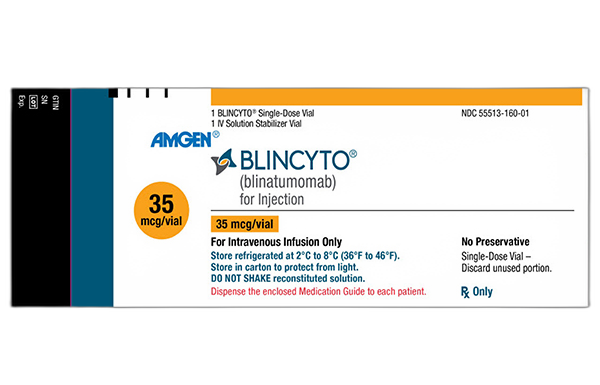
Blinatumomab 35mcg Injection — First-in-Class BiTE Antibody for Philadelphia Chromosome-Negative and Philadelphia Chromosome-Positive B-Cell Precursor Acute Lymphoblastic Leukaemia
Supplied only against a valid prescription from a registered medical practitioner.
Sourced from authorised channels
Temperature-controlled packing
Hospitals, clinics, pharmacies
Delhi drug licence holder
Blincyto® (Blinatumomab) — First-in-Class BiTE Antibody Revolutionising ALL Treatment
The World’s First Bispecific T-Cell Engager — Redirecting the Immune System to Eliminate Leukaemia Cells
Blincyto® (Blinatumomab) is a first-in-class bispecific T-cell engager (BiTE®) antibody construct that simultaneously binds to CD19 on B-cell leukaemia cells and CD3 on cytotoxic T-lymphocytes — physically connecting T-cells to leukaemia cells and activating T-cell killing of CD19-positive blast cells. Blinatumomab represents a fundamentally different approach to leukaemia treatment compared to chemotherapy — rather than using cytotoxic drugs, it harnesses the patient’s own immune system, redirecting T-cells to recognise and eliminate leukaemia cells with extraordinary potency. A single T-cell engaged by Blinatumomab can sequentially kill multiple leukaemia cells — a serial killing mechanism that amplifies anti-leukaemic activity far beyond what stoichiometric cytotoxic killing can achieve.
Blinatumomab is approved for treatment of relapsed or refractory B-cell precursor acute lymphoblastic leukaemia (ALL) — both Philadelphia chromosome-negative (Ph–) and Philadelphia chromosome-positive (Ph+) — and for treatment of B-cell precursor ALL in first or second complete remission with minimal residual disease (MRD). The MRD indication is particularly significant — Blinatumomab is the first therapy approved specifically for MRD-positive ALL, targeting the residual leukaemic cells that remain after standard chemotherapy-induced remission and drive eventual relapse.
A.K. Pharma is a trusted medicine distributor in Delhi supplying genuine Blincyto (Blinatumomab) to hospitals, haematology centres, oncology clinics, and pharmacies across India. Manufactured by Amgen, Blincyto represents one of the most innovative advances in haematological malignancy treatment — a true paradigm shift from cytotoxic to immune-mediated leukaemia elimination.
What is Blincyto (Blinatumomab)?
Blincyto contains Blinatumomab — a bispecific T-cell engager (BiTE) antibody construct. Unlike conventional monoclonal antibodies which have two identical binding sites for a single target, Blinatumomab is an engineered single-chain bispecific construct with two distinct binding domains:
CD19-Binding Domain: CD19 is a cell surface glycoprotein expressed on virtually all B-lineage cells — from early B-cell progenitors through mature B-lymphocytes. Critically, CD19 is expressed on essentially all B-cell precursor ALL cells — making it an ideal target for ALL-directed immunotherapy. The CD19-binding domain of Blinatumomab binds with high affinity to CD19 on leukaemia cells.
CD3-Binding Domain: CD3 is a cell surface complex expressed exclusively on T-lymphocytes — it is the signalling component of the T-cell receptor complex. The CD3-binding domain of Blinatumomab binds to CD3 on cytotoxic T-cells — activating T-cell killing mechanisms.
The BiTE Bridge — Physical T-Cell/Leukaemia Cell Contact: By simultaneously binding CD19 on leukaemia cells and CD3 on T-cells, Blinatumomab forms a physical bridge between the two cell types — creating an immunological synapse between the T-cell and the leukaemia cell. This proximity and the CD3 cross-linking activates T-cell cytotoxic mechanisms — release of perforin and granzymes into the immunological synapse → leukaemia cell membrane disruption and DNA fragmentation → leukaemia cell apoptosis.
Serial Killing and Catalytic Activity: A critical and unique feature of Blinatumomab’s mechanism is its catalytic nature — after killing one leukaemia cell, the T-cell is released from the dead cell and can immediately re-engage another CD19-positive leukaemia cell. A single T-cell can sequentially kill hundreds of leukaemia cells — dramatically amplifying the anti-leukaemic effect relative to the number of T-cells available.
T-Cell Activation Without Antigen Presentation: Conventional T-cell activation requires MHC-restricted antigen presentation — leukaemia cells that downregulate MHC class I can evade immune recognition. Blinatumomab bypasses MHC restriction entirely — it activates T-cells through CD3 cross-linking independent of TCR-MHC interaction — meaning leukaemia cells cannot escape through MHC downregulation.
Full prescribing information is available at the FDA label for Blinatumomab.
Clinical Studies and Evidence
TOWER Trial (Blinatumomab vs Chemotherapy in Relapsed/Refractory Ph– ALL) Published in the New England Journal of Medicine (2017), the landmark TOWER trial was a Phase 3 randomised controlled trial of 405 adult patients with relapsed or refractory Ph– B-cell precursor ALL — comparing Blinatumomab to standard of care chemotherapy. Key results:
ALCANTARA Trial (Blinatumomab in Relapsed/Refractory Ph+ ALL) Published in the Journal of Clinical Oncology (2017), the ALCANTARA trial enrolled 45 adult patients with relapsed or refractory Ph+ ALL after ≥2 prior lines of therapy including at least one TKI. Key results:
MRD Trials — BLAST and MT103-203 (Blinatumomab in MRD-Positive ALL) Published in the Journal of Clinical Oncology (2018), the BLAST trial enrolled 116 adult patients with B-cell precursor ALL in haematological complete remission but with MRD positivity (≥10⁻⁴). Key results:
Paediatric Data — MT103-205 Study The paediatric study demonstrated Blinatumomab achieved CR/CRh in 39% of heavily pre-treated children with relapsed/refractory B-cell precursor ALL — with 52% achieving MRD negativity — leading to paediatric approval and establishing Blinatumomab as an important option in the challenging setting of relapsed paediatric ALL.
Available Strengths
Blincyto is available as:
| Presentation | Dose | Reconstitution |
|---|---|---|
| Blincyto 35mcg powder for concentrate | 35mcg lyophilised powder per vial | Reconstitute then dilute in IV bag with stabiliser solution |
Important — Blincyto requires a unique preparation process: Blincyto is prepared with a provided IV solution stabiliser (CYTOSOL-solution) that prevents the drug from adhering to IV tubing and bag materials. This stabiliser is essential — Blinatumomab without the stabiliser would be absorbed onto standard IV materials causing significant dose loss. The preparation must be performed by trained pharmacy staff following the detailed preparation instructions.
Dosing — Continuous IV Infusion: Blinatumomab is administered as a continuous intravenous infusion — unlike most haematology drugs given as bolus injections or short infusions. Continuous infusion is required because of Blinatumomab’s very short serum half-life (approximately 2 hours) — bolus administration would not maintain therapeutic T-cell engagement. This requires a programmable ambulatory pump or infusion pump.
Indications — What Blincyto is Used For
Relapsed/Refractory B-Cell Precursor ALL:
MRD-Positive B-Cell Precursor ALL:
For detailed indication information refer to MedlinePlus Blinatumomab.
Key Benefits of Blincyto
First-in-Class BiTE Technology — Immune-Mediated Leukaemia Elimination Blinatumomab is the world’s first approved BiTE antibody — a revolutionary technology that redirects T-cells to kill leukaemia cells without requiring antigen presentation or cytotoxic drugs. The BiTE technology has since inspired a new class of cancer immunotherapies — with dozens of BiTE and bispecific antibody constructs in development across multiple haematological and solid tumour indications.
Proven OS Benefit Over Chemotherapy in Relapsed/Refractory ALL The TOWER trial demonstrates median OS 7.7 months vs 4.0 months with chemotherapy — a 93% improvement in median survival in a disease with extremely poor prognosis after first relapse. This OS benefit in a randomised trial vs active chemotherapy established Blinatumomab as the new standard of care for relapsed/refractory Ph– ALL.
First Approved Therapy for MRD-Positive ALL The MRD indication is arguably the most clinically important — MRD positivity after chemotherapy-induced remission is the strongest predictor of relapse in ALL, and eliminating MRD before clinical relapse significantly improves outcomes. Blinatumomab achieves MRD negativity in 78% of MRD-positive patients — translating to dramatically improved relapse-free survival.
Deep MRD-Negative Responses 76-88% of Blinatumomab responders achieve MRD negativity — reflecting deep, immune-mediated elimination of leukaemic clones at the molecular level. MRD-negative complete remission is associated with significantly better outcomes compared to MRD-positive remission.
Bridge to Allogeneic Stem Cell Transplant For eligible patients, Blinatumomab-induced remission — particularly MRD-negative remission — provides an opportunity to proceed to allogeneic SCT in optimal disease status. Deep MRD-negative remission before transplant is associated with significantly lower post-transplant relapse rates — making Blinatumomab an important pre-transplant bridge therapy.
MHC-Independent T-Cell Activation By activating T-cells through CD3 cross-linking independent of MHC-TCR interaction, Blinatumomab overcomes a key immune evasion mechanism — leukaemia cells cannot escape T-cell killing through MHC class I downregulation.
How Blincyto Works — BiTE Mechanism in Detail
Step 1 — Simultaneous CD19/CD3 Binding: After IV infusion, Blinatumomab circulates and simultaneously binds CD19 on B-cell leukaemia cells and CD3 on T-lymphocytes — forming a trimolecular complex (T-cell/Blinatumomab/leukaemia cell).
Step 2 — Immunological Synapse Formation: The physical bridge formed by Blinatumomab mimics the natural immunological synapse — bringing T-cell and target cell into intimate contact and orientating T-cell cytotoxic machinery towards the leukaemia cell.
Step 3 — CD3 Cross-linking and T-Cell Activation: CD3 cross-linking by Blinatumomab activates T-cell signal transduction — calcium flux, PKC activation, MAPK signalling — leading to expression of cytotoxic effector molecules.
Step 4 — Cytotoxic Killing: Activated T-cell releases cytotoxic granules (perforin and granzymes) directionally into the immunological synapse → perforin creates pores in the leukaemia cell membrane → granzymes enter the cell → caspase activation → leukaemia cell apoptosis.
Step 5 — Serial Killing — Catalytic Amplification: After killing the first leukaemia cell, Blinatumomab/T-cell complex detaches and the T-cell serially engages another CD19-positive leukaemia cell — a single T-cell can kill hundreds of leukaemia cells in succession. This serial killing mechanism provides extraordinary anti-leukaemic potency even at the low T-cell-to-leukaemia-cell ratios often seen in relapsed ALL.
Why Continuous Infusion is Required: Blinatumomab has a very short serum half-life of approximately 2 hours — reflecting rapid clearance from the circulation. Bolus or short infusions would result in subtherapeutic blood levels within hours. Continuous IV infusion maintains constant blood levels — ensuring persistent T-cell engagement with leukaemia cells throughout the treatment cycle.
For detailed mechanism overview refer to ELN ALL Recommendations and NCCN ALL Guidelines.
Dosage and Administration
Dosing Schedule:
| Indication | Cycle 1 (Days 1-28) | Subsequent Cycles (Days 1-28) | Rest Period |
|---|---|---|---|
| R/R ALL (adults ≥45kg) | 9mcg/day days 1-7; 28mcg/day days 8-28 | 28mcg/day days 1-28 | 14 days off between cycles |
| MRD-positive ALL (adults ≥45kg) | 28mcg/day days 1-28 | 28mcg/day days 1-28 | 14 days off between cycles |
| Paediatric (<45kg) | Weight and BSA-based dosing | Weight and BSA-based dosing | 14 days off between cycles |
Critical — Dose Ramp-Up in Cycle 1 (R/R ALL): In relapsed/refractory ALL, Cycle 1 uses a ramp-up dosing schedule — 9mcg/day for the first 7 days, then 28mcg/day for the remaining 21 days. This ramp-up is essential to reduce the risk of cytokine release syndrome (CRS) and neurological events — the most important safety concerns with Blinatumomab.
Administration — Continuous IV Infusion:
Pre-Medication:
Hospitalisation:
Full dosing and preparation guidelines available at Drugs.com Blinatumomab Dosage.
Critical Safety — CRS and Neurological Toxicity
Blincyto carries Black Box Warnings for two serious adverse effects:
Cytokine Release Syndrome (CRS) — Black Box Warning: CRS results from massive T-cell activation and cytokine release when Blinatumomab engages T-cells with leukaemia cells — particularly early in treatment when leukaemia burden is high.
Neurological Toxicity (NT) — Black Box Warning: Neurological adverse events are the most clinically challenging safety concern with Blinatumomab.
Additional serious adverse events:
Full safety information available at FDA Blinatumomab Safety Information.
Who Should Use Blincyto
Blincyto is prescribed for:
Adults:
Children:
Clinical Assessment Required:
Blincyto is prescribed exclusively by haematologists specialising in acute leukaemia management at specialist centres. A.K. Pharma supplies Blincyto to haematology centres, transplant units, and hospitals across Delhi and India.
Possible Side Effects
Common side effects include pyrexia (62%), headache (36%), febrile neutropenia (25%), peripheral oedema (25%), nausea (25%), hypokalemia (23%), constipation (20%), anaemia (18%), and fatigue (17%).
Serious side effects include:
Full side effect information available at FDA Blinatumomab Safety Information.
Precautions
Storage and Handling
As a responsible medicine distributor in Delhi, A.K. Pharma maintains full cold chain requirements during storage and supply of Blincyto ensuring product integrity for every unit supplied to haematology centres.
Manufacturer Information
Blincyto (Blinatumomab) is manufactured by Amgen Inc., a global biotechnology company. Blinatumomab received FDA accelerated approval in December 2014 for relapsed/refractory Ph– ALL — the first BiTE antibody approved for any indication — with subsequent regular approval following TOWER trial results and MRD indication approval in 2018. A.K. Pharma supplies only genuine Blincyto sourced from authorized Amgen distributors.
Related Haematology Medicines Available at A.K. Pharma
Frequently Asked Questions
Q. What is Blincyto used for? Blincyto (Blinatumomab) is used to treat relapsed or refractory B-cell precursor acute lymphoblastic leukaemia (ALL) in adults and children, and to treat B-cell precursor ALL in complete remission with minimal residual disease (MRD). More information available at MedlinePlus.
Q. What is the generic name of Blincyto? The generic name of Blincyto is Blinatumomab. It is a bispecific T-cell engager (BiTE) antibody construct — the world’s first approved BiTE antibody — that simultaneously targets CD19 on B-cell leukaemia cells and CD3 on T-lymphocytes.
Q. What is a BiTE antibody and how is it different from a regular monoclonal antibody? A regular monoclonal antibody has two identical binding sites for a single target. A BiTE (bispecific T-cell engager) antibody has two different binding sites — one for a cancer cell target (CD19 on leukaemia cells) and one for CD3 on T-lymphocytes. By simultaneously binding both cell types, Blinatumomab physically connects T-cells to leukaemia cells — activating T-cell killing without requiring antigen presentation or cytotoxic drugs.
Q. Why is Blincyto given as a continuous infusion? Blinatumomab has a very short serum half-life of approximately 2 hours — bolus injection or short infusions would result in subtherapeutic drug levels within hours. Continuous IV infusion maintains constant therapeutic blood levels — ensuring persistent T-cell engagement with leukaemia cells throughout each treatment cycle.
Q. What is MRD-positive ALL and why is Blincyto approved for this? MRD (Minimal Residual Disease) positive ALL means the patient has achieved a haematological complete remission (blood counts are normal) but sensitive molecular or flow cytometry testing detects residual leukaemia cells below the threshold detectable by morphology alone. MRD positivity after remission induction is the strongest predictor of eventual relapse. Blinatumomab converts MRD-positive to MRD-negative status in 78% of patients — significantly improving relapse-free survival.
Q. What are the most important safety concerns with Blincyto? The two most important safety concerns are Cytokine Release Syndrome (CRS) — fever, hypotension, hypoxia from T-cell activation — and Neurological Toxicity — tremor, confusion, encephalopathy, seizures. Both carry Black Box Warnings. Mandatory hospitalisation for first 9 days of Cycle 1 and dexamethasone pre-medication significantly reduce risk.
Q. Is Blincyto available in India? Blincyto can be supplied to hospitals, haematology centres, and pharmacies across India through licensed pharmaceutical distributors. Contact A.K. Pharma — medicine distributor in Delhi — for availability and pricing.
Q. What is the price of Blincyto in India? Blincyto 35mcg price in India varies. Contact A.K. Pharma at 011 4172 6999 or WhatsApp +91 9810034827 for current pricing and bulk supply rates.
Q. How to order Blincyto from A.K. Pharma? You can request a quote directly from this page, call us at 011 4172 6999, or WhatsApp us at +91 9810034827 with your requirements and we will respond promptly.
Q. Does A.K. Pharma supply Blincyto in bulk? Yes. A.K. Pharma supplies Blincyto to haematology centres, transplant units, hospitals, and pharmacies across Delhi and India. Contact us for bulk pricing and availability.
Why Order Blincyto from A.K. Pharma?
Contact A.K. Pharma for Blincyto Supply 📍 E-2/257A, 2nd Floor, Shastri Nagar, New Delhi 110052 📞 011 4172 6999 📱 WhatsApp: +91 9810034827 🌐 akpharma.in