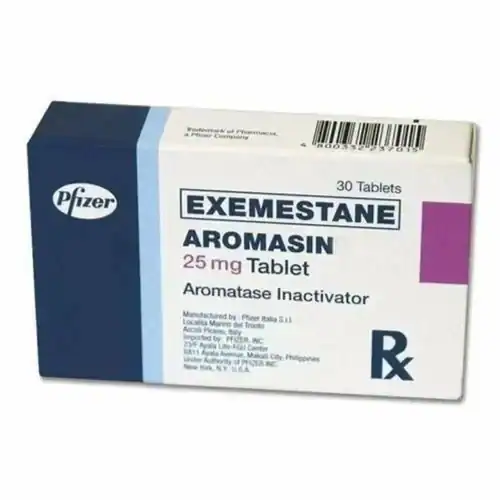
Exemestane 25mg Film-Coated Tablets — Steroidal Aromatase Inactivator for Hormone Receptor-Positive Breast Cancer in Postmenopausal Women
Supplied only against a valid prescription from a registered medical practitioner.
Sourced from authorised channels
Temperature-controlled packing
Hospitals, clinics, pharmacies
Delhi drug licence holder
Aromasin® (Exemestane) — Steroidal Aromatase Inactivator for HR-Positive Breast Cancer
Irreversible Aromatase Inactivation — A Mechanistically Distinct Endocrine Therapy for Postmenopausal Breast Cancer
Aromasin® (Exemestane) is a steroidal, irreversible aromatase inactivator — used to treat hormone receptor-positive (HR-positive) breast cancer in postmenopausal women both as adjuvant therapy in early breast cancer and as treatment for advanced or metastatic disease. Unlike non-steroidal aromatase inhibitors (NSAIs) such as Anastrozole (Arimidex) and Letrozole which reversibly and competitively inhibit the aromatase enzyme, Exemestane is a steroidal compound that acts as a false substrate — binding irreversibly to the aromatase enzyme’s active site and permanently inactivating it through mechanism-based (suicide) inhibition. New aromatase activity is only restored when new enzyme protein is synthesised.
This irreversible inactivation mechanism distinguishes Exemestane fundamentally from NSAIs — providing complete and sustained aromatase blockade between doses, potential advantages in the setting of NSAI resistance through ESR1 and aromatase pathway mutations, and a mild androgenic profile (from Exemestane’s steroidal structure) that may provide modest bone-protective effects relative to NSAIs.
A.K. Pharma is a trusted medicine distributor in Delhi supplying genuine Aromasin (Exemestane) to hospitals, oncology centres, breast cancer clinics, and pharmacies across India. Manufactured by Pfizer, Aromasin has been used in breast cancer treatment for over two decades — with an extensive evidence base across adjuvant, sequential, and metastatic breast cancer settings and a unique combination role with Everolimus (mTOR inhibitor) in PI3K/mTOR pathway-resistant HR-positive advanced breast cancer.
What is Aromasin (Exemestane)?
Aromasin contains Exemestane — a steroidal compound structurally related to androstenedione (the natural aromatase substrate) that acts as a mechanism-based (suicide) inhibitor of aromatase.
Steroidal vs Non-Steroidal Aromatase Inhibitors — A Critical Mechanistic Distinction:
Non-Steroidal AIs (Anastrozole, Letrozole):
Steroidal AI — Exemestane (Aromasin):
Clinical Implications of Irreversible Inactivation:
Estrogen Suppression: Exemestane 25mg once daily suppresses plasma estrogens (estrone, estradiol, estrone sulphate) by >85-95% in postmenopausal women — comparable to NSAIs — achieving profound estrogen deprivation that deprives ER-positive breast cancer cells of their primary growth stimulus.
Full prescribing information is available at the FDA label for Exemestane.
Clinical Studies and Evidence
IES Trial (Exemestane After Tamoxifen — Landmark Sequential Adjuvant Trial) Published in the New England Journal of Medicine (2004) with long-term follow-up, the Intergroup Exemestane Study (IES) was a Phase 3 randomised controlled trial of 4,724 postmenopausal women with HR-positive early breast cancer who had received 2-3 years of adjuvant Tamoxifen — comparing switching to Exemestane for the remaining adjuvant period vs continuing Tamoxifen for 5 years total. Key results:
BOLERO-2 Trial (Exemestane + Everolimus in Advanced Breast Cancer After NSAI Failure) Published in the New England Journal of Medicine (2012), the landmark BOLERO-2 trial was a Phase 3 randomised controlled trial of 724 postmenopausal women with HR-positive HER2-negative advanced breast cancer who had progressed on a non-steroidal aromatase inhibitor (Anastrozole or Letrozole). Comparing Exemestane + Everolimus (mTOR inhibitor) vs Exemestane + placebo, key results:
TEXT and SOFT Trials (Exemestane + Ovarian Suppression in Premenopausal Breast Cancer) Published in the New England Journal of Medicine (2014), the TEXT and SOFT trials specifically compared Exemestane + ovarian function suppression (OFS) vs Tamoxifen + OFS in premenopausal women with HR-positive early breast cancer. Key results at 5-year analysis:
Exemestane as CDK4/6 Inhibitor Combination Partner: While Ribociclib (Kryxana) + AI and Palbociclib (Palbace) + AI combinations are typically studied with NSAIs (Letrozole, Anastrozole), Exemestane can be used as an alternative aromatase inhibitor partner in CDK4/6 inhibitor combinations in patients who have progressed on or are intolerant to NSAIs — the CDK4/6 inhibition mechanism is independent of which specific AI is used.
Available Strengths
Aromasin is available as:
| Presentation | Dose | Administration |
|---|---|---|
| Aromasin 25mg Film-Coated Tablets | 25mg | Oral once daily after a meal |
Standard dose: 25mg orally once daily — taken after a meal. Food increases Exemestane absorption and bioavailability — consistent post-meal administration is recommended for reliable drug exposure.
Indications — What Aromasin is Used For
Adjuvant Treatment — Early Breast Cancer (Sequential After Tamoxifen):
Adjuvant Treatment — Early Breast Cancer (With Ovarian Suppression in Premenopausal Women):
Advanced Breast Cancer — Monotherapy:
Advanced Breast Cancer — In Combination With Everolimus (BOLERO-2 — Standard of Care):
For detailed indication information refer to MedlinePlus Exemestane.
Key Benefits of Aromasin
Irreversible Aromatase Inactivation — Mechanistic Advantage Over NSAIs Exemestane’s irreversible mechanism-based inactivation provides more complete and sustained aromatase blockade throughout the dosing interval compared to reversible NSAIs — with no possibility of enzyme recovery between doses. This mechanistic distinction is clinically relevant in the post-NSAI resistance setting where aromatase protein may be upregulated — Exemestane permanently destroys each aromatase molecule it encounters regardless of expression levels.
The Only AI With BOLERO-2 Data — Standard Backbone for Everolimus Combination The BOLERO-2 trial specifically evaluated Exemestane + Everolimus in post-NSAI advanced breast cancer — Exemestane is therefore the standard aromatase inhibitor backbone for the Everolimus combination regimen. No equivalent Level 1 evidence exists for Everolimus + NSAI in the post-NSAI setting — making Aromasin the specific AI of choice when prescribing the Everolimus combination.
Preferred AI for Combination With Ovarian Suppression in Premenopausal Breast Cancer The TEXT and SOFT trials demonstrate Exemestane + OFS is superior to Tamoxifen + OFS in high-risk premenopausal HR-positive early breast cancer. Current international guidelines (ESMO, ASCO, St Gallen) recommend Exemestane + OFS as the preferred endocrine approach for high-risk premenopausal patients — making Aromasin the go-to AI when combining with Zoladex (Goserelin) or other GnRH agonists.
Mild Androgenic Properties — Potential Bone Advantage Over NSAIs Exemestane’s steroidal structure provides partial androgenic activity — which may partially counteract estrogen deprivation-related bone loss. Studies suggest less bone mineral density loss with Exemestane compared to NSAIs — potentially reducing fracture risk with long-term use. This modest bone advantage may be clinically relevant for patients at high baseline fracture risk.
Effective Sequential Therapy After Tamoxifen The IES trial establishes switching to Exemestane after 2-3 years of Tamoxifen as significantly superior to completing 5 years of Tamoxifen — a 24% reduction in recurrence risk. This sequential strategy is particularly important for patients who started adjuvant Tamoxifen as premenopausal and have become postmenopausal during treatment — they should switch to Exemestane (or another AI) at the point of confirmed postmenopausal status.
Simple Oral Once-Daily Dosing — Excellent Long-Term Tolerability Once-daily oral tablet taken after a meal — with generally good tolerability. The main side effects are estrogen deprivation-related (joint pain, hot flushes, bone loss) — manageable with appropriate monitoring and supportive care. Exemestane avoids the endometrial cancer and thromboembolic risks associated with Tamoxifen.
How Aromasin Works — Mechanism-Based Aromatase Inactivation
The Aromatase Enzyme and Estrogen Biosynthesis in Postmenopausal Women:
In postmenopausal women, ovarian estrogen production has ceased. The primary source of circulating estrogen is peripheral aromatisation — conversion of adrenal androgens (androstenedione, testosterone, DHEA) to estrogens (estrone, estradiol) by aromatase (CYP19A1) in adipose tissue, muscle, liver, skin, and breast tissue including tumour tissue itself.
This peripheral aromatisation is the only meaningful estrogen source in postmenopausal women — making aromatase inhibition highly effective at achieving estrogen deprivation and depriving ER-positive breast cancer of its primary growth stimulus.
Exemestane’s Mechanism-Based Inhibition:
Step 1 — Substrate Mimicry: Exemestane is structurally similar to androstenedione — the natural aromatase substrate. The aromatase enzyme recognises Exemestane as a substrate analog and binds it in the active site — just as it would bind natural androstenedione.
Step 2 — Enzymatic Activation: Aromatase begins the normal catalytic process on Exemestane — the first hydroxylation step proceeds normally. This generates a reactive intermediate (6-methylenandrosta-1,4-diene-3,17-dione).
Step 3 — Covalent Active Site Alkylation: The reactive intermediate forms a covalent bond with a nucleophilic residue in the aromatase active site — typically through Michael addition to the enzyme protein. This covalent modification permanently blocks the active site.
Step 4 — Irreversible Enzyme Inactivation: The covalently modified aromatase cannot release the inhibitor or resume catalytic activity — the enzyme is permanently inactivated. Normal substrate (androstenedione) cannot access the blocked active site.
Step 5 — Sustained Estrogen Suppression: With each molecule of aromatase permanently inactivated, plasma estrogen levels fall profoundly — >85-95% reduction — and remain suppressed until new aromatase enzyme protein is synthesised (enzyme turnover, which takes days). This provides sustained estrogen deprivation throughout and between doses.
Mild Androgenic Properties: Exemestane’s steroidal structure and the metabolite 17-hydroexemestane have mild androgenic activity — binding to the androgen receptor weakly. This mild androgen receptor activity may partially counteract estrogen deprivation effects on bone by stimulating osteoblast activity and inhibiting osteoclasts — contributing to the modest bone advantage observed vs NSAIs.
For detailed mechanism overview refer to ESMO Breast Cancer Guidelines and ASCO Breast Cancer Treatment Guidelines.
Aromasin vs Arimidex — Steroidal vs Non-Steroidal Aromatase Inhibitor
| Feature | Aromasin (Exemestane) | Arimidex (Anastrozole) |
|---|---|---|
| Class | Steroidal aromatase inactivator | Non-steroidal aromatase inhibitor |
| Mechanism | Irreversible — covalent enzyme inactivation | Reversible — competitive haem binding |
| Androgenic properties | Mild — from steroidal structure | None |
| Bone mineral density loss | Modest | Moderate |
| Estrogen suppression | >85-95% | >80% |
| Post-Tamoxifen sequential use | ✅ Yes (IES trial) | ✅ Yes (ABCSG-8/ARNO) |
| Premenopausal + OFS | ✅ Preferred (TEXT/SOFT) | ✅ Yes |
| Everolimus combination | ✅ BOLERO-2 standard backbone | ❌ No Level 1 data |
| CDK4/6 inhibitor partner | ✅ Yes (alternative to NSAI) | ✅ Yes (first-line combination) |
| ESR1 mutation resistance | ❌ Inactive (as all AIs) | ❌ Inactive |
| Duration (adjuvant) | 5 years total (2-3 Tam + 2-3 Exemestane) | 5 years upfront or sequential |
| Available at A.K. Pharma | Request Quote | Request Quote |
Dosage and Administration
All Indications — Standard Dose:
Duration by Indication:
When Used With Everolimus (BOLERO-2 Regimen):
Bone Monitoring and Protection:
Drug Interactions:
Full dosing guidelines available at Drugs.com Exemestane Dosage.
Who Should Use Aromasin
Aromasin is prescribed for:
Adjuvant Early Breast Cancer:
Advanced/Metastatic Breast Cancer:
Aromasin is prescribed by medical oncologists, breast cancer specialists, and gynaecological oncologists. A.K. Pharma supplies Aromasin to hospitals, oncology centres, breast cancer clinics, and pharmacies across Delhi and India.
Possible Side Effects
Common side effects relate primarily to estrogen deprivation and mild androgenic activity:
Serious side effects:
Bone Loss and Fracture Risk: Long-term estrogen deprivation causes progressive reduction in bone mineral density → increased fracture risk. Monitor with DEXA and consider bone-protective therapy. Exemestane has slightly less bone loss than NSAIs due to mild androgenic properties — but monitoring is still required.
Cardiovascular Effects: Mild increase in total cholesterol — monitor lipid profile periodically. No significant increase in cardiovascular events vs placebo demonstrated in clinical trials.
Hepatotoxicity: Rare elevations in liver enzymes — monitor liver function if clinically indicated.
Embryo-Foetal Toxicity: Exemestane can cause foetal harm — effective contraception required in women of reproductive potential (perimenopausal patients); not for use in pregnancy.
Full side effect information available at FDA Exemestane Safety Information.
Precautions
Storage and Handling
As a responsible medicine distributor in Delhi, A.K. Pharma stores all medicines including Aromasin under manufacturer-recommended conditions ensuring product integrity for every supply to oncology centres and breast cancer clinics.
Manufacturer Information
Aromasin (Exemestane) is manufactured by Pfizer Inc., a global pharmaceutical company with an extensive oncology portfolio. Exemestane received FDA approval in October 1999 for advanced breast cancer — with subsequent approval for adjuvant treatment of early breast cancer in 2005 following IES trial results. A.K. Pharma supplies only genuine Aromasin sourced from authorized Pfizer distributors.
Related Breast Cancer Medicines Available at A.K. Pharma
Frequently Asked Questions
Q. What is Aromasin used for? Aromasin (Exemestane) is used for adjuvant treatment of postmenopausal women with HR-positive early breast cancer — particularly as sequential therapy after Tamoxifen — and for treatment of advanced HR-positive HER2-negative breast cancer in postmenopausal women after NSAI failure, typically in combination with Everolimus. More information available at MedlinePlus.
Q. What is the generic name of Aromasin? The generic name of Aromasin is Exemestane. It is a steroidal, irreversible aromatase inactivator — structurally related to androstenedione — manufactured by Pfizer.
Q. How is Aromasin different from Arimidex (Anastrozole)? The key difference is the mechanism. Arimidex (Anastrozole) is a non-steroidal reversible aromatase inhibitor — it inhibits the enzyme but releases it intact. Aromasin (Exemestane) is a steroidal irreversible aromatase inactivator — it permanently destroys the enzyme through covalent binding. Practical differences: Aromasin has mild androgenic properties (potentially better for bones), is the standard backbone for Everolimus combination (BOLERO-2), and is the preferred AI for combination with ovarian suppression in premenopausal patients (TEXT/SOFT).
Q. When should Aromasin be used instead of Arimidex? Aromasin is specifically preferred in three situations: (1) Sequential adjuvant therapy after 2-3 years of Tamoxifen — IES trial evidence; (2) In combination with Everolimus for advanced breast cancer after NSAI (Anastrozole/Letrozole) failure — BOLERO-2 trial specifically used Exemestane; (3) In combination with ovarian suppression (Zoladex) for high-risk premenopausal early breast cancer — TEXT/SOFT trials used Exemestane.
Q. Can Aromasin be used in premenopausal women? Aromasin is not effective as sole therapy in premenopausal women — active ovarian estrogen production compensates for aromatase inhibition. However, Exemestane can be used effectively in premenopausal women when combined with ovarian function suppression using a GnRH agonist such as Zoladex (Goserelin). The TEXT and SOFT trials establish this combination as superior to Tamoxifen + OFS in high-risk premenopausal HR-positive early breast cancer.
Q. What is the BOLERO-2 trial and why does it matter for Aromasin? BOLERO-2 demonstrated that adding Everolimus (mTOR inhibitor) to Exemestane more than doubled progression-free survival (11.0 vs 4.1 months) in HR-positive HER2-negative advanced breast cancer after NSAI failure. This makes Exemestane the specific steroidal AI of choice when prescribing the Everolimus combination — the trial specifically used Exemestane, and it is this combination that is approved and guideline-recommended in the post-NSAI setting.
Q. Should Aromasin be taken with food? Yes — Aromasin should be taken after a meal. Food significantly increases Exemestane absorption and bioavailability. Taking consistently after meals ensures reliable drug exposure and optimal efficacy.
Q. Is Aromasin available in India? Aromasin can be supplied to hospitals, oncology centres, and pharmacies across India through licensed pharmaceutical distributors. Contact A.K. Pharma — medicine distributor in Delhi — for availability and pricing.
Q. What is the price of Aromasin in India? Aromasin 25mg price in India varies by pack size. Contact A.K. Pharma at 011 4172 6999 or WhatsApp +91 9810034827 for current pricing and bulk supply rates.
Q. How to order Aromasin from A.K. Pharma? You can request a quote directly from this page, call us at 011 4172 6999, or WhatsApp us at +91 9810034827 with your requirements and we will respond promptly.
Q. Does A.K. Pharma supply Aromasin in bulk? Yes. A.K. Pharma supplies Aromasin in bulk to oncology centres, breast cancer clinics, hospitals, and pharmacies across Delhi and India. Contact us for bulk pricing and availability.
Why Order Aromasin from A.K. Pharma?
Contact A.K. Pharma for Aromasin Supply 📍 E-2/257A, 2nd Floor, Shastri Nagar, New Delhi 110052 📞 011 4172 6999 📱 WhatsApp: +91 9810034827 🌐 akpharma.in