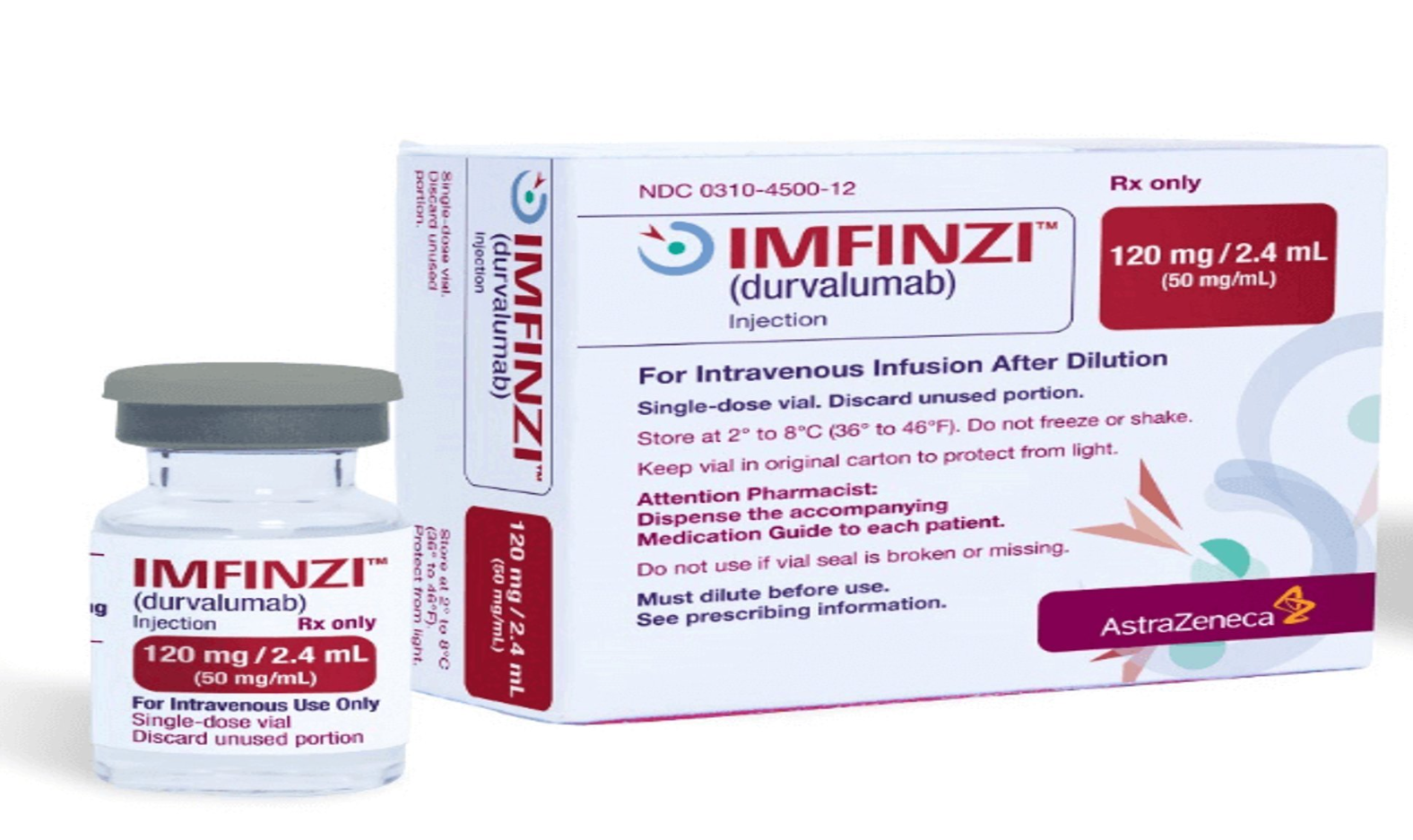
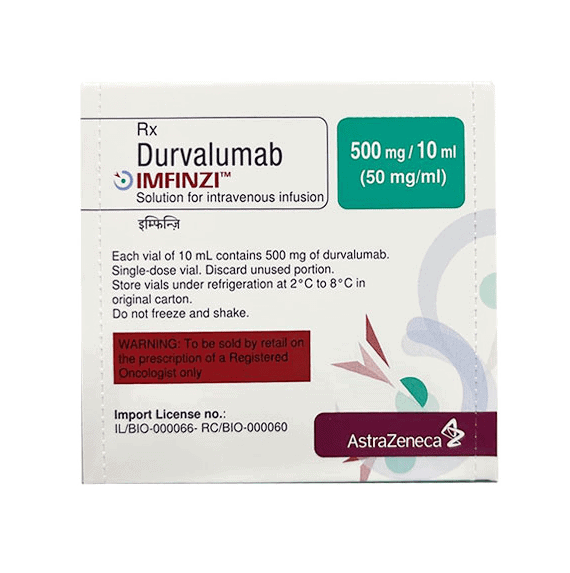
Durvalumab 120mg/2.4mL, 500mg/10mL Injection — Anti-PD-L1 Checkpoint Inhibitor for Unresectable Stage III NSCLC, Extensive-Stage SCLC, Biliary Tract Cancer and Hepatocellular Carcinoma
Supplied only against a valid prescription from a registered medical practitioner.
Sourced from authorised channels
Temperature-controlled packing
Hospitals, clinics, pharmacies
Delhi drug licence holder
Imfinzi® (Durvalumab) — Anti-PD-L1 Checkpoint Inhibitor Transforming Thoracic and GI Oncology
The First Immunotherapy Approved for Unresectable Stage III NSCLC — Proven Survival Benefit Across Four Tumour Types
Imfinzi® (Durvalumab) is a human IgG1 kappa monoclonal antibody that binds with high affinity and specificity to programmed death-ligand 1 (PD-L1) — blocking its interaction with both PD-1 and CD80 (B7-1) receptors on T-cells. By blocking PD-L1 — the ligand expressed by tumour cells and cells of the tumour microenvironment that suppresses anti-tumour T-cell responses — Durvalumab removes a key inhibitory brake on the anti-tumour immune response, restoring cytotoxic T-cell activity against cancer cells.
Imfinzi holds a unique position in oncology as the first and only immunotherapy approved for unresectable Stage III non-small cell lung cancer (NSCLC) — based on the landmark PACIFIC trial demonstrating that consolidation Durvalumab after concurrent chemoradiotherapy significantly improves both progression-free survival and overall survival — transforming the standard of care for this large patient population that previously had no approved systemic consolidation therapy. Beyond Stage III NSCLC, Imfinzi has demonstrated proven survival benefit across extensive-stage small cell lung cancer (ES-SCLC), biliary tract cancer (BTC), and hepatocellular carcinoma (HCC) — making it one of the most broadly effective PD-L1 inhibitors in solid tumour oncology.
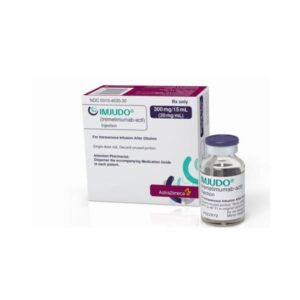
A.K. Pharma is a trusted medicine distributor in Delhi supplying genuine Imfinzi (Durvalumab) in both 120mg and 500mg presentations to hospitals, oncology centres, thoracic oncology units, and pharmacies across India. Manufactured by AstraZeneca, Imfinzi is an essential immunotherapy medicine across thoracic and gastrointestinal oncology — available alongside Imjudo (Tremelimumab) which is used in combination with Imfinzi for certain indications.
What is Imfinzi (Durvalumab)?
Imfinzi contains Durvalumab — a human IgG1 kappa monoclonal antibody engineered with a triple mutation in the Fc region to minimise Fc-mediated effector functions (ADCC, CDC) — ensuring that Durvalumab does not kill activated T-cells expressing PD-L1 on their surface, which would counteract the intended immune-activating effect.
The PD-1/PD-L1 Immune Checkpoint — Key to Anti-Tumour Immunity:
The PD-1 (Programmed Death-1) pathway is a critical negative regulatory checkpoint of T-cell function — evolved to prevent excessive immune activation and autoimmunity:
How Tumours Exploit the PD-1/PD-L1 Checkpoint: Many tumours — particularly NSCLC, SCLC, BTC, and HCC — upregulate PD-L1 expression on their surface (often driven by oncogenic signalling including IFN-γ in the tumour microenvironment). High tumour PD-L1 expression:
Durvalumab’s Dual Blockade Mechanism: Durvalumab is unique among anti-PD-L1 antibodies in simultaneously blocking both PD-L1:PD-1 and PD-L1:CD80 interactions — providing comprehensive PD-L1 checkpoint blockade at both the effector phase (tumour-T cell interface) and the priming phase (dendritic cell-T cell interface).
Full prescribing information is available at the FDA label for Durvalumab.
Clinical Studies and Evidence
PACIFIC Trial (Durvalumab in Unresectable Stage III NSCLC After CRT) Published in the New England Journal of Medicine (2017) with updated 5-year OS data, the landmark PACIFIC trial was a Phase 3 randomised controlled trial of 713 patients with unresectable Stage III NSCLC who had not progressed after platinum-based concurrent chemoradiotherapy (cCRT) — comparing Durvalumab consolidation for up to 12 months vs placebo. Key results at 5-year OS analysis:
The 5-year OS rate of 42.9% with Durvalumab represents a dramatic improvement in long-term outcomes for Stage III NSCLC — a disease where 5-year survival was historically approximately 15-20% with cCRT alone.
CASPIAN Trial (Durvalumab + Chemotherapy in Extensive-Stage SCLC) Published in The Lancet (2019) with updated 3-year OS data, the CASPIAN trial was a Phase 3 randomised controlled trial of 805 patients with treatment-naive ES-SCLC — comparing Durvalumab + platinum-etoposide chemotherapy vs chemotherapy alone (and also Durvalumab + Tremelimumab + chemotherapy — the CASPIAN triplet arm involving Imjudo). Key results for Durvalumab + chemotherapy at 3-year analysis:
TOPAZ-1 Trial (Durvalumab + Gemcitabine/Cisplatin in Biliary Tract Cancer) Published in the New England Journal of Medicine (2022), the landmark TOPAZ-1 trial was a Phase 3 randomised controlled trial of 685 patients with previously untreated unresectable locally advanced or metastatic biliary tract cancer (including cholangiocarcinoma and gallbladder cancer) — comparing Durvalumab + gemcitabine/cisplatin vs placebo + gemcitabine/cisplatin. Key results:
HIMALAYA Trial (Durvalumab ± Tremelimumab in Hepatocellular Carcinoma) Published in Nature Medicine (2022), the HIMALAYA trial was a Phase 3 randomised controlled trial evaluating Durvalumab + Tremelimumab (STRIDE regimen — Single Tremelimumab Regular Interval Durvalumab) vs Durvalumab monotherapy vs Sorafenib in 1,171 patients with unresectable HCC who had not received prior systemic therapy. Key results at 4-year follow-up:
Available Strengths
Imfinzi is available in the following presentations:
| Presentation | Concentration | Volume | Use |
|---|---|---|---|
| Imfinzi 120mg/2.4mL | 50mg/mL | 2.4mL vial | Lower doses — HCC monotherapy, dose calculation |
| Imfinzi 500mg/10mL | 50mg/mL | 10mL vial | Standard dose regimens — NSCLC, SCLC, BTC, HCC |
Both presentations are 50mg/mL concentration — enabling flexible dose preparation across weight-based and fixed dose regimens.
Indications — What Imfinzi is Used For
Unresectable Stage III NSCLC (PACIFIC Indication):
Extensive-Stage Small Cell Lung Cancer (CASPIAN Indication):
Biliary Tract Cancer (TOPAZ-1 Indication):
Hepatocellular Carcinoma (HIMALAYA Indication):
For detailed indication information refer to MedlinePlus Durvalumab.
Key Benefits of Imfinzi
First and Only Immunotherapy Approved for Unresectable Stage III NSCLC The PACIFIC trial established Durvalumab consolidation as the only approved systemic therapy after cCRT in Stage III NSCLC — transforming a disease where 5-year survival was approximately 15-20% to one where 42.9% of patients are alive at 5 years with Durvalumab. No other immunotherapy has replicated this result in this specific and large patient population.
Remarkable 18.4-Month OS Improvement in Stage III NSCLC The PACIFIC trial demonstrates an 18.4-month improvement in median OS — from 29.1 to 47.5 months — representing one of the largest absolute OS improvements ever demonstrated in a lung cancer Phase 3 trial. This OS benefit is sustained at 5-year follow-up with clear separation of survival curves.
First Immunotherapy to Improve OS in Biliary Tract Cancer TOPAZ-1 was the first Phase 3 trial to demonstrate significant OS benefit with any immunotherapy in BTC — more than doubling the 2-year OS rate (24.9% vs 10.4%). Biliary tract cancers are difficult to treat with limited options — Durvalumab + gemcitabine/cisplatin represents a major advance in first-line BTC management.
PD-L1:CD80 Dual Blockade — Mechanistic Completeness Unlike Atezolizumab (anti-PD-L1 only blocking PD-1 interaction) and Pembrolizumab/Nivolumab (anti-PD-1 only), Durvalumab blocks both PD-L1:PD-1 and PD-L1:CD80 interactions — providing more comprehensive checkpoint blockade at both T-cell effector and priming phases.
Combination With Imjudo (Tremelimumab) — Dual Checkpoint Blockade Durvalumab (anti-PD-L1) combines synergistically with Imjudo (Tremelimumab) (anti-CTLA-4) — creating dual checkpoint blockade addressing both the PD-1/PD-L1 axis (effector T-cell function) and the CTLA-4 axis (T-cell priming and regulatory T-cell depletion). Both medicines are available from A.K. Pharma — simplifying procurement for STRIDE (HCC) and CASPIAN triplet regimens.
Four Tumour Type Approvals — Broadest Efficacy Among AstraZeneca Immunotherapies With proven survival benefit demonstrated in Stage III NSCLC, ES-SCLC, BTC, and HCC — and ongoing trials in multiple additional tumour types — Durvalumab has one of the broadest evidence bases of any anti-PD-L1 antibody in oncology.
How Imfinzi Works — PD-L1 Checkpoint Blockade in Solid Tumours
Normal Anti-Tumour Immune Response:
How Tumours Suppress Anti-Tumour Immunity:
At the tumour site — activated T-cells upregulate PD-1 (inhibitory receptor). Tumour cells respond to IFN-γ from T-cells by upregulating PD-L1 → PD-L1 binds PD-1 on TILs → inhibitory signalling → T-cell exhaustion, reduced cytokine production, impaired cytotoxic function → tumour immune evasion despite T-cell presence.
Durvalumab’s Mechanism:
Step 1 — PD-L1 Binding: Durvalumab binds PD-L1 with high affinity on tumour cells and tumour-associated macrophages/stromal cells — physically blocking PD-L1 from engaging PD-1 on T-cells.
Step 2 — CD80 (B7-1) Interaction Blockade: Durvalumab simultaneously blocks PD-L1 from engaging CD80 on dendritic cells — preventing PD-L1-mediated suppression of T-cell priming in tumour-draining lymph nodes.
Step 3 — T-Cell Reinvigoration: Without PD-L1 inhibitory signals — exhausted T-cells are reinvigorated, cytokine production (IFN-γ, TNF, IL-2) is restored, and cytotoxic function resumes — T-cells can effectively kill PD-L1-expressing tumour cells.
Step 4 — Fc-Mediated Effector Function Ablation: Durvalumab’s IgG1 Fc region carries triple mutations (L234F/L235E/P331S) that eliminate ADCC and CDC activity — preventing killing of PD-L1-expressing activated T-cells that would otherwise be destroyed by unmodified IgG1 Fc effector functions.
Why This Matters in Stage III NSCLC After cCRT: Concurrent chemoradiotherapy kills tumour cells → releases tumour antigens → primes anti-tumour T-cell responses. However, residual tumour cells and radiation-induced PD-L1 upregulation suppress these T-cell responses. Durvalumab consolidation captures and amplifies the immune priming effect of cCRT — preventing T-cell exhaustion and enabling durable anti-tumour immune responses before micrometastatic disease can establish.
For detailed mechanism overview refer to ESMO NSCLC Guidelines and NCCN NSCLC Guidelines.
Imfinzi + Imjudo — The STRIDE Regimen for HCC and CASPIAN Triplet for SCLC
Both Imfinzi (Durvalumab) and Imjudo (Tremelimumab) are available from A.K. Pharma — simplifying procurement for combination regimens:
STRIDE Regimen (HCC — HIMALAYA trial):
CASPIAN Triplet (ES-SCLC):
The dual checkpoint mechanism — anti-PD-L1 (Durvalumab) blocking the effector phase checkpoint + anti-CTLA-4 (Tremelimumab) enhancing T-cell priming and depleting regulatory T-cells — provides synergistic and complementary immune activation across both phases of anti-tumour immunity.
Dosage and Administration
Stage III NSCLC (PACIFIC):
ES-SCLC (CASPIAN — Durvalumab + Chemotherapy):
Biliary Tract Cancer (TOPAZ-1):
HCC — STRIDE Regimen (HIMALAYA):
HCC — Durvalumab Monotherapy:
Infusion Administration:
Dose Modifications:
Monitoring:
Full dosing guidelines available at Drugs.com Durvalumab Dosage.
Immune-Mediated Adverse Reactions — Critical Safety
Like all PD-L1/PD-1 checkpoint inhibitors, Durvalumab can cause immune-mediated adverse reactions — resulting from excessive immune activation affecting normal tissues. The most important include:
Immune-Mediated Pneumonitis: Most clinically relevant irAE in the PACIFIC setting — occurs in approximately 34% (all grades) of Durvalumab-treated patients vs 25% placebo in PACIFIC. Grade 3-4 pneumonitis in approximately 3.4%. Monitor for new or worsening respiratory symptoms at every visit. CT chest for any new respiratory symptoms. Withhold for Grade 2; permanently discontinue for Grade 3-4. Treat with systemic corticosteroids.
Immune-Mediated Hepatitis: Monitor LFTs before each cycle. Withhold for Grade 2; permanently discontinue for Grade 3-4 transaminase elevation. Treat with systemic corticosteroids.
Immune-Mediated Endocrinopathies:
Immune-Mediated Colitis: Diarrhoea and colitis — grade per NCI CTCAE. Withhold for Grade 2; permanently discontinue for Grade 3-4. Treat with systemic corticosteroids; Grade 4 or steroid-refractory — add infliximab.
Immune-Mediated Nephritis: Monitor creatinine before each cycle. Withhold for Grade 2; permanently discontinue for Grade 3-4.
General irAE Management Principles:
Full side effect information available at FDA Durvalumab Safety Information.
Who Should Use Imfinzi
Imfinzi is prescribed for:
Stage III NSCLC:
ES-SCLC:
Biliary Tract Cancer:
HCC:
Imfinzi is prescribed by thoracic oncologists, medical oncologists, radiation oncologists, and hepatologists. A.K. Pharma supplies Imfinzi to hospitals, oncology centres, thoracic oncology units, and pharmacies across Delhi and India.
Possible Side Effects
Common side effects in the PACIFIC trial include radiation pneumonitis/pneumonitis (34%), upper respiratory tract infection (26%), fatigue (24%), cough (21%), and dyspnoea (18%).
Common side effects across all indications include fatigue, musculoskeletal pain, rash, diarrhoea, decreased appetite, nausea, and abdominal pain.
Serious immune-mediated adverse reactions — see immune-mediated adverse reactions section above.
Infusion-Related Reactions: Approximately 2% of patients — Grade 3-4 in <1%. Pre-medicate with antihistamine and paracetamol for subsequent infusions after Grade 1-2 reactions. Permanently discontinue for Grade 3-4 infusion reactions.
Full side effect information available at FDA Durvalumab Safety Information.
Precautions
Storage and Handling
As a responsible medicine distributor in Delhi, A.K. Pharma maintains full cold chain requirements during storage and supply of Imfinzi ensuring product integrity for every unit supplied.
Manufacturer Information
Imfinzi (Durvalumab) is manufactured by AstraZeneca, a global biopharmaceutical company with a leading oncology portfolio. Durvalumab received FDA approval in May 2017 for urothelial carcinoma — with subsequent approvals for Stage III NSCLC (2018), ES-SCLC (2020), BTC (2022), and HCC (2022). A.K. Pharma supplies only genuine Imfinzi sourced from authorized AstraZeneca distributors.
Related Cancer Medicines Available at A.K. Pharma
Frequently Asked Questions
Q. What is Imfinzi used for? Imfinzi (Durvalumab) is used for consolidation treatment of unresectable Stage III NSCLC after concurrent chemoradiotherapy, first-line treatment of extensive-stage SCLC with chemotherapy, first-line treatment of biliary tract cancer with gemcitabine/cisplatin, and first-line treatment of unresectable HCC — as monotherapy or combined with Imjudo (Tremelimumab) in the STRIDE regimen. More information available at MedlinePlus.
Q. What is the generic name of Imfinzi? The generic name of Imfinzi is Durvalumab. It is a human IgG1 anti-PD-L1 monoclonal antibody manufactured by AstraZeneca.
Q. What is the PACIFIC trial and why is it important? PACIFIC was a landmark Phase 3 trial demonstrating Durvalumab consolidation after concurrent chemoradiotherapy significantly improved PFS and OS in unresectable Stage III NSCLC — increasing median OS from 29.1 to 47.5 months and the 5-year OS rate from 33.4% to 42.9%. This was the first trial to demonstrate survival benefit with any systemic therapy in this patient population — establishing Durvalumab as the new standard of care for Stage III NSCLC and fundamentally transforming treatment guidelines globally.
Q. Is PD-L1 testing required before prescribing Imfinzi for Stage III NSCLC? No — PD-L1 testing is not required for the PACIFIC Stage III NSCLC indication. The PACIFIC trial demonstrated significant PFS and OS benefit with Durvalumab regardless of PD-L1 expression status — all patients with unresectable Stage III NSCLC who have not progressed after concurrent platinum-based CRT are eligible.
Q. What is the STRIDE regimen? The STRIDE (Single Tremelimumab Regular Interval Durvalumab) regimen for HCC combines a single priming dose of Imjudo (Tremelimumab) 300mg IV with Durvalumab 1500mg IV on Cycle 1 Day 1 — followed by Durvalumab 1500mg IV every 4 weeks (without further Tremelimumab). This dual checkpoint approach demonstrated significantly improved OS vs Sorafenib in the HIMALAYA trial with a 4-year OS rate of 25.2% vs 15.1%. Both Imfinzi and Imjudo are available from A.K. Pharma.
Q. How does Imfinzi differ from anti-PD-1 antibodies like Pembrolizumab and Nivolumab? Imfinzi targets PD-L1 (the ligand) while Pembrolizumab and Nivolumab target PD-1 (the receptor). Durvalumab’s PD-L1 targeting additionally blocks PD-L1:CD80 interaction — which anti-PD-1 antibodies cannot do. Durvalumab’s modified Fc region also prevents killing of PD-L1-expressing T-cells — an important safety design feature.
Q. Is Imfinzi available in India? Imfinzi can be supplied to hospitals, oncology centres, and pharmacies across India through licensed pharmaceutical distributors. Contact A.K. Pharma — medicine distributor in Delhi — for availability and pricing.
Q. What is the price of Imfinzi in India? Imfinzi 120mg and 500mg price in India varies. Contact A.K. Pharma at 011 4172 6999 or WhatsApp +91 9810034827 for current pricing and bulk supply rates.
Q. How to order Imfinzi from A.K. Pharma? You can request a quote directly from this page, call us at 011 4172 6999, or WhatsApp us at +91 9810034827 with your requirements and we will respond promptly.
Q. Does A.K. Pharma supply Imfinzi in bulk? Yes. A.K. Pharma supplies Imfinzi in bulk to oncology centres, hospitals, and pharmacies across Delhi and India. Contact us for bulk pricing and availability.
Why Order Imfinzi from A.K. Pharma?
Contact A.K. Pharma for Imfinzi Supply 📍 E-2/257A, 2nd Floor, Shastri Nagar, New Delhi 110052 📞 011 4172 6999 📱 WhatsApp: +91 9810034827 🌐 akpharma.in