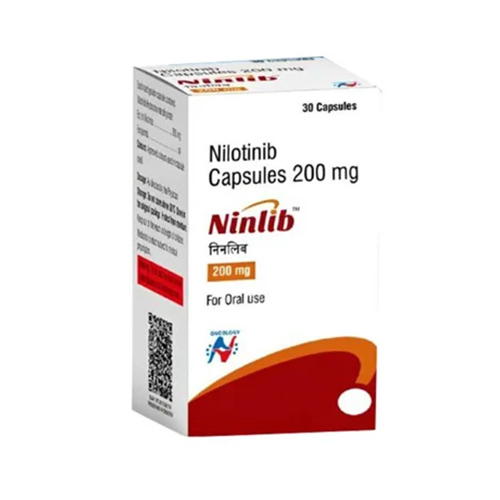
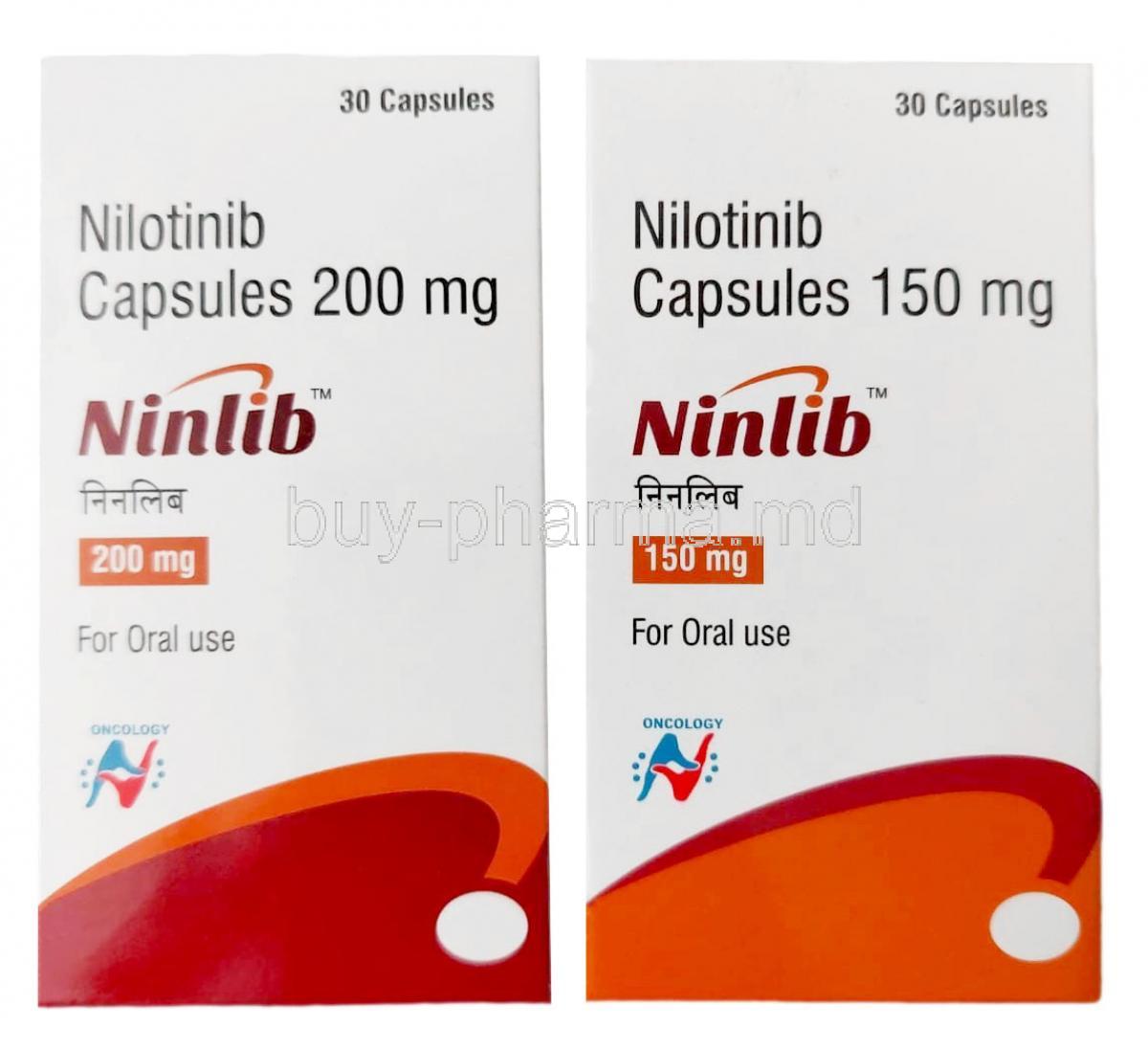
Nilotinib 150mg, 200mg Capsules — Second Generation BCR-ABL Tyrosine Kinase Inhibitor for Philadelphia Chromosome-Positive Chronic Myeloid Leukaemia
Supplied only against a valid prescription from a registered medical practitioner.
Sourced from authorised channels
Temperature-controlled packing
Hospitals, clinics, pharmacies
Delhi drug licence holder
30-Fold Greater BCR-ABL Potency Than Imatinib — Faster and Deeper Molecular Responses With Treatment-Free Remission Potential
Ninlib® (Nilotinib) is a second-generation, highly selective BCR-ABL tyrosine kinase inhibitor (TKI) used to treat Philadelphia chromosome-positive chronic myeloid leukaemia (Ph+ CML) in chronic phase (CP) and accelerated phase (AP) — both as first-line therapy and in patients who have failed or are intolerant to prior therapy including Imatinib. Nilotinib was specifically engineered to overcome Imatinib resistance — with a binding affinity to BCR-ABL approximately 30 times greater than Imatinib, tighter binding that locks BCR-ABL in its inactive conformation, and activity against most Imatinib-resistant BCR-ABL mutations (with the notable exception of the T315I gatekeeper mutation).
Beyond overcoming Imatinib resistance, Nilotinib as first-line therapy achieves significantly higher and faster rates of major molecular response (MMR — ≥3-log BCR-ABL reduction) and deep molecular response (MR4, MR4.5 — ≥4-4.5-log BCR-ABL reduction) compared to Imatinib — making it the preferred choice for patients where achieving deep molecular response and eventual treatment-free remission (TFR) is the clinical goal.
A.K. Pharma is a trusted medicine distributor in Delhi supplying genuine Ninlib (Nilotinib) to hospitals, haematology centres, oncology clinics, and pharmacies across India. Ninlib contains Nilotinib — the same active ingredient as the originator Tasigna (Novartis) — available at accessible pricing for Indian patients.
Ninlib contains Nilotinib — a synthetic aminopyrimidine derivative that acts as a highly selective, second-generation BCR-ABL tyrosine kinase inhibitor. In CML the Philadelphia chromosome — a translocation between chromosomes 9 and 22 (t(9;22)(q34;q11)) — creates the BCR-ABL fusion oncogene encoding a constitutively active tyrosine kinase that drives uncontrolled myeloid cell proliferation. Nilotinib inhibits this constitutively active BCR-ABL kinase — blocking the signalling cascade that drives CML leukaemogenesis.
Structural advantages over Imatinib:
BCR-ABL mutation coverage:
Full prescribing information is available at the FDA label for Nilotinib.
ENESTnd Trial (Nilotinib vs Imatinib — First-Line CML)
Published in the New England Journal of Medicine (2010), the landmark ENESTnd (Evaluating Nilotinib Efficacy and Safety in Clinical Trials — Newly Diagnosed) trial was a Phase 3 randomised controlled trial of 846 patients with newly diagnosed Ph+ CML-CP — comparing Nilotinib 300mg twice daily and Nilotinib 400mg twice daily to Imatinib 400mg once daily. Key results at 5-year follow-up:
ENESTnd 10-Year Long-Term Data
Published in Leukemia (2020), 10-year follow-up from ENESTnd confirmed maintained superiority of Nilotinib over Imatinib for MMR and MR4.5 rates — with stable, low rates of transformation to advanced phase in Nilotinib-treated patients. The 10-year data also revealed the cardiovascular risk signal with long-term Nilotinib use — peripheral arterial occlusive disease (PAOD) at higher rates than Imatinib — requiring careful cardiovascular monitoring in long-term Nilotinib-treated patients.
ENESTcmr Trial (Nilotinib Switch in Imatinib-Treated Patients)
Published in Blood (2012), ENESTcmr demonstrated that switching to Nilotinib in Imatinib-treated patients who had achieved complete cytogenetic response but not MMR significantly improved the rate of MR4.5 deep molecular response — enabling more patients to achieve the deep response required for TFR attempts.
ENESTfreedom Trial (Treatment-Free Remission With Nilotinib)
Published in Leukemia (2016), ENESTfreedom demonstrated that 51.6% of patients who achieved sustained deep molecular response (MR4.5) on Nilotinib first-line therapy and discontinued treatment remained in treatment-free remission at 48 weeks — establishing TFR as an achievable clinical goal in appropriately selected Nilotinib-treated patients. This represented a paradigm shift in CML management — making treatment-free remission a realistic goal for many patients.
ENESTnd Imatinib-Resistant/Intolerant CML
Multiple Phase 2 trials demonstrated Nilotinib 400mg twice daily achieved major cytogenetic response (MCyR) in 59% and CCyR in 44% of Imatinib-resistant CML-CP patients — with MMR in 29% — establishing Nilotinib as highly effective second-line therapy after Imatinib failure.
Ninlib is available in the following strengths:
| Presentation | Dose Per Capsule | Standard Daily Dose | Indication |
|---|---|---|---|
| Ninlib 150mg Capsules | 150mg | 300mg twice daily (600mg total) | First-line CML-CP |
| Ninlib 200mg Capsules | 200mg | 400mg twice daily (800mg total) | Resistant/Intolerant CML – CP and AP |
Critical — Must be taken on an empty stomach: Like Abiraterone, food dramatically increases Nilotinib absorption — taking with food can increase plasma exposure by 82% (high-fat meal) to 112% (low-fat meal), causing toxic blood levels. Nilotinib must be taken on an empty stomach — no food for at least 2 hours before and 1 hour after each dose. This is the single most critical patient counselling point for Nilotinib therapy.
Newly Diagnosed Ph+ CML in Chronic Phase (First-Line):
Ph+ CML Resistant to or Intolerant of Prior Therapy:
For detailed indication information refer to MedlinePlus Nilotinib.
Superior MMR and Deep Molecular Response Rates vs Imatinib
ENESTnd demonstrates Nilotinib achieves MMR in 55.5% vs 28.0% of patients at 12 months — and MR4.5 in 54% vs 31% at 5 years. These higher rates of deep molecular response are directly relevant to achieving treatment-free remission — the ultimate goal of modern CML management.
Treatment-Free Remission (TFR) — Potentially Stopping Treatment
The ENESTfreedom trial demonstrates that patients who achieve sustained MR4.5 on Nilotinib first-line therapy have a 51.6% probability of remaining in TFR after stopping treatment — making Nilotinib the preferred first-line TKI for patients who prioritise eventual treatment discontinuation. Imatinib achieves lower MR4.5 rates — reducing TFR candidacy.
Significantly Fewer Progressions to Advanced Phase
ENESTnd demonstrates 0.7% vs 4.2% progression to advanced phase with Nilotinib vs Imatinib — dramatically reducing the risk of disease transformation to accelerated or blast phase — the most serious complication of CML management.
Overcomes Most Imatinib Resistance Mutations
Nilotinib is active against >40 BCR-ABL mutations that cause Imatinib resistance — providing a highly effective salvage option for patients who develop Imatinib-resistant disease (except T315I).
30-Fold Greater BCR-ABL Potency
Superior BCR-ABL inhibition translates to faster and deeper molecular responses — achieving MMR faster than Imatinib, enabling earlier assessment of TFR candidacy.
Over 15 Years of Post-Marketing Experience
Extensive long-term real-world and clinical trial experience provides comprehensive safety characterisation — enabling informed monitoring and management decisions in clinical practice.
CML Pathogenesis: The Philadelphia chromosome translocation (t(9;22)) fuses the BCR gene on chromosome 22 to the ABL1 tyrosine kinase gene on chromosome 9 — creating the BCR-ABL1 fusion oncogene. BCR-ABL protein is a constitutively active tyrosine kinase — unlike normal ABL which is tightly regulated, BCR-ABL is always switched on — continuously phosphorylating downstream substrates that drive:
Nilotinib’s Mechanism:
Step 1 — ABL Kinase Domain Binding: Nilotinib binds with high affinity to the ATP-binding site of the BCR-ABL kinase domain — competing with ATP (the substrate whose γ-phosphate is transferred to target proteins). Critically, Nilotinib stabilises BCR-ABL in its inactive (DFG-out) conformation — a conformation less accessible to resistance mutations that affect the active site.
Step 2 — Tyrosine Kinase Inhibition: By occupying the ATP-binding site, Nilotinib prevents ATP from binding → BCR-ABL cannot phosphorylate downstream substrates → signalling cascades driving proliferation and survival are blocked.
Step 3 — Downstream Signalling Blockade: Key downstream pathways blocked include:
Step 4 — Induction of Apoptosis: Loss of survival signalling → BCR-ABL-dependent leukaemic progenitor cells undergo apoptosis (programmed cell death) → progressive reduction in leukaemic clone — reflected in declining BCR-ABL PCR values on molecular monitoring.
Why Empty Stomach is Critical: Nilotinib is a BCS Class II compound — poorly water-soluble but highly permeable. Food — particularly fat — increases gastric acid secretion and prolongs gastric emptying, dramatically increasing Nilotinib dissolution and absorption. This food effect is non-linear and unpredictable — making consistent fasted-state administration essential for reliable, controlled drug exposure.
For detailed mechanism overview refer to ELN (European LeukemiaNet) CML Recommendations 2020 and NCCN CML Guidelines.
CML treatment response is monitored by quantitative PCR measuring BCR-ABL1 transcript levels in peripheral blood — standardised on the International Scale (IS):
| Response Milestone | BCR-ABL1 IS Level | Clinical Significance |
|---|---|---|
| Complete Haematological Response (CHR) | Not measured by PCR | Normal blood counts |
| Complete Cytogenetic Response (CCyR) | ≈ BCR-ABL ≤1% IS | Ph+ metaphases 0% |
| Major Molecular Response (MMR) | BCR-ABL ≤0.1% IS | 3-log reduction — TFR candidacy begins |
| MR4 | BCR-ABL ≤0.01% IS | 4-log reduction |
| MR4.5 | BCR-ABL ≤0.0032% IS | 4.5-log reduction — TFR candidacy |
| Molecular Remission (MR5) | BCR-ABL ≤0.001% IS | 5-log reduction |
ELN Milestone Monitoring Schedule for Ninlib:
Treatment-Free Remission (TFR) Criteria:
First-Line CML-CP:
Resistant/Intolerant CML-CP and CML-AP:
Dose Modifications:
Monitoring Schedule:
Full dosing guidelines available at Drugs.com Nilotinib Dosage.
TFR with Nilotinib is appropriate for carefully selected patients meeting all of the following:
Patients who relapse after TFR restart Nilotinib and virtually all regain molecular response — TFR discontinuation is safe when guidelines are followed.
Ninlib is prescribed for:
Ninlib is prescribed by haematologists and oncologists specialising in leukaemia management. A.K. Pharma supplies Ninlib to hospitals, haematology centres, and pharmacies across Delhi and India.
Common side effects include rash (36%), nausea (22%), headache (21%), fatigue (18%), pruritus (15%), constipation (12%), diarrhoea (11%), vomiting (10%), and musculoskeletal pain.
Serious side effects include:
QT Prolongation and Sudden Death: Nilotinib prolongs the QT interval — risk of potentially fatal ventricular arrhythmias (Torsades de Pointes) — Black Box Warning. Do not use with other QT-prolonging drugs. Correct hypokalaemia and hypomagnesaemia before starting. ECG monitoring is mandatory.
Peripheral Arterial Occlusive Disease (PAOD): Long-term Nilotinib therapy — particularly at 400mg twice daily — is associated with increased risk of PAOD including claudication, critical limb ischaemia, and coronary artery disease. Monitor with ankle-brachial index at baseline and annually. Discontinue if PAOD develops.
Hepatotoxicity: Elevated liver enzymes in up to 10% of patients. Monthly LFT monitoring required. Dose reduce or discontinue for significant elevation.
Pancreatitis: Lipase and amylase elevation — monitor monthly. Suspend if clinical pancreatitis develops.
Haematological toxicity: Neutropenia and thrombocytopenia — particularly in first 2 months. CBC monitoring every 2 weeks initially.
Full side effect information available at FDA Nilotinib Safety Information.
As a responsible medicine distributor in Delhi, A.K. Pharma stores all haematology medicines including Ninlib under manufacturer-recommended conditions ensuring product integrity for every supply.
Ninlib (Nilotinib) contains the same active ingredient as the originator Tasigna — developed by Novartis AG. Nilotinib received FDA approval in October 2007 for resistant/intolerant CML and in June 2010 for newly diagnosed CML-CP. A.K. Pharma supplies only genuine Ninlib sourced from authorised distributors.
Q. What is Ninlib used for?
Ninlib (Nilotinib) is used to treat Philadelphia chromosome-positive chronic myeloid leukaemia (Ph+ CML) — both as first-line therapy in newly diagnosed CML-CP and in patients whose CML is resistant to or intolerant of prior TKI therapy including Imatinib. More information available at MedlinePlus.
Q. What is the generic name of Ninlib?
The generic name of Ninlib is Nilotinib. It is a second-generation BCR-ABL tyrosine kinase inhibitor containing the same active ingredient as the originator Tasigna.
Q. How is Nilotinib different from Imatinib?
Nilotinib is a second-generation BCR-ABL TKI with approximately 30-fold greater potency than Imatinib. The ENESTnd trial demonstrates Nilotinib achieves significantly higher MMR and MR4.5 rates and fewer progressions to advanced phase compared to Imatinib — making it the preferred first-line choice when deep molecular response and treatment-free remission are the clinical goals.
Q. Why must Ninlib be taken on an empty stomach?
Food dramatically increases Nilotinib absorption — a high-fat meal increases plasma exposure by up to 112%. This unpredictable food effect can cause toxic drug levels. Nilotinib must be taken on a completely empty stomach — at least 2 hours after and 1 hour before food — this is mandatory and non-negotiable for safe treatment.
Q. What is treatment-free remission and can it be achieved with Nilotinib?
Treatment-free remission (TFR) means stopping CML treatment while maintaining molecular response — effectively being in remission without taking medicine. The ENESTfreedom trial demonstrates 51.6% of appropriately selected patients who achieve sustained MR4.5 on Nilotinib first-line therapy can stop treatment and remain in TFR at 48 weeks. Patients who relapse restart Nilotinib and virtually all regain response.
Q. What is the T315I mutation and why is it important?
T315I is a BCR-ABL gatekeeper mutation that confers resistance to Nilotinib, Imatinib, and Dasatinib. Before using Nilotinib as second-line therapy, BCR-ABL mutation testing is mandatory to identify T315I — which requires different therapy (Ponatinib or Asciminib). A.K. Pharma recommends mutation testing before second-line TKI selection.
Q. Is Ninlib available in India?
Ninlib can be supplied to hospitals, haematology centres, and pharmacies across India through licensed pharmaceutical distributors. Contact A.K. Pharma — medicine distributor in Delhi — for availability and pricing.
Q. What is the price of Ninlib in India?
Ninlib price in India varies by strength and pack size. Contact A.K. Pharma at 011 4172 6999 or WhatsApp +91 9810034827 for current pricing and bulk supply rates.
Q. How to order Ninlib from A.K. Pharma?
You can request a quote directly from this page, call us at 011 4172 6999, or WhatsApp us at +91 9810034827 with your requirements and we will respond promptly.
Q. Does A.K. Pharma supply Ninlib in bulk?
Yes. A.K. Pharma supplies Ninlib in bulk to haematology centres, oncology clinics, hospitals, and pharmacies across Delhi and India.
📍 E-2/257A, 2nd Floor, Shastri Nagar, New Delhi 110052
📞 011 4172 6999
📱 WhatsApp: +91 9810034827