Tremelimumab 300mg Injection — Anti-CTLA-4 Monoclonal Antibody Used in Combination With Imfinzi (Durvalumab) for Unresectable Hepatocellular Carcinoma and Extensive-Stage Small Cell Lung Cancer
Supplied only against a valid prescription from a registered medical practitioner.
Sourced from authorised channels
Temperature-controlled packing
Hospitals, clinics, pharmacies
Delhi drug licence holder
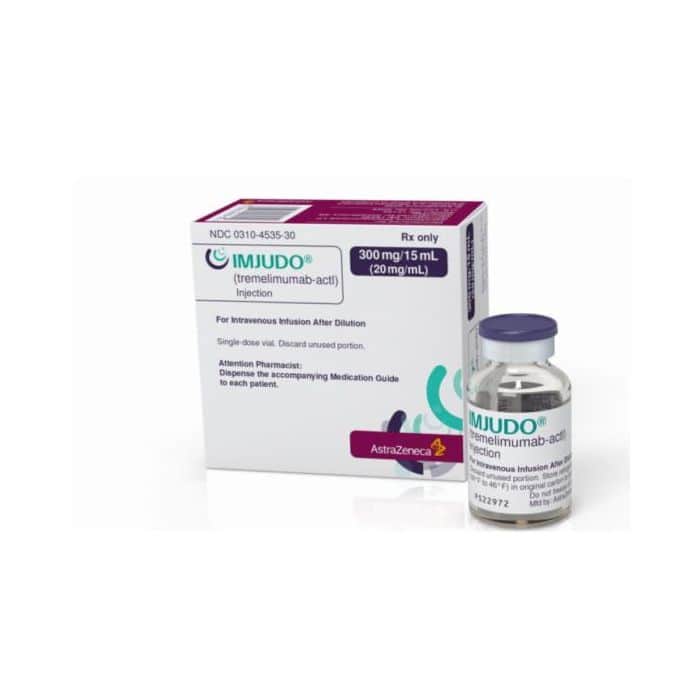
Imjudo® (Tremelimumab) — Anti-CTLA-4 Checkpoint Inhibitor for Dual Immune Checkpoint Blockade
The First Anti-CTLA-4 Antibody Approved in Combination With an Anti-PD-L1 for HCC — Transforming Dual Checkpoint Blockade in Solid Tumours
Imjudo® (Tremelimumab) is a human IgG2 monoclonal antibody that binds to cytotoxic T-lymphocyte-associated antigen 4 (CTLA-4) — blocking its interaction with CD80 (B7-1) and CD86 (B7-2) ligands on antigen-presenting cells. By blocking CTLA-4 — a critical negative regulator of T-cell activation at the priming phase — Tremelimumab amplifies T-cell activation and proliferation, depletes immunosuppressive regulatory T-cells (Tregs) in the tumour microenvironment, and enhances anti-tumour immune responses. Used in combination with Imfinzi (Durvalumab) — an anti-PD-L1 antibody — Tremelimumab creates comprehensive dual immune checkpoint blockade addressing both the priming phase (CTLA-4) and the effector phase (PD-L1/PD-1) of anti-tumour immunity.
Imjudo is approved specifically for use in the innovative STRIDE regimen (Single Tremelimumab Regular Interval Durvalumab) for unresectable hepatocellular carcinoma (HCC) — where a single priming dose of Tremelimumab 300mg combined with Durvalumab provides a unique approach to dual checkpoint blockade that achieves superior outcomes vs Sorafenib with a favourable tolerability profile — and in combination with Durvalumab + chemotherapy for extensive-stage small cell lung cancer (ES-SCLC).
A.K. Pharma is a trusted medicine distributor in Delhi supplying genuine Imjudo (Tremelimumab) alongside Imfinzi (Durvalumab) to hospitals, oncology centres, hepatology units, and pharmacies across India. Both components of the STRIDE regimen are available from A.K. Pharma — simplifying procurement for hepatologists and oncologists managing HCC. Manufactured by AstraZeneca, Imjudo represents a clinically important advance in HCC and SCLC immunotherapy.
What is Imjudo (Tremelimumab)?
Imjudo contains Tremelimumab — a fully human IgG2 kappa monoclonal antibody that binds CTLA-4 with high affinity and specificity — blocking CTLA-4’s interactions with its ligands CD80 and CD86 on antigen-presenting cells.
CTLA-4 — The Master Regulator of T-Cell Priming:
CTLA-4 (CD152) is a co-inhibitory receptor expressed on T-cells — particularly activated T-cells and regulatory T-cells (Tregs). CTLA-4 regulates the amplitude of T-cell activation during the priming phase in lymph nodes:
Normal CTLA-4 Function:
Tumour Exploitation of CTLA-4: In the tumour-draining lymph nodes, CTLA-4 activation limits the amplitude of tumour antigen-specific T-cell priming — preventing the generation of sufficient numbers of high-affinity tumour-reactive T-cells. Additionally, CTLA-4-expressing Tregs accumulate in tumours — suppressing local anti-tumour effector T-cell function through CTLA-4-mediated mechanisms.
Tremelimumab’s Mechanism: Tremelimumab binds CTLA-4 — blocking its interaction with CD80 and CD86 on dendritic cells and APCs:
Why IgG2 Subclass is Chosen for Tremelimumab: The IgG2 subclass enables FcγR-mediated effector functions (particularly ADCP) at lower affinity than IgG1 — this allows selective Treg depletion in the FcγR-rich tumour microenvironment while minimising systemic toxicity. This is distinct from anti-PD-1/PD-L1 antibodies which use modified IgG4 or IgG1 to minimise effector functions.
Synergy With Durvalumab (Anti-PD-L1): Tremelimumab (anti-CTLA-4) and Imfinzi (Durvalumab) (anti-PD-L1) are mechanistically complementary and synergistic:
Full prescribing information is available at the FDA label for Tremelimumab.
Clinical Studies and Evidence
HIMALAYA Trial (STRIDE Regimen vs Sorafenib in Unresectable HCC) Published in Nature Medicine (2022) with 4-year OS follow-up, the landmark HIMALAYA trial was a Phase 3 randomised controlled trial of 1,171 patients with unresectable HCC who had not received prior systemic therapy — comparing the STRIDE regimen (Tremelimumab 300mg single dose + Durvalumab 1500mg on Cycle 1, then Durvalumab 1500mg every 4 weeks) vs Durvalumab monotherapy vs Sorafenib. Key results at 4-year follow-up:
STRIDE vs Sorafenib:
Durvalumab monotherapy vs Sorafenib:
The 4-year OS rate of 25.2% with STRIDE vs 15.1% with Sorafenib is a landmark result in HCC — demonstrating that dual checkpoint blockade achieves durable long-term survival in a meaningful proportion of HCC patients who historically had no effective long-term options. More than 1 in 4 patients on STRIDE are alive at 4 years — vs approximately 1 in 7 with Sorafenib.
CASPIAN Triplet Arm (Tremelimumab + Durvalumab + Chemotherapy in ES-SCLC) The CASPIAN trial included a triplet arm — Durvalumab 1500mg + Tremelimumab 75mg + etoposide/carboplatin or cisplatin — for 4 cycles, then Durvalumab 1500mg every 4 weeks maintenance. While the CASPIAN triplet arm did not demonstrate statistically significant OS improvement over chemotherapy alone at the primary analysis (median OS 10.4 months vs 10.5 months — HR 0.82 — not significant), the triplet arm is an approved regimen option in certain regulatory jurisdictions and the data informed the broader understanding of dual checkpoint blockade in SCLC.
Rationale for Single-Dose Tremelimumab in STRIDE: A key innovation of the STRIDE regimen is the use of a single priming dose of Tremelimumab 300mg rather than repeated dosing. This design was based on preclinical and clinical evidence demonstrating:
This single-dose CTLA-4 priming + repeated PD-L1 maintenance design is an elegant pharmacological approach that maximises efficacy while minimising toxicity — a major advance over concurrent repeated dual checkpoint blockade.
Available Strengths
Imjudo is available as:
| Presentation | Dose | Volume | Use |
|---|---|---|---|
| Imjudo 300mg/10mL | 300mg | 10mL vial | STRIDE regimen — single priming dose on Cycle 1 Day 1 |
Single-dose design: In the STRIDE regimen, Tremelimumab 300mg is administered as a single IV infusion on Cycle 1 Day 1 only — it is NOT repeated in subsequent cycles. Only one vial of Imjudo is required per patient in the STRIDE regimen. Durvalumab (Imfinzi) continues every 4 weeks indefinitely.
Indications — What Imjudo is Used For
Unresectable Hepatocellular Carcinoma (STRIDE Regimen):
Extensive-Stage Small Cell Lung Cancer (Triplet Regimen):
For detailed indication information refer to MedlinePlus Tremelimumab.
Key Benefits of Imjudo
More Than Doubling 4-Year HCC Survival The HIMALAYA trial demonstrates 25.2% 4-year OS with STRIDE vs 15.1% with Sorafenib — more than doubling the proportion of unresectable HCC patients alive at 4 years. In a disease historically associated with median survival of 6-8 months before the Sorafenib era, achieving 25% 4-year survival with STRIDE represents a fundamental change in the long-term prognosis of HCC.
Better Tolerability Than Sorafenib The HIMALAYA trial demonstrates Grade 3-4 treatment-related adverse events in 25.8% with STRIDE vs 36.9% with Sorafenib — the dual checkpoint combination is better tolerated than the kinase inhibitor standard of care. This is particularly meaningful in HCC patients who frequently have underlying cirrhosis and compromised liver function — tolerability is a critical consideration in treatment selection.
Innovative Single-Dose CTLA-4 Priming Strategy The STRIDE regimen’s single-dose Tremelimumab design provides the immunological priming benefit of CTLA-4 blockade while minimising cumulative immune-related toxicity from repeated anti-CTLA-4 dosing. This elegant pharmacological design makes dual checkpoint blockade more clinically practical and patient-friendly than traditional concurrent repeated dual checkpoint regimens.
First Anti-CTLA-4 + Anti-PD-L1 Combination Approved for HCC The STRIDE regimen represents the first approved dual checkpoint immunotherapy combination for HCC — providing a new treatment paradigm for a cancer with historically limited systemic therapy options and poor long-term outcomes.
Complementary Mechanism to Durvalumab Tremelimumab (CTLA-4 blockade — priming phase) and Durvalumab (PD-L1 blockade — effector phase) address different and complementary phases of the anti-tumour immune response — providing more comprehensive immune activation than either agent alone. This mechanistic complementarity is the scientific rationale for the STRIDE combination and explains its superior outcomes vs Durvalumab monotherapy or Sorafenib.
Both STRIDE Components Available From A.K. Pharma A.K. Pharma supplies both Imfinzi (Durvalumab) and Imjudo (Tremelimumab) — providing the complete STRIDE regimen from a single distributor. This simplifies procurement logistics for hospitals and oncology centres managing HCC patients on the STRIDE protocol.
How Imjudo Works — CTLA-4 Blockade and Anti-Tumour Immunity
The CTLA-4 Checkpoint in Anti-Tumour Immunity:
When cancer develops, the immune system attempts to mount an anti-tumour response:
Tremelimumab’s Step-by-Step Mechanism:
Step 1 — CTLA-4 Binding: Tremelimumab binds CTLA-4 on activated T-cells and Tregs with high affinity — blocking CTLA-4 from engaging CD80 and CD86 on dendritic cells and other APCs.
Step 2 — CD28 Costimulation Restoration: Without CTLA-4 competing for CD80/CD86, CD28 has unrestricted access to its co-stimulatory ligands → full and amplified CD28-mediated Signal 2 costimulation → enhanced T-cell activation, IL-2 production, and T-cell proliferation.
Step 3 — Amplified T-Cell Priming: More CD28 costimulation → more tumour antigen-specific T-cells activated and expanded in lymph nodes → larger pool of tumour-reactive effector T-cells available to traffic to the tumour.
Step 4 — Intratumoural Treg Depletion: Tremelimumab’s IgG2 Fc domain engages FcγR (particularly FcγRIIa) on macrophages in the tumour microenvironment → antibody-dependent cellular phagocytosis (ADCP) of CTLA-4-expressing Tregs → depletion of immunosuppressive Tregs within the tumour → reduced local immune suppression → enhanced effector T-cell function.
Step 5 — Synergy With Durvalumab: The increased pool of tumour-reactive T-cells generated by Tremelimumab priming now traffic to the tumour — where Durvalumab (anti-PD-L1) prevents their exhaustion and reinvigorates any that have become exhausted through PD-L1 interaction. The two mechanisms are sequential and complementary — more T-cells generated (Tremelimumab) + those T-cells stay active and kill tumour cells (Durvalumab).
Why One Dose of Tremelimumab Is Sufficient: The key insight of the STRIDE regimen is that CTLA-4 blockade is most important at the priming phase — generating the initial expanded pool of tumour-reactive T-cells. Once this expanded T-cell pool is established, maintaining those T-cells in an active state is the priority — which Durvalumab achieves through sustained PD-L1 blockade. A single high dose of Tremelimumab effectively accomplishes the priming goal, and additional doses of anti-CTLA-4 would primarily increase toxicity without proportionate additional benefit.
For detailed mechanism overview refer to ESMO HCC Guidelines and AASLD HCC Practice Guidance.
The STRIDE Regimen — Complete Protocol
Cycle 1 Day 1:
Cycle 2 onwards (every 4 weeks):
Important — Tremelimumab is NOT used beyond Cycle 1: The entire STRIDE regimen requires only ONE vial of Imjudo (Tremelimumab 300mg). All subsequent cycles use Imfinzi (Durvalumab) only. When ordering for a new HCC patient on STRIDE, order 1 × Imjudo 300mg vial + ongoing Imfinzi 500mg supply.
Patient Selection for STRIDE:
Dosage and Administration
STRIDE Regimen — HCC:
CASPIAN Triplet — ES-SCLC:
Infusion Preparation:
Dose Modifications:
Full dosing guidelines available at Drugs.com Tremelimumab Dosage.
Immune-Mediated Adverse Reactions — Safety With Imjudo
Tremelimumab — as an anti-CTLA-4 agent — carries risk of immune-mediated adverse reactions similar to other checkpoint inhibitors, though the single-dose STRIDE design significantly reduces cumulative toxicity compared to repeated anti-CTLA-4 dosing.
Key irAEs with anti-CTLA-4 therapy:
Immune-Mediated Enterocolitis/Diarrhoea: Most common clinically significant irAE with CTLA-4 blockade — occurs at higher rates with CTLA-4 vs PD-1/PD-L1 inhibitors. Monitor for diarrhoea and colitis symptoms. Withhold for Grade 2; permanently discontinue for Grade 3-4. Treat with systemic corticosteroids; Grade 4 or steroid-refractory — add infliximab.
Immune-Mediated Hepatitis: Monitor LFTs before each cycle. Withhold for Grade 2; permanently discontinue for Grade 3-4.
Immune-Mediated Endocrinopathies: Thyroid dysfunction, adrenal insufficiency, hypophysitis, diabetes — monitor thyroid function, cortisol, and blood glucose periodically.
Immune-Mediated Dermatitis: Rash, pruritus, Stevens-Johnson syndrome/toxic epidermal necrolysis (rare) — grade and manage per severity.
Immune-Mediated Pneumonitis: Less common with CTLA-4 vs PD-L1 blockade — but monitor for respiratory symptoms; CT chest evaluation for new symptoms.
In HIMALAYA — STRIDE Safety Profile: Grade 3-4 immune-mediated adverse events occurred in approximately 22% of STRIDE patients — lower than the Grade 3-4 rate observed with traditional concurrent dual checkpoint blockade regimens. The single-dose CTLA-4 approach significantly reduces the anti-CTLA-4-related toxicity burden while retaining clinical benefit.
Full side effect information available at FDA Tremelimumab Safety Information.
Who Should Use Imjudo
Imjudo is used exclusively as part of combination regimens — it is never used as monotherapy:
HCC (STRIDE Regimen):
ES-SCLC (CASPIAN Triplet):
Important contraindications:
Imjudo is prescribed by hepatologists, medical oncologists, and thoracic oncologists. A.K. Pharma supplies Imjudo alongside Imfinzi to hospitals, oncology centres, and pharmacies across Delhi and India.
Possible Side Effects
Common side effects in the HIMALAYA STRIDE arm include fatigue (20%), rash (18%), diarrhoea (17%), pruritus (16%), abdominal pain (12%), and decreased appetite (11%).
Serious immune-mediated adverse reactions include:
Full side effect information available at FDA Tremelimumab Safety Information.
Precautions
Storage and Handling
As a responsible medicine distributor in Delhi, A.K. Pharma maintains full cold chain requirements during storage and supply of Imjudo ensuring product integrity for every unit supplied.
Manufacturer Information
Imjudo (Tremelimumab) is manufactured by AstraZeneca, a global biopharmaceutical company. Tremelimumab was originally developed by Pfizer and licensed to AstraZeneca — who developed the STRIDE regimen and conducted the HIMALAYA trial. Tremelimumab received FDA approval in October 2022 for unresectable HCC in combination with Durvalumab — the first anti-CTLA-4 antibody approved in an anti-CTLA-4 + anti-PD-L1 combination for HCC. A.K. Pharma supplies only genuine Imjudo sourced from authorized AstraZeneca distributors.
Related Cancer Medicines Available at A.K. Pharma
Frequently Asked Questions
Q. What is Imjudo used for? Imjudo (Tremelimumab) is used in combination with Imfinzi (Durvalumab) as the STRIDE regimen for unresectable hepatocellular carcinoma (HCC) in adults who have not received prior systemic therapy, and in combination with Durvalumab + chemotherapy for extensive-stage small cell lung cancer. More information available at MedlinePlus.
Q. What is the generic name of Imjudo? The generic name of Imjudo is Tremelimumab. It is a fully human IgG2 anti-CTLA-4 monoclonal antibody manufactured by AstraZeneca.
Q. What is the STRIDE regimen? STRIDE stands for Single Tremelimumab Regular Interval Durvalumab. It consists of a single priming dose of Tremelimumab (Imjudo) 300mg IV + Durvalumab (Imfinzi) 1500mg IV on Cycle 1 Day 1 — followed by Durvalumab 1500mg IV every 4 weeks indefinitely. Tremelimumab is given only once. The HIMALAYA trial demonstrated STRIDE significantly improved OS vs Sorafenib in unresectable HCC — with a 4-year OS rate of 25.2% vs 15.1%.
Q. Why is Tremelimumab given only once in the STRIDE regimen? Clinical data demonstrated that a single high priming dose of Tremelimumab (300mg) effectively amplifies T-cell priming and depletes intratumoural Tregs — the key immunological goals of CTLA-4 blockade. Additional doses of anti-CTLA-4 beyond the priming dose primarily increase cumulative immune toxicity without proportionate additional benefit. The subsequent Durvalumab maintains the anti-tumour immune response generated by the Tremelimumab priming. This single-dose design achieves the benefit of dual checkpoint blockade with a more favourable tolerability profile.
Q. How many vials of Imjudo are needed per patient on STRIDE? Only ONE vial of Imjudo (Tremelimumab 300mg) is needed per patient — it is given as a single dose on Cycle 1 Day 1 only and is not repeated. All subsequent treatment cycles use Imfinzi (Durvalumab) only — available separately from A.K. Pharma.
Q. Can Imjudo be used without Imfinzi? No — Imjudo (Tremelimumab) is not approved as monotherapy for any indication. It is used exclusively in combination with Imfinzi (Durvalumab). Both medicines are available from A.K. Pharma.
Q. Is Imjudo suitable for patients with Child-Pugh B liver function? The HIMALAYA trial primarily enrolled Child-Pugh A patients. Use in Child-Pugh B patients requires careful benefit-risk assessment — data are limited and underlying liver function impairment increases the risk of immune-mediated hepatitis. Child-Pugh C is generally a contraindication for systemic immunotherapy in HCC.
Q. Is Imjudo available in India? Imjudo can be supplied to hospitals, oncology centres, and pharmacies across India through licensed pharmaceutical distributors. Contact A.K. Pharma — medicine distributor in Delhi — for availability and pricing.
Q. What is the price of Imjudo in India? Imjudo 300mg price in India varies. Contact A.K. Pharma at 011 4172 6999 or WhatsApp +91 9810034827 for current pricing and supply information.
Q. How to order Imjudo from A.K. Pharma? You can request a quote directly from this page, call us at 011 4172 6999, or WhatsApp us at +91 9810034827. Please specify Imjudo (Tremelimumab) when ordering — and if ordering for the STRIDE regimen, also order Imfinzi (Durvalumab) for ongoing cycles.
Q. Does A.K. Pharma supply Imjudo in bulk? Yes. A.K. Pharma supplies Imjudo to oncology centres, hospitals, and pharmacies across Delhi and India alongside Imfinzi for complete STRIDE regimen procurement. Contact us for pricing and availability.
Why Order Imjudo from A.K. Pharma?
Contact A.K. Pharma for Imjudo Supply 📍 E-2/257A, 2nd Floor, Shastri Nagar, New Delhi 110052 📞 011 4172 6999 📱 WhatsApp: +91 9810034827 🌐 akpharma.in