Palbociclib 75mg, 100mg, 125mg Capsules — First-in-Class CDK4/6 Inhibitor for HR-Positive HER2-Negative Advanced and Metastatic Breast Cancer in Combination With Endocrine Therapy
Supplied only against a valid prescription from a registered medical practitioner.
Sourced from authorised channels
Temperature-controlled packing
Hospitals, clinics, pharmacies
Delhi drug licence holder
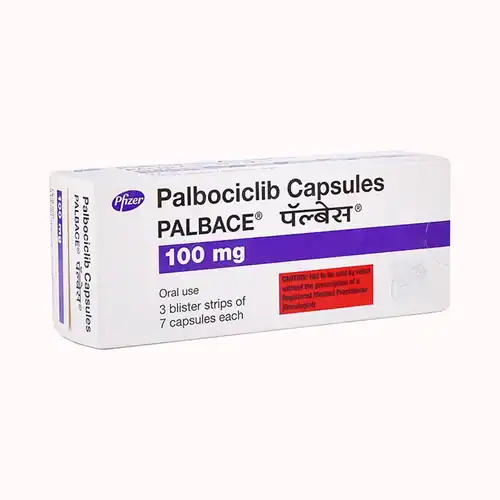
Palbace® (Palbociclib) — The First Approved CDK4/6 Inhibitor in Breast Cancer
Pioneer of the CDK4/6 Inhibitor Class — Longest Clinical Experience With the Most Extensively Studied Real-World Evidence Base
Palbace® (Palbociclib) is a selective cyclin-dependent kinase 4 and 6 (CDK4/6) inhibitor — the first CDK4/6 inhibitor approved anywhere in the world for any cancer indication — used in combination with endocrine therapy for hormone receptor-positive (HR+) HER2-negative locally advanced or metastatic breast cancer. Palbociclib inhibits CDK4 and CDK6 — preventing phosphorylation of the retinoblastoma protein (Rb) and blocking G1 to S phase cell cycle progression — arresting HR-positive breast cancer cell division and dramatically extending progression-free survival when added to endocrine therapy.
As the first-in-class CDK4/6 inhibitor, Palbociclib has the longest clinical experience, the most extensive real-world evidence base, and the most robust physician familiarity of any CDK4/6 inhibitor. The pivotal PALOMA trials established CDK4/6 inhibitors as a transformative advance in HR-positive metastatic breast cancer — changing the global standard of care and paving the way for the entire CDK4/6 inhibitor class now including Kryxana (Ribociclib) and Ramiven (Abemaciclib).
A.K. Pharma is a trusted medicine distributor in Delhi supplying genuine Palbace (Palbociclib) in all three capsule strengths — 75mg, 100mg, and 125mg — to hospitals, oncology centres, breast cancer clinics, and pharmacies across India. Manufactured by Pfizer, Palbace provides accessible pricing for Indian patients requiring CDK4/6 inhibitor therapy with the longest-established safety and efficacy track record in the class.
What is Palbace (Palbociclib)?
Palbace contains Palbociclib — a selective, reversible, small molecule inhibitor of CDK4 and CDK6 that competitively binds to the ATP-binding pocket of both kinases — blocking their catalytic activity and preventing downstream Rb phosphorylation and cell cycle progression.
Why CDK4/6 Inhibitors Are Transformative in HR-Positive Breast Cancer:
HR-positive breast cancer cells are critically dependent on estrogen signalling for proliferation — estrogen receptor activation drives cyclin D1 expression → cyclin D1 activates CDK4/6 → CDK4/6 phosphorylates Rb → Rb releases E2F transcription factors → E2F drives S-phase gene expression → DNA replication and cell division.
Endocrine therapies (aromatase inhibitors, Fulvestrant) reduce estrogen or block ER — reducing cyclin D1 and partially suppressing CDK4/6. However, CDK4/6 remains partially active through alternative cyclin D sources and upstream signalling — limiting the depth and durability of endocrine therapy alone.
Adding Palbociclib directly inhibits CDK4/6 — the shared downstream convergence point of all mitogenic signals driving HR-positive breast cancer proliferation — providing a more complete, durable cell cycle blockade that translates to clinically meaningful PFS and OS improvements.
Palbociclib’s Selectivity: Palbociclib was specifically designed for CDK4/6 selectivity — achieving >1000-fold selectivity for CDK4/6 over other CDK family members and most other kinases. This high selectivity contributes to a predictable, manageable toxicity profile primarily characterised by neutropenia (CDK6 is expressed in haematopoietic progenitors) — without the off-target toxicities that would occur with less selective kinase inhibition.
Full prescribing information is available at the FDA label for Palbociclib.
Clinical Studies and Evidence
PALOMA-1 Trial (Palbociclib + Letrozole — Proof of Concept) Published in The Lancet Oncology (2015), the Phase 2 PALOMA-1 trial was the pivotal proof-of-concept trial demonstrating Palbociclib + Letrozole dramatically improved PFS vs Letrozole alone in postmenopausal HR-positive HER2-negative advanced breast cancer — median PFS 20.2 months vs 10.2 months — HR 0.488. This result led to accelerated FDA approval in February 2015 — making Palbociclib the first CDK4/6 inhibitor approved anywhere in the world.
PALOMA-2 Trial (Palbociclib + Letrozole — First-Line — Phase 3 Confirmatory) Published in the New England Journal of Medicine (2016) with long-term follow-up published in Annals of Oncology (2021), PALOMA-2 was a Phase 3 randomised controlled trial of 666 postmenopausal women with HR-positive HER2-negative locally advanced or metastatic breast cancer — comparing Palbociclib + Letrozole vs placebo + Letrozole as first-line therapy. Key results:
PALOMA-3 Trial (Palbociclib + Fulvestrant — After Endocrine Therapy Failure) Published in the New England Journal of Medicine (2015) with final OS analysis published in Annals of Oncology (2021), the PALOMA-3 trial enrolled 521 women (both pre and postmenopausal) with HR-positive HER2-negative advanced breast cancer who had progressed on prior endocrine therapy — comparing Palbociclib + Fulvestrant (Faslodex) vs placebo + Fulvestrant. Key results at final OS analysis:
PALOMA-2 — Long-Term 5-Year Data: At 5-year follow-up, 23.1% of patients in the Palbociclib + Letrozole arm remained progression-free vs 16.5% in the Letrozole arm — demonstrating durable long-term disease control in a meaningful proportion of patients.
Real-World Evidence — The Most Extensive CDK4/6 Inhibitor Real-World Database: As the first approved CDK4/6 inhibitor, Palbociclib has accumulated over 8 years of real-world clinical data across multiple countries, registries, and practice settings — including data from IQVIA, Flatiron Health, and national cancer registries. This extensive real-world evidence base confirms clinical trial findings in diverse patient populations and practice settings — providing oncologists with the most comprehensive real-world data for any CDK4/6 inhibitor.
Available Strengths
Palbace is available in the following capsule strengths:
| Strength | Use | Capsules Per Day |
|---|---|---|
| Palbace 125mg Capsules | Standard starting dose | 1 capsule once daily |
| Palbace 100mg Capsules | First dose reduction | 1 capsule once daily |
| Palbace 75mg Capsules | Second dose reduction | 1 capsule once daily |
Standard starting dose: 125mg orally once daily for 21 days followed by 7 days off — in 28-day cycles.
All three strengths are available from A.K. Pharma — providing complete dose management capability without needing to source from multiple suppliers.
Indications — What Palbace is Used For
HR-Positive HER2-Negative Locally Advanced or Metastatic Breast Cancer:
For detailed indication information refer to MedlinePlus Palbociclib.
Key Benefits of Palbace
First-in-Class — Longest Clinical Experience and Most Extensive Evidence Base As the first CDK4/6 inhibitor approved (2015), Palbociclib has over 8 years of clinical and real-world evidence — more than any other CDK4/6 inhibitor. This depth of physician experience, established safety monitoring protocols, and extensive real-world data makes Palbace the most familiar CDK4/6 inhibitor for oncologists who have prescribed it since its approval.
Largest PFS Improvement in First-Line Metastatic Breast Cancer History (at time of PALOMA-2) The PALOMA-2 trial demonstrated a 13.1-month improvement in median PFS — at the time the largest PFS improvement ever seen with the addition of any agent to first-line endocrine therapy for metastatic breast cancer. This dramatic PFS benefit was the data that transformed CDK4/6 inhibitors into the new standard of care.
Active in ESR1-Mutant Tumours — Post-Aromatase Inhibitor Resistance PALOMA-3 data demonstrates comparable benefit in ESR1-mutant and ESR1 wild-type tumours — confirming that Palbociclib + Fulvestrant is effective in the important post-AI resistance setting where ESR1 mutations are common acquired resistance mechanisms to aromatase inhibitors.
Premenopausal Activity — Included in PALOMA-3 Premenopausal women were included in PALOMA-3 (with Goserelin ovarian suppression) — confirming Palbociclib + Fulvestrant + OFS as an option in premenopausal patients who have progressed on prior endocrine therapy.
No QTc Monitoring Required — Simplified Monitoring vs Ribociclib Unlike Kryxana (Ribociclib) which requires mandatory ECG monitoring for QTc prolongation, Palbociclib does not prolong QTc — simplifying monitoring requirements and making it appropriate in settings where ECG monitoring capacity is limited.
Three Dose Strengths — Complete Dose Management The availability of 75mg, 100mg, and 125mg capsules enables systematic dose reduction in steps of 25mg — providing precise dose management for toxicity without gaps in treatment. A.K. Pharma supplies all three strengths.
Oral Once-Daily Dosing — 3 Weeks On / 1 Week Off Simple oral capsule — one capsule once daily — with a predictable 28-day cycle structure. The one-week rest period allows haematological recovery between cycles and provides patients with a regular break from medication.
How Palbace Works — CDK4/6 Inhibition and Cell Cycle Arrest
Normal Cell Cycle — G1 to S Phase Transition:
The transition from G1 (growth phase) to S phase (DNA synthesis) is the key commitment step in cell division — controlled by the CDK4/6-cyclin D-Rb-E2F axis:
Palbociclib’s Mechanism:
Step 1 — Competitive ATP Binding: Palbociclib binds to the ATP-binding cleft of CDK4 and CDK6 with high affinity and selectivity — competitively blocking ATP from binding. The inhibitor forms hydrogen bonds with the hinge region of the kinase domain and occupies the ATP-binding pocket.
Step 2 — Kinase Activity Abolition: Without ATP, CDK4/6 cannot perform phosphoryl transfer — the kinase is catalytically inactive regardless of cyclin D binding. CDK4/6-cyclin D complexes form normally but cannot phosphorylate Rb.
Step 3 — Rb Dephosphorylation: Rb protein is actively dephosphorylated by phosphatases (PP1, PP2A) — in the absence of CDK4/6 kinase activity, Rb dephosphorylation dominates. Rb reverts to its hypophosphorylated (active) state.
Step 4 — E2F Sequestration: Active hypophosphorylated Rb binds and sequesters E2F transcription factors — E2F cannot activate S-phase gene transcription. The cell is held in G1 — unable to commit to DNA replication.
Step 5 — G1 Cell Cycle Arrest: Without E2F-driven S-phase gene expression, cells arrest in late G1 — accumulating in a growth-arrested state. HR-positive breast cancer cells — which depend on continuous CDK4/6 activity for proliferation — arrest and cannot divide.
Step 6 — Cellular Senescence (Prolonged Arrest): With prolonged CDK4/6 inhibition, arrested cells may enter cellular senescence — an irreversible growth arrest state associated with changes in chromatin organisation, gene expression, and cell secretory profile (SASP). Senescent cells contribute to durable responses even after drug level fluctuations.
Synergy With Endocrine Therapy:
For detailed mechanism overview refer to ESMO Breast Cancer Guidelines and ASCO Breast Cancer Guidelines.
Palbace vs Kryxana vs Ramiven — Comprehensive CDK4/6 Inhibitor Comparison
| Feature | Palbace (Palbociclib) | Kryxana (Ribociclib) | Ramiven (Abemaciclib) |
|---|---|---|---|
| Approval year | 2015 — first in class | 2017 | 2017 |
| Dosing | 125mg once daily 3W on/1W off | 600mg once daily 3W on/1W off | 150mg twice daily — continuous |
| Capsule/tablet | Capsule | Tablet | Tablet |
| Food requirement | With food | With or without food | With or without food |
| OS benefit demonstrated | Not statistically significant | ✅ 3 trials — strongest evidence | ✅ 2 trials |
| Premenopausal OS evidence | No (included in PALOMA-3 only) | ✅ MONALEESA-7 — unique | No specific OS data |
| Monotherapy approval | ❌ No | ❌ No | ✅ Yes |
| Adjuvant early BC | ❌ No | ❌ No | ✅ Yes (monarchE) |
| QTc monitoring required | ❌ Not required | ✅ Required | ❌ Not required |
| Grade 3-4 neutropenia | ~66% | ~60% | ~26% |
| Diarrhoea | ~26% | ~35% | ~85% |
| Real-world evidence | Most extensive (8+ years) | Extensive | Growing |
| Strengths available | 75mg, 100mg, 125mg | 200mg | 50mg, 100mg, 150mg |
| Manufacturer | Pfizer | Novartis | Eli Lilly |
| Available at A.K. Pharma | Request Quote | Request Quote | Request Quote |
Dosage and Administration
Standard Dose:
Important — Take With Food: Food significantly increases Palbociclib bioavailability — particularly high-fat meals. The prescribing information recommends taking with food to ensure consistent and adequate drug exposure. Consistent with-food administration avoids variability in drug levels between doses.
Administration:
Dose Reduction Schedule:
Endocrine Therapy Partner Dosing:
Monitoring Schedule:
| Parameter | Frequency |
|---|---|
| CBC (neutrophils, platelets, WBC) | Baseline, Day 15 Cycle 1, Day 1 Cycle 2, then Day 1 of each subsequent cycle |
| LFTs | Baseline, then as clinically indicated |
| Signs of pulmonary embolism/DVT | Monitor throughout |
| Signs of infection | Monitor throughout — particularly during neutropenic nadir |
Full dosing guidelines available at Drugs.com Palbociclib Dosage.
Neutropenia Management — The Primary Clinical Consideration With Palbace
Neutropenia is the most common significant toxicity — Grade 3-4 in approximately 66% of patients. Key management principles:
Why CDK4/6 Inhibitor Neutropenia Is Different: CDK4/6 inhibitor-related neutropenia is generally not associated with febrile neutropenia at high rates (approximately 1.8% febrile neutropenia with Palbociclib) — because the neutrophils that remain are functionally competent, and the neutropenia reflects CDK6-mediated haematopoietic progenitor cell cycle arrest rather than cytotoxic bone marrow suppression. Patients tolerate CDK4/6 inhibitor neutropenia much better than chemotherapy-induced neutropenia.
CBC Monitoring is Mandatory:
G-CSF: Routine G-CSF prophylaxis is not generally recommended for CDK4/6 inhibitor neutropenia — the functional competence of residual neutrophils and low febrile neutropenia rates mean most patients can be managed with dose modifications alone.
Who Should Use Palbace
Palbace is prescribed for:
Postmenopausal Women:
Pre/Perimenopausal Women:
Clinical Scenarios Where Palbace Is Particularly Suitable:
Palbace is prescribed by medical oncologists and breast cancer specialists. A.K. Pharma supplies Palbace to hospitals, oncology centres, breast cancer clinics, and pharmacies across Delhi and India.
Possible Side Effects
Common side effects include neutropenia (80% — most common toxicity), leukopenia (39%), fatigue (41%), nausea (35%), upper respiratory infection (31%), stomatitis (25%), anaemia (24%), diarrhoea (26%), thrombocytopenia (23%), vomiting (19%), alopecia (19%), rash (18%), and decreased appetite (16%).
Serious side effects include:
Neutropenia: Grade 3-4 neutropenia in approximately 66% — the primary dose-limiting toxicity. Mandatory CBC monitoring. Dose delay and reduction per protocol. Febrile neutropenia approximately 1.8% — low despite high neutropenia rates. See neutropenia management section above.
Pulmonary Embolism: PE has been reported — monitor for signs and symptoms (dyspnoea, chest pain, pleuritic pain, tachycardia). Evaluate promptly if suspected.
Infections: Increased risk of infections during neutropenic nadir — instruct patients to report fever, chills, or signs of infection promptly.
Embryo-Foetal Toxicity: Palbociclib can cause foetal harm. Effective contraception required during treatment and for 3 weeks after the last dose. Male patients with female partners of reproductive potential should use contraception during treatment and for 3 months after last dose.
Full side effect information available at FDA Palbociclib Safety Information.
Precautions
Storage and Handling
As a responsible medicine distributor in Delhi, A.K. Pharma stores all medicines including Palbace under manufacturer-recommended conditions ensuring product integrity for every supply.
Manufacturer Information
Palbace (Palbociclib) is manufactured by Pfizer Inc., a global pharmaceutical company that developed Palbociclib as the world’s first CDK4/6 inhibitor. Palbociclib received FDA accelerated approval in February 2015 for postmenopausal HR-positive HER2-negative advanced breast cancer with Letrozole — with regular approval following PALOMA-2 results (2016) and expanded approval for Fulvestrant combination (2016). A.K. Pharma supplies only genuine Palbace sourced from authorized Pfizer distributors.
Related Breast Cancer Medicines Available at A.K. Pharma
Frequently Asked Questions
Q. What is Palbace used for? Palbace (Palbociclib) is used in combination with endocrine therapy for HR-positive HER2-negative locally advanced or metastatic breast cancer — in combination with aromatase inhibitors as first-line therapy or with Fulvestrant after prior endocrine therapy failure. More information available at MedlinePlus.
Q. What is the generic name of Palbace? The generic name of Palbace is Palbociclib. It is the world’s first approved CDK4/6 inhibitor — manufactured by Pfizer — the same active ingredient as the originator Ibrance.
Q. How is Palbace different from Kryxana (Ribociclib) and Ramiven (Abemaciclib)? All three inhibit CDK4/6 but differ in dosing, safety profile, and evidence base. Palbace uses 125mg once daily in a 3-weeks-on/1-week-off schedule — taken with food — and does not require ECG monitoring. Kryxana (Ribociclib) requires mandatory QTc monitoring but has proven OS benefit in 3 trials including premenopausal women. Ramiven (Abemaciclib) is dosed continuously twice daily, has the lowest neutropenia rate but highest diarrhoea rate, and has adjuvant and monotherapy approvals. Palbace has the longest clinical experience and most extensive real-world data.
Q. Why does Palbace need to be taken with food? Food — particularly high-fat meals — significantly increases Palbociclib bioavailability and ensures reliable drug absorption. Taking Palbociclib consistently with food maintains predictable plasma levels. Without food, Palbociclib absorption is reduced and more variable — potentially leading to subtherapeutic drug levels. Always take Palbace with food at approximately the same time each day.
Q. How is neutropenia from Palbace different from chemotherapy neutropenia? CDK4/6 inhibitor neutropenia is mechanistically different from chemotherapy neutropenia — Palbociclib arrests haematopoietic progenitor cells in G1 (CDK6-mediated) without destroying them. The residual circulating neutrophils are functionally normal. This explains the relatively low rate of febrile neutropenia (approximately 1.8%) despite high rates of Grade 3-4 neutropenia — patients tolerate CDK4/6 inhibitor neutropenia much better than cytotoxic chemotherapy-induced neutropenia.
Q. Does Palbace require ECG monitoring? No — unlike Kryxana (Ribociclib) which requires mandatory ECG monitoring for QTc prolongation, Palbociclib does not prolong the QTc interval and does not require routine ECG monitoring. This simplifies monitoring requirements significantly.
Q. What are the three dose strengths of Palbace and how are they used? 125mg is the standard starting dose — one capsule once daily. 100mg is the first dose reduction for toxicity management. 75mg is the second dose reduction. If 75mg is not tolerated, permanently discontinue. A.K. Pharma supplies all three strengths — enabling complete dose management from one supplier.
Q. Is Palbace available in India? Palbace can be supplied to hospitals, oncology centres, and pharmacies across India through licensed pharmaceutical distributors. Contact A.K. Pharma — medicine distributor in Delhi — for availability and pricing.
Q. What is the price of Palbace in India? Palbace price in India varies by strength and pack size. Contact A.K. Pharma at 011 4172 6999 or WhatsApp +91 9810034827 for current pricing and bulk supply rates.
Q. How to order Palbace from A.K. Pharma? You can request a quote directly from this page, call us at 011 4172 6999, or WhatsApp us at +91 9810034827 with your requirements and we will respond promptly.
Q. Does A.K. Pharma supply Palbace in bulk? Yes. A.K. Pharma supplies Palbace in bulk to oncology centres, breast cancer clinics, hospitals, and pharmacies across Delhi and India. Contact us for bulk pricing and availability.
Why Order Palbace from A.K. Pharma?
Contact A.K. Pharma for Palbace Supply 📍 E-2/257A, 2nd Floor, Shastri Nagar, New Delhi 110052 📞 011 4172 6999 📱 WhatsApp: +91 9810034827 🌐 akpharma.in